



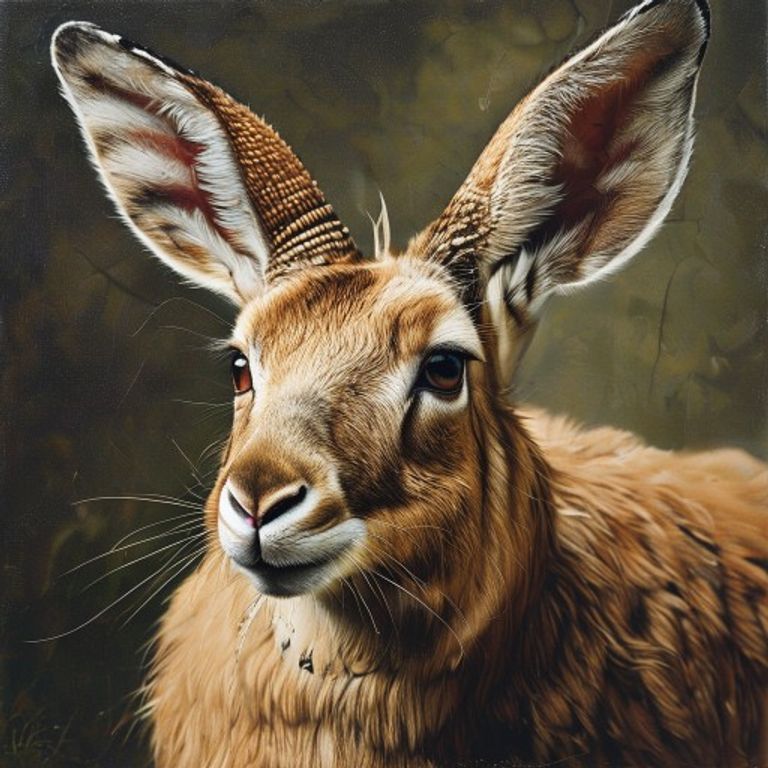
The legend of a rabbit with antelope horns common in American West folklore, often scientifically explained by a virus that causes bone growths.
⚠️ Research conducted with the aid of Deep Research is subject to referential ambiguity.
🖥️ Clean HTML code using a proprietary tool.
👥 Research by Guilherme Felipe, Curation by Sílvio Lôbo
The Jackalope Enigma: A Case of Hunting, Deception, and the Ghost of Wyoming
The vastness and mystery of the American plains, especially the state of Wyoming, have always been fertile ground for legends and stories that defy logic. Among them, few have captured the popular imagination and the perplexity of investigators like the intricate and largely unresolved Jackalope Case. It is not a common crime, but rather a phenomenon that oscillates between folklore, elaborate fraud, and, for some, a glimpse of the inexplicable.
1. The Context and the Incident: Where, When, and How the Mystery Began
The story of the Jackalope, as we know it today, has its roots in the 1930s, in Douglas, Wyoming. The mythological creature, described as a rabbit with antelope horns, did not emerge spontaneously. Its popularity was amplified by a specific and astute act:
In 1932, brothers Douglas and Ralph Herrick, known for their taxidermy skills and peculiar sense of humor, were asked by a client to create a rabbit with horns. Having been informed by the client that the rabbit had been found dead, they decided, with a pinch of malice and ingenuity, to bring this bizarre chimera to life. They crafted a stuffed rabbit and skillfully added deer or antelope horns. The piece, initially a mere creative prank, soon became a success.
What began as a peculiar piece of taxidermy quickly turned into a cultural icon. The Herrick brothers began producing and selling these "horned rabbits," fueling the legend and fostering the popular belief that such creatures actually existed in the wild lands of Wyoming. The story spread like wildfire, driven by "sighting" reports and the seductive nature of the extraordinary itself.
2. Timeline of Key Events
The chronological reconstruction of the events that shaped the Jackalope myth reveals a gradual evolution from an anecdote to a cultural phenomenon:
- 1930s: The Herrick brothers, in Douglas, Wyoming, create the first taxidermied versions of "horned rabbits."
- Late 1930s and 1940s: The popularity of the stuffed creatures grows. Reports of sightings, often anecdotal and exaggerated, begin to circulate, fueling the legend.
- 1950s and 1960s: The Jackalope becomes firmly established in American folklore. It becomes a popular souvenir, with mass-produced versions sold in gift shops throughout the state. The Jackalope, as it is known, appears on postcards, songs, and stories.
- 1970s onwards: The Wyoming government officially embraces the myth as part of its tourism identity. In 1987, the Jackalope Festival was established in Douglas, cementing the creature as a state symbol.
- Recent years: The case itself is not a "case" in the sense of a criminal investigation, but the mystery persists in what it represents: the thin line between reality and fantasy, and man's ability to create and perpetuate myths. There are no official reports of "Jackalope investigations" as a real animal, but rather documentation of its folkloric rise.
3. Main Theories
The persistence of the Jackalope mystery, despite its seemingly clear origin, leaves room for various interpretations:
Fraud and Creative Taxidermy Theory (Most Likely Scientific/Police Hypothesis)
This is the most widely accepted and historically documented explanation. The logic is straightforward: the Herrick brothers, with their taxidermy skills, created the horned rabbits. The "mystery" lies in the ability to deceive the public and turn a fraud into a cultural icon. There is no scientific or forensic evidence to support the existence of a natural species of horned rabbit. Reports on the taxidermy practice of the time and the Herrick brothers' own confession or admitted intent anchor this theory.
Natural Genetic Mutation Theory (Alternative Scientific Hypothesis)
Although highly unlikely for a feature as prominent as horns, some speculate that certain genetic mutations could, theoretically, lead to the growth of abnormal bone structures in animals. In rabbits, this would be extraordinary. The theory finds support in the existence of other genetic anomalies in various species, but there is a lack of any concrete evidence of a genetic horned rabbit that matches the description of the Jackalope.
Disinformation and Amplified Folklore Theory (Sociological Hypothesis)
This theory focuses on how stories, once started, can be amplified and distorted through oral narratives, speculation, and the very nature of folklore. It is believed that human fascination with the unusual and the desire to believe in fantastic creatures contributed to the spread and solidification of the myth, regardless of factual truth. The lack of confirmed sightings and the absence of physical evidence support the idea that the Jackalope thrived in the realm of collective imagination.
Conspiracy Theory or Paranormal Phenomenon (Alternative/Paranormal Theories)
Less grounded and more speculative, some theories suggest that the Jackalope could be a real being whose sightings were intentionally suppressed, or that the creature possesses abilities or origins that transcend conventional scientific understanding. These theories are generally based on isolated testimonies, subjective experiences, and a general distrust of official explanations. There are no declassified reports or evidence supporting such notions.
4. Controversies and Blind Spots
The "Jackalope Case," by its nature, is not a traditional criminal investigation with "blind spots" in terms of missing evidence of a crime. However, the controversies lie in how the myth was built and maintained:
- The Mix of Fact and Fiction: The main blind spot is the difficulty in separating the original intent of the Herrick brothers from any genuine popular belief in the creature's existence. Commercial success quickly obscured the origin as an elaborate joke.
- "Eyewitness" Reports: Many reports of Jackalope sightings are anecdotal and not corroborated by physical evidence. The subjective nature of these testimonies makes them questionable as irrefutable proof of a natural phenomenon.
- Lack of Biological Evidence: The total absence of biological specimens, fossils, or any scientific trace of a horned rabbit is one of the biggest "blind spots" for any theory that posits the natural existence of the animal.
- The "Official" Douglas Document: While the Wyoming government has embraced the myth, there is no "declassified file" investigating the creature as a real animal. The documents that do exist deal with the history of the folklore and tourism promotion.
5. Curiosities and Legacy
The Jackalope has transcended its status as a mere taxidermy curiosity to become an indelible symbol of the American West and Wyoming, in particular.
- Cultural Impact: The creature has inspired countless works of art, literature, music, and even marketing campaigns. It has become a pop icon, representing the humor, creativity, and adventurous spirit of the Old West.
- Tourism Promotion: Douglas, Wyoming, calls itself the "Jackalope Capital of the World" and capitalizes on the myth to attract tourists. The annual festival and the giant Jackalope statue in the city are testaments to its success.
- Current Status: The Jackalope "case" has not been reopened, as it was never a formal investigation of a crime or natural phenomenon. It is filed away in the domain of folklore, popular culture, and human cunning. The story serves as a fascinating reminder of how a good story, combined with a touch of naivety and commercialization, can create a lasting myth that continues to captivate and intrigue generations. The legacy of the Jackalope is proof of the powerful influence of human imagination and the art of storytelling.





