



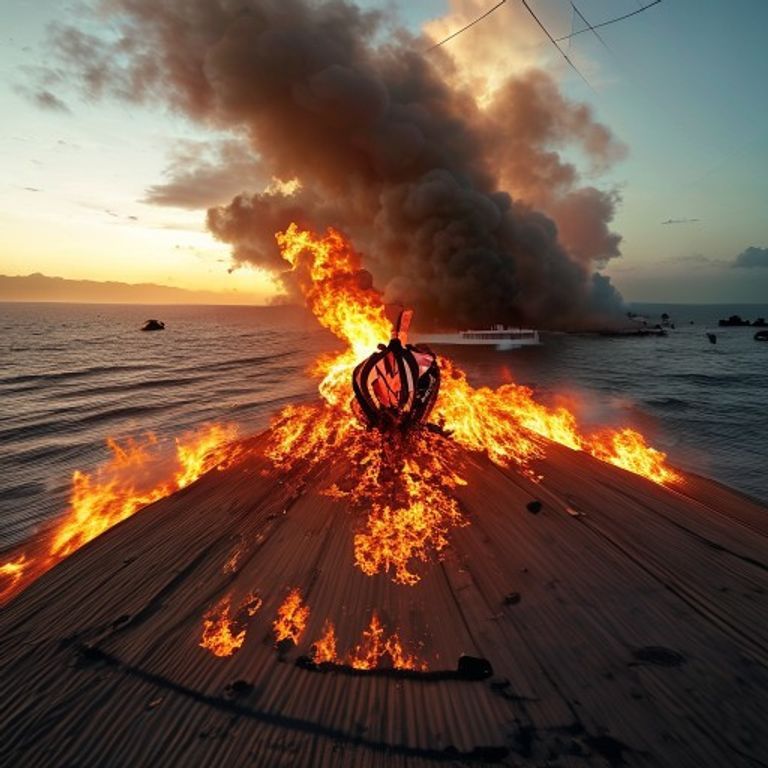
Reports of disappearances and mysterious deaths linked to the extreme density of venomous snakes and legends of hidden pirate treasures that were never recovered.
⚠️ Research conducted with the aid of Deep Research is subject to referential ambiguity.
🖥️ Clean HTML code using a proprietary tool.
👥 Research by Guilherme Felipe, Curation by Sílvio Lôbo
The Incident at Queimada Grande Island: The Enigma of Snake Island
In 1977, the turbulent waters and dense vegetation of Queimada Grande Island, also known as Snake Island, off the coast of São Paulo, were the stage for an event that, to this day, defies rational explanation. What was supposed to be a routine scientific expedition turned into one of Brazil's most intriguing unsolved mysteries, leaving a trail of uncertainty and speculation.
This article investigates the "Queimada Grande Island Incident" in depth, seeking to uncover the facts behind the veil of secrecy and the theories surrounding the disappearance and subsequent gruesome discovery of a research team.
1. The Context and the Incident: Where, when, and how the mystery began.
Queimada Grande Island, located about 35 kilometers off the coast of Itanhaém, is a unique ecosystem known for housing the largest colony of the golden lancehead (Bothrops insularis), an endemic and highly venomous snake. Its isolated fauna and flora made it a site of interest for biological studies.
In August 1977, an expedition composed of researchers from the University of São Paulo (USP) and members of an environmental research organization—not specified at the time, but frequently associated with the name of the renowned biologist Dr. Arnaldo Paschoal—set off for the island. The goal was to catalog the local biodiversity, with a special focus on the golden lancehead population.
What is known is that after a few days of exploration, communication with the group was abruptly cut off. Initial reports point to a mass disappearance. The gravity of the situation only became clear when a rescue mission was sent, discovering a shocking scene and a mystery that persists to this day.
2. Timeline of Events
- Early August 1977: Departure of the scientific expedition to Queimada Grande Island, with the goal of conducting biological research. The exact number of members and the full composition of the team are vague in many reports.
- Mid-August 1977: Interruption of communications with the expedition. Contact attempts fail, causing concern among organizers and authorities.
- Late August 1977: A rescue mission is sent to the island. The search expedition, composed of military and civilians, arrives at the site.
- Gruesome Discovery: The rescue team finds the bodies of some members of the original expedition scattered across the island under suspicious circumstances. Other members appear to have vanished without a trace.
- Preliminary Investigation: Local authorities and possibly security agencies initiate an investigation. However, the nature of the location and the complexity of the events hinder progress.
- Subsequent Years: The case becomes a "cold case," fueling various theories and speculations. The lack of detailed official information contributes to the mystery.
3. The Main Theories
The absence of a definitive official explanation has opened the door to a range of theories, varying from plausible scientific hypotheses to more fantastic speculations:
3.1. Scientific and Police Hypotheses
- Mass Attacks by Golden Lanceheads: This is the most direct and frequently cited explanation. The island is the habitat of thousands of golden lanceheads, and the hypothesis suggests that an unusually large number of snakes may have attacked the researchers, possibly due to some disturbance in their ecosystem or more aggressive movement of the local fauna. The snake population density on the island is extraordinary, making this a real possibility, although the number of fatalities and the disappearance of some members require a more robust explanation for the event itself.
- Individual Accidents and Disorientation: Some researchers may have suffered isolated accidents (falls, bites), gotten lost on the island, and succumbed to adverse conditions or the fauna. The difficulty of movement and the dense vegetation could have hindered rescue or the location of the bodies. However, this does not explain the total disappearance or the apparent organization of attacks.
- Food or Environmental Poisoning: The ingestion of a contaminated plant or animal, or exposure to an unknown toxic agent in the insular environment, is also considered. However, the nature of the deaths and the number of victims make this hypothesis less likely as a sole cause.
3.2. Alternative, Conspiracy, or Paranormal Theories
- Secret Military or Scientific Experiments: Rumors point to the possibility that the island could have been used for undisclosed experiments involving biological agents or technologies. The disappearance of the team could have been an attempt to cover up an incident related to these experiments. Declassified reports on military activities in the region, if they exist, could shed light on this hypothesis.
- Internal Conflict or Crime: Although unlikely given the context of a scientific expedition, the possibility of a conflict between team members resulting in deaths and disappearances cannot be completely ruled out. The isolated nature of the island could have facilitated a cover-up.
- Paranormal or Supernatural Phenomena: In a case so shrouded in mystery and tragedy, theories about paranormal events, hauntings, or even interventions by unknown forces arise. The island, with its isolated atmosphere and the striking presence of snakes, can be fertile ground for this type of speculation.
- Extraterrestrial Intervention: In more speculative circles, the disappearance of people without leaving traces is often associated with alien activity. The island, due to its remote location and unique biodiversity, could have been a site of interest for such entities.
4. Controversies and Blind Spots
What is most intriguing about the Queimada Grande Island Incident is the lack of transparency and the inconsistency in some reports:
- Vague Official Reports: Most available reports are informal or based on secondary testimonies. The lack of access to detailed official reports, complete forensic examinations, or investigation records hinders an objective analysis of the facts. Declassified files, if they exist, are crucial to demystifying the case.
- Ignored or Lost Clues: There is speculation that some evidence found on the island by the rescue team may have been lost, destroyed, or simply not properly analyzed due to the urgency and shock of the discovery.
- Conflicting Testimonies: In reports that have circulated over the years, some key witnesses or members of the rescue teams presented slightly different versions of events, causing confusion and distrust. Accurately identifying these witnesses is a challenge.
- Secrecy Regarding the Research Organization: The exact identity of the organization that funded or organized the expedition, beyond Dr. Arnaldo Paschoal, is often omitted or presented ambiguously, which raises suspicions about possible hidden agendas.
- The Absence of Unrecovered Bodies: The exact number of missing members and the failure to recover all bodies raise questions about what really happened and whether there was some type of removal or accelerated disintegration.
5. Curiosities and Legacy
The Queimada Grande Island Incident, despite its tragic and mysterious nature, shaped public perception of the site and generated a legacy of fascination:
- Island Isolation: After the incident, access to Queimada Grande Island was drastically restricted, with the Brazilian Navy establishing exclusion zones to protect the ecosystem and prevent further incidents. The island is considered an ecological sanctuary, but also a place of extreme caution.
- Inspiration for Fiction: The mystery of the incident inspired short stories, urban legends, and even works of fiction. The island, with its fame as "Snake Island" and the dark episode, became a symbol of danger and mystery in Brazilian popular culture.
- Current Status: The case, as far as is known, remains officially a tragic incident with causes that are not fully clarified. There is no public information about a formal reopening of investigations, but the mystery continues to be a recurring theme in discussions about unsolved crimes and historical enigmas.
- Ongoing Research (with restrictions): Although access is restricted, scientific research continues to be carried out on the island under special authorization, always with extreme care and safety protocols. However, this research does not appear to have officially reopened the case of the 1977 incident.
The Queimada Grande Island Incident remains a dark testament to human fragility in the face of nature and the mysteries it can hide. The hope that the truth will one day come to light, through new evidence or the declassification of documents, still pulses among those dedicated to unraveling the enigmas of the past.





