



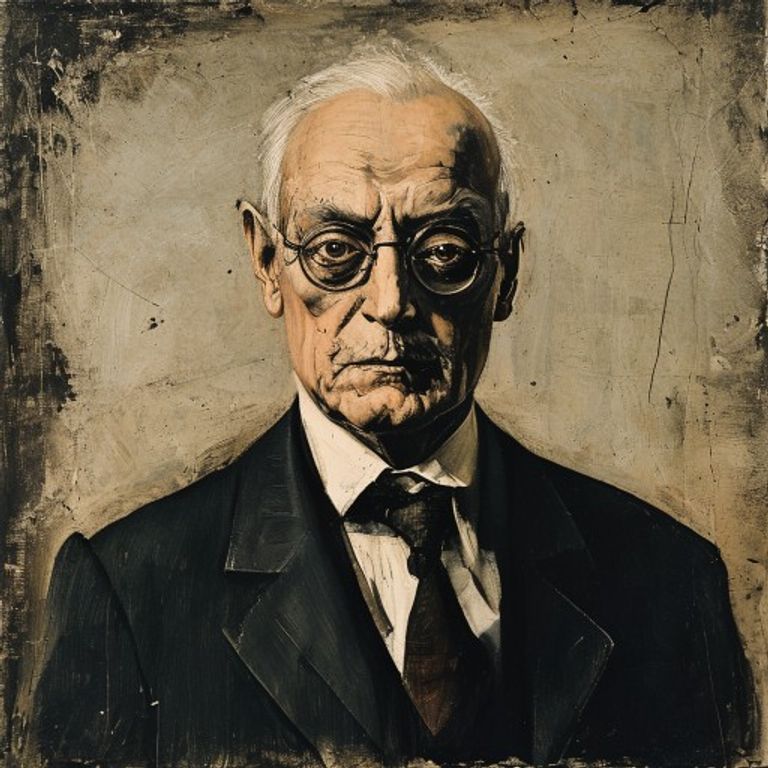
A German engineer shouted the word 'YOGTZE' before leaving home in 1984; hours later, he was found severely injured in his overturned car and naked, dying before he could explain what happened.
⚠️ Research elaborated with the help of Deep Research is subject to referential ambiguity.
🖥️Clean HTML code using a proprietary tool.
👥 Research by Guilherme Felipe, Curation by Sílvio Lôbo
The Enigma of Gunter Stoll: An Unanswered Murder in the Black Forest
In the autumn of 1984, the picturesque and seemingly peaceful Black Forest in West Germany became the stage for a mystery that, decades later, still weaves its web of uncertainty. The disappearance and subsequent discovery of the body of Gunter Stoll, a successful businessman and prominent member of Freiburg society, cast a shadow over the region and triggered an investigation full of gaps, twists, and unanswered questions. This is the case of Gunter Stoll, one of Germany's most intriguing unsolved enigmas.
1. The Context and the Incident: Where, When, and How the Mystery Began
The setting for Gunter Stoll's disappearance was the idyllic landscape of the Black Forest, specifically in the surroundings of Todtnauberg, a small town known for its ski resorts and natural beauty. Gunter Stoll, then 59 years old, was a respected man, known for his work in consulting and his active participation in Freiburg's social and business circles. He owned a holiday home in Todtnauberg, a quiet retreat where he used to spend weekends and holidays.
The mystery began on the night of October 12, 1984. Stoll had traveled to his holiday home in Todtnauberg that afternoon, as usual. It is believed he arrived around 6 PM. However, the following morning, October 13, 1984, Stoll's housekeeper, Erika B., arrived at the house and found a disturbing scene: Stoll's car, a Mercedes-Benz 300D, was parked in the garage, the house lights were on, and there were signs that Stoll had started preparing dinner. However, Gunter Stoll was nowhere to be found.
What followed was an initially fruitless search. The police were alerted, and searches intensified in the following days, mobilizing volunteers and the police force itself. The dense forest and rugged terrain made the work difficult.
2. Timeline of Events
- October 12, 1984, afternoon: Gunter Stoll travels from Freiburg to his holiday home in Todtnauberg.
- October 12, 1984, approximately 6:00 PM: Stoll is believed to have arrived at his holiday home.
- October 13, 1984, morning: The housekeeper, Erika B., arrives at the house and finds Stoll missing.
- October 13, 1984, day: The police are alerted and begin the search.
- October 26, 1984: Gunter Stoll's body is discovered by a hunter in a remote area of the forest, about a kilometer from his holiday home. The discovery occurred approximately two weeks after his disappearance.
- Autopsy: The autopsy revealed that Stoll suffered severe head injuries. The exact cause of death was initially considered undetermined, with the hypothesis of a traumatic fall followed by exposure to cold and hypothermia. However, the presence of injuries that did not fully align with a simple fall raised suspicions.
- Investigation: The police launched a homicide investigation, but the lack of concrete evidence and clear suspects led to the case being closed as an "unsolved mystery."
3. The Main Theories
The mysterious nature of Gunter Stoll's disappearance and death has given rise to a series of theories, ranging from plausible explanations to more audacious speculations.
3.1. Accident and Traumatic Fall
This was the initial and most plausible theory, supported by the location of the body in rugged terrain and the possibility that Stoll went out for a night walk or to perform some task outside the house and suffered a fall. The head injuries could have been caused by the impact of the fall. The cold and hypothermia would have worsened the condition, leading to death.
- Logic: Explains the presence of the body in the forest and the nature of the injuries without the need for immediate external intervention.
- Controversies: The head injuries presented characteristics that, for some forensic experts, were not entirely compatible with a simple fall.
3.2. Murder with Concealment of Evidence
The theory that Gunter Stoll was murdered by one or more individuals and that his body was subsequently hidden in the forest is one of the strongest, given the incomplete nature of the investigation and the possibility of hidden motives.
- Possible Motives:
- Financial Motives: Stoll was a successful man. He could have had enemies or unknown debts that led to a crime of passion or a robbery gone wrong.
- Personal/Relational Motives: Stoll's private life, although seemingly tranquil, could have held secrets that culminated in a fatal conflict.
- Random Murder: Although less likely, a chance encounter with a criminal in the remote area cannot be entirely ruled out.
- Logic: Justifies the lack of clear evidence and the need to hide the body. The theory suggests that the perpetrators were cunning enough not to leave obvious traces.
- Controversies: The absence of clear suspects and conclusive forensic evidence makes it difficult to prove this theory.
3.3. Involvement of Third Parties and Conspiracy
This theory, while more speculative, considers the possibility that Stoll was forced into a vehicle and taken to another location before being abandoned in the forest, or that the scene was manipulated to look like an accident.
- Logic: Explains why the car was in the garage and why Stoll would be out of the house at night. It suggests a planned operation.
- Controversies: Requires the existence of a group of individuals with the motivation and capability to orchestrate a complex crime without leaving a trace.
3.4. Alternative and Paranormal Theories (Less Proven)
Although without basis in official investigations, the aura of mystery surrounding the case has generated more esoteric speculations, which, while captivating, lack any concrete evidence.
- Voluntary Disappearance: Some speculated that Stoll might have faked his own disappearance. However, his reputation and the lack of preparations for such an act make this hypothesis unlikely.
- Unexplained Phenomena: In smaller communities, where persistent mysteries accumulate, speculation about paranormal or inexplicable events is common. However, there are no reports or indications to support such theories in the Stoll case.
4. Controversies and Blind Spots
The official investigation into the murder of Gunter Stoll is marked by a series of controversies and blind spots that contribute to its status as an unsolved mystery:
- Delay in Body Discovery: Two weeks passed between Stoll's disappearance and the discovery of his body. This time lapse allowed any initial evidence to deteriorate or be diluted by weather conditions and the action of nature.
- Inconclusive Autopsy: Although the autopsy revealed head injuries, the exact cause of death could not be determined with absolute certainty. The possibility that the injuries were caused by an assault before the fall, or that the scene was manipulated, was never fully dismissed by the police, but it was also not proven.
- Lack of Conclusive Forensic Evidence: The crime scene, whether the holiday home or the location where the body was found, did not provide sufficient forensic evidence to identify an assailant. The absence of fingerprints, DNA traces, or signs of struggle that could not be explained by other factors is one of the biggest enigmas.
- Ignored Testimonies and Clues: Reports suggest that some clues and witness testimonies may not have been fully explored or valued by the investigation. However, the lack of access to detailed files makes it difficult to verify these claims.
- The Motive: The absence of a clear and convincing motive for the crime is one of the biggest obstacles to solving the case. Stoll was a man with a seemingly stable social and professional life, making it difficult to identify who would have had a motive to attack him.
5. Curiosities and Legacy
The Gunter Stoll case, despite not achieving the same level of international notoriety as other mysteries, has left a mark on the collective memory of the region and German folklore. It is frequently cited in discussions about unsolved crimes and serves as a grim reminder that even the most peaceful places can hide deep secrets.
- Current Status: The Gunter Stoll case was officially closed as an unsolved case. However, as with many similar mysteries, the file is not completely closed. If new evidence emerges, the police could reopen the investigation.
- Cultural Impact: The story of Gunter Stoll is periodically revisited in the German press and in documentaries exploring the country's great mysteries. The Black Forest, with its dense and historic atmosphere, has become an almost mythical setting for this type of narrative.
- The Search for Answers: The lack of a definitive resolution fuels speculation and the desire for justice, both for the victim and for his family. The Gunter Stoll case remains a challenge for the authorities and a fascinating enigma for all who delve into it.
The Gunter Stoll case is a testament to the persistence of doubt and the insidious nature of unsolved mysteries. As the Black Forest continues to whisper its secrets, the truth about Gunter Stoll's fate remains, perhaps forever, lost in its dark depths.





