



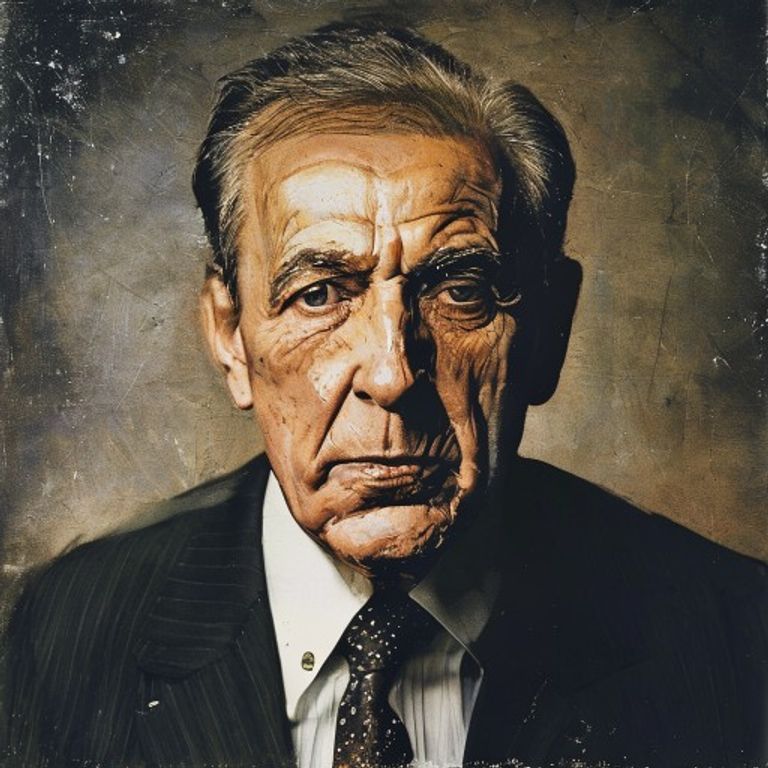
The Rockefeller fortune heir disappeared in the New Guinea region in 1961 after his boat capsized, sparking persistent rumors about his final fate among local tribes.
⚠️ Research conducted with the assistance of Deep Research may be subject to referential ambiguity.
🖥️ Clean HTML code using a proprietary tool.
👥 Research by Guilherme Felipe, Curation by Sílvio Lôbo
The Disappearance of Michael Rockefeller: The Enigma of the Lost Tribe and the Missing Heir
The name Rockefeller evokes images of power, wealth, and unshakeable influence. However, the legacy of this American dynasty is also marked by one of the most intriguing and disturbing mysteries of the 20th century: the disappearance of Michael Rockefeller, in 1961, in the remote and unexplored jungles of Dutch New Guinea (present-day Indonesia). What began as an anthropological expedition in search of artifacts and knowledge about isolated cultures turned into a labyrinth of speculation, dark theories, and official investigations that, to this day, have not managed to close the circle of this enigma.
1. The Context and the Incident: The Call of the Unexplored Jungle
Michael Rockefeller, son of the then-lieutenant governor of New York, Nelson Rockefeller, was a 23-year-old young anthropologist with a particular fascination for the tribal cultures of Melanesia. Driven by his academic interest and the desire to collect artifacts for the Museum of Primitive Art in New York, he embarked on his fateful expedition in 1961. The objective was to document and acquire artworks from the Asmat tribe, known for their unique cultural practices, including ritualistic art and, unfortunately, historical accounts of warfare and cannibalism.
The expedition, composed of Michael, a Dutch filmmaker named René Wassing, and a small group of local guides, was navigating a remote river in Dutch New Guinea. Michael's boat, a small vessel with two engines, capsized unexpectedly. The exact details of what led to the shipwreck are still debated, but reports indicate it may have been due to a wave or mechanical issues. After the incident, Michael and René Wassing, along with other natives, attempted to swim to shore. However, Michael, confident in his swimming abilities, decided to continue alone towards the coast, separating himself from the group.
It was the last time Michael Rockefeller was seen alive. From that moment on, the impenetrable jungle and the mysteries of the Asmat culture swallowed the American heir, leaving behind a void of answers and a sea of speculation.
2. Timeline of Key Events
- 1961 (November): Michael Rockefeller begins his anthropological expedition to Dutch New Guinea, aiming to document and acquire Asmat artifacts.
- 1961 (November 20): Michael Rockefeller's boat capsizes in the river. He separates from the group to swim to shore.
- 1961 (November 21): Michael Rockefeller's disappearance is noted. An initial search begins with the help of local authorities and guides.
- 1961 (Late November - December): The official search intensifies, involving air and ground forces. Conflicting reports and unconfirmed sightings emerge.
- 1962 (January): The official search is suspended after weeks of fruitless efforts. Michael Rockefeller is declared legally dead.
- Decades Later: Several unofficial expeditions and journalistic investigations seek to unravel the mystery, fueling new theories.
3. The Main Theories: Navigating the Possibilities
The disappearance of Michael Rockefeller has given rise to a myriad of theories, ranging from the most plausible, based on official reports, to the most bizarre and paranormal. The remote and unexplored nature of the region, coupled with the complex culture of the Asmat, has opened space for unbridled imagination and speculation.
Scientific and Police Theories (Most Probable):
- Death by Drowning or Natural Accident: This is the most straightforward hypothesis and, according to initial official investigations, the most likely. River currents, aquatic predators (crocodiles), or exhaustion could have led to Rockefeller's death while he was trying to reach dry land.
- Attack by Wild Animals: New Guinea is home to diverse and dangerous fauna. Attacks by crocodiles, venomous snakes, or other wild animals in the region could have been the cause of his death.
- Death by Illness or Exhaustion: Even if he managed to reach land, Rockefeller would have been exposed to tropical diseases to which he had no immunity, in addition to extreme exhaustion from attempting to swim long distances.
Alternative and Speculative Theories:
- Victim of the Asmat Tribe: This is one of the most persistent and grim theories. Accounts of Asmat tribal rituals, including warfare and cannibalism, fueled speculation that Rockefeller might have been captured, killed, and consumed by tribe members. The belief was that he had invaded sacred territory or incurred the wrath of the warriors. Although shocking, this hypothesis finds some support in accounts of other interactions with isolated tribes at the time.
- Intentional Escape / New Life: Some theories suggest that Rockefeller, perhaps tired of the pressure from his family and the world around him, planned his disappearance to start a new life away from everything. However, this hypothesis lacks concrete evidence.
Conspiracy and Paranormal Theories:
- Involvement of the Family or Government: More conspiratorial speculations suggest that the Rockefeller family or the Dutch government itself might have had reasons to cover up the truth, perhaps to avoid a diplomatic scandal or to protect interests.
- Experiments or Paranormal Cover-ups: In more fantastical lines, theories involve secret experiments, alien abductions, or inexplicable phenomena that led to Rockefeller's disappearance. These hypotheses, while captivating, lack any evidentiary basis.
4. Controversies and Blind Spots: The Cracks in the Official Investigation
The official investigation into the disappearance of Michael Rockefeller was marked by logistical challenges and, according to critics, by flaws and inconsistencies that left significant gaps:
- Scope of the Search: The search area was immense and difficult to access, which limited the effectiveness of operations. The dense jungle and lack of infrastructure made finding any trace of Rockefeller a Herculean task.
- Conflicting Witness Accounts: The accounts of local guides and shipwreck survivors presented inconsistencies in crucial details, increasing confusion and hindering an accurate reconstruction of events.
- Filtered Information about the Asmat: The Asmat's reputation as cannibalistic warriors, while perhaps exaggerated or based on superficial cultural interpretations, may have skewed the investigation in a specific direction, possibly neglecting other hypotheses.
- Pressure from the Rockefeller Family: The enormous influence and resources of the Rockefeller family may have generated tacit pressure on authorities, seeking a quick resolution, which, paradoxically, may have led to the premature suspension of more extensive searches.
- Absence of Concrete Evidence: The biggest failure of the investigation was the complete absence of a body or any of Rockefeller's belongings that could confirm his death or fate. This gap allowed speculation to flourish.
5. Curiosities and Legacy: An Echo in Popular Culture
The disappearance of Michael Rockefeller transcended newspaper headlines and official reports, becoming a recurring element in the popular imagination and a catalyst for fascination with unsolved mysteries.
- Documentaries and Books: The case has inspired countless documentaries, investigative books, and articles exploring the various theories, fueling public debate about what really happened on that fateful day in 1961.
- Cultural Impact: Rockefeller's story has become an archetype of the modern man lost in a primitive world, a cautionary tale about the dangers of exploring isolated cultures and the fragility of life in the face of nature.
- Current Status: Officially, the case of Michael Rockefeller remains closed. However, the absence of a definitive outcome and the presence of so many unanswered questions keep the flame of speculation alive. There has been no formal reopening of official investigations in recent years, but public curiosity and the work of independent researchers and journalists continue to keep the mystery in vogue. The enigma of Michael Rockefeller is a persistent reminder that, even in the modern world, there are still unexplored corners and stories that defy understanding, leaving a trail of questions that echo through time.





