



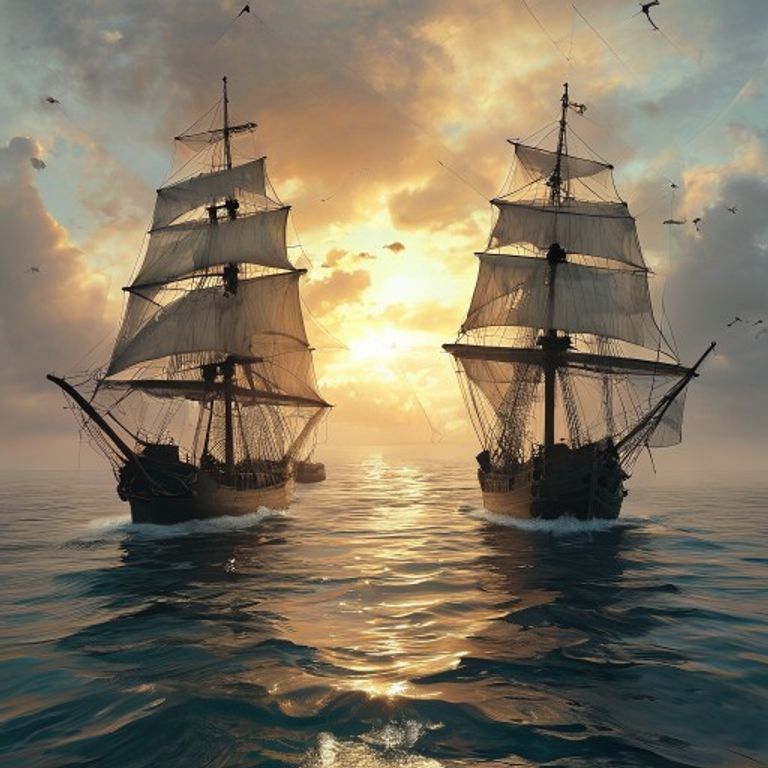
Sir John Franklin's 1845 Arctic expedition, which ended with the disappearance of all one hundred and twenty-nine crew members and the abandonment of the ships in the ice.
⚠️ Research conducted with the aid of Deep Research is subject to referential ambiguity.
🖥️ Clean HTML code using a proprietary tool.
👥 Research by Guilherme Felipe, Curation by Sílvio Lôbo
The Frozen Enigma: The Case of the Terror and Erebus Ships
By Your Name, Senior Investigative Journalist
In the icy and unforgiving depths of the Canadian Arctic lies a mystery that for over a century has challenged logic, science, and human imagination: the disappearance of the British vessels HMS Terror and HMS Erebus, part of Sir John Franklin's expedition in search of the Northwest Passage. What began as an audacious mission in 1845 turned into one of the most disturbing enigmas of maritime exploration, a tale of bravery, despair, and a sepulchral silence that echoes through the ages.
1. The Context and the Incident: Where, When, and How the Mystery Began
Sir John Franklin's expedition, funded by the British Royal Navy, departed from Greenhithe, England, on May 18, 1845. The goal was ambitious and crucial for British imperial expansion: to find and map the Northwest Passage, a maritime route that would connect the Atlantic and Pacific Oceans, drastically shortening travel time to Asia. The ships, HMS Erebus and HMS Terror, were robust vessels equipped with state-of-the-art technology for the time, including steam engines and reinforced hulls to withstand the ice.
The last time the ships were sighted by Europeans was on July 26, 1845, when spotted by whalers near the entrance to Lancaster Sound, on Baffin Island. From that point on, both ships, with their 129 crew members on board, including Franklin himself, disappeared without leaving concrete traces for many years. The initial expectation of a triumphant return soon gave way to growing apprehension, culminating in a series of rescue expeditions that, ironically, only deepened the mystery.
2. Timeline of Key Events
- May 19, 1845: Departure of the expedition from Greenhithe, England.
- July 26, 1845: Last confirmed sighting of the ships in the Arctic by whalers.
- May 1847: The British Admiralty, without news, begins preparations for rescue expeditions.
- 1848-1854: Multiple rescue expeditions are launched, exploring various routes.
- 1850: Sir James Ross's expedition finds the first concrete sign: an abandoned camp on Beechey Island, with belongings and inscriptions indicating the ships' presence.
- 1854: Scottish explorer John Rae, while traveling among the Inuit, receives information about a group of starving Europeans who tried to head south. He finds evidence of cannibalism.
- 1859: Sir Leopold McClintock's expedition, funded by Franklin's widow, Lady Jane Franklin, finds the "Victory Point Note" on King William Island. This document, dated April 25, 1848, contained the crucial information that the ships had been trapped in the ice since September 1846 and that Sir John Franklin had died on June 11, 1847. The note also indicated that the survivors planned to head south on foot.
- 2014: Parks Canada begins a new search expedition, combining modern technology with traditional Inuit knowledge.
- September 1, 2014: The HMS Erebus is located at the bottom of the Victoria Strait, incredibly well-preserved.
- September 10, 2016: The HMS Terror is discovered in the waters off King William Island, also in excellent condition.
3. The Main Theories: Deciphering the Frozen Enigma
The absence of a direct and complete account has led to a whirlwind of speculation over the years. Theories range from scientific and military explanations to darker and paranormal hypotheses.
3.1. Scientific and Forensic Theories (Most Likely)
- Disease and Scurvy: A diet deficient in vitamin C, common on long maritime voyages, is a likely cause of scurvy, which weakens the crew and compromises their reasoning and survival capabilities. The lack of fresh meat may have been exacerbated by the inability to hunt due to being trapped in the ice.
- Lead Poisoning: Food and drink containers were often made of tin, which can contain lead. Prolonged preservation and cooking food in low-quality containers may have led to chronic lead poisoning, resulting in neurological problems, weakness, and madness. Forensic analysis of recovered bones found elevated levels of lead.
- Botulism: Canned food, a technological innovation of the time, could have been poorly sealed, leading to the proliferation of the bacterium Clostridium botulinum and botulism, a fatal paralytic disease. Although less proven than scurvy or lead poisoning, it is a possibility.
- Starvation and Cannibalism: Faced with the failure to find food resources and being trapped in the ice, extreme hunger became a reality. Inuit reports, corroborated by forensic evidence on remains found on King William Island, suggest that the survivors resorted to cannibalism to try to survive.
- Fatigue and Despair: Confinement in extreme conditions, lack of hope, hunger, and disease would have led to physical and mental exhaustion, compromising the crew's ability to make rational decisions and execute escape plans.
- Ship Design Failure: Although the ships were considered robust, Arctic ice is unforgiving. Excessive pressure or an unusual blockage could have compromised the hull structure, leading to a faster-than-expected shipwreck.
3.2. Alternative and Conspiracy Theories
- Inuit Attack: Although most contacts with the Inuit were peaceful, some theories suggest a possible conflict that could have led to the death of part of the crew or the sabotage of the ships. However, this hypothesis is largely devoid of concrete evidence and contradicts knowledge about the intercultural relations of the time.
- Mysterious (Unidentified) Disease: An unknown epidemic, which does not fit the known diseases of the time, could have decimated the crew. This theory is vague and lacks any empirical support.
- Espionage or Sabotage: Given the context of imperialist rivalry, some less credible theories suggest that the ships may have been sabotaged by other European powers or even by Russian spies, who were also seeking the Northwest Passage.
3.3. Paranormal and Supernatural Theories
- Arctic Phenomena: Rumors of "strange lights" or "inexplicable sounds" in the Arctic, combined with extreme isolation, fueled theories about interference from unknown forces or "Arctic spirits." These hypotheses, without any scientific basis, are more the product of folklore and imagination.
- Attraction by Unknown Entities: Some more fanciful speculations suggest that the crew may have been led to drown or get lost by some attractive force or supernatural entity.
4. Controversies and Blind Spots
The investigation into Franklin's disappearance was marked by challenges and, in retrospect, by questionable decisions.
- Lack of Communication: The absence of an effective communication plan for long expeditions in remote areas was a crucial factor. The Royal Navy was slow to recognize the severity of the situation.
- Devaluation of Inuit Knowledge: Initially, the knowledge and reports of the Inuit people, who had lived and survived in the Arctic for centuries, were often underestimated or dismissed by European explorers. It was thanks to John Rae, who respected and listened to the Inuit, that vital information was obtained.
- Ignored Clues: The interpretation of the few traces left behind was a complex process. The "Victory Point Note," for example, contained crucial information about the ships' fate, but its full interpretation and understanding of the extent of the despair only came with time.
- Missing Evidence: The vastness of the Arctic and extreme weather conditions made it impossible to recover all artifacts or remains, leaving gaps in the narrative.
- Political Motivations: The search for trade routes and British maritime supremacy created intense pressure, which may have influenced dispatch decisions and the interpretation of available information.
5. Curiosities and Legacy
The case of the Terror and Erebus ships transcended the realm of geographical exploration to become a pillar of popular culture, inspiring books, films, songs, and legends.
- The Treasure Hunt: The search for the lost ships turned into a modern "treasure hunt," mobilizing significant scientific and financial resources. The discovery of the wrecks in 2014 and 2016 represented a triumph for maritime archaeology.
- Ice as an Archive: The fact that the ships were found in excellent condition, frozen in the ice, allowed for an unprecedented analysis of the objects and life on board, providing new perspectives on the lives of 19th-century sailors.
- The Persistence of Humanity: The legacy of the case is a testament to human persistence in the face of extreme adversity, but also a warning about the dangers of arrogance and the underestimation of nature and local knowledge.
- Current Status: The discovery of the ships reignited interest in the case, and further research continues to be conducted to unravel the crew's final moments. The mystery, although with new evidence, still holds many secrets, echoing the fragility of human life in the face of the grandeur and implacability of the Arctic.
The enigma of the Terror and Erebus ships continues to haunt us, a somber reminder that, even in our era of advanced technology, nature still holds deep and frightening mysteries, capable of swallowing entire expeditions and silencing the sounds of human bravery forever.





