



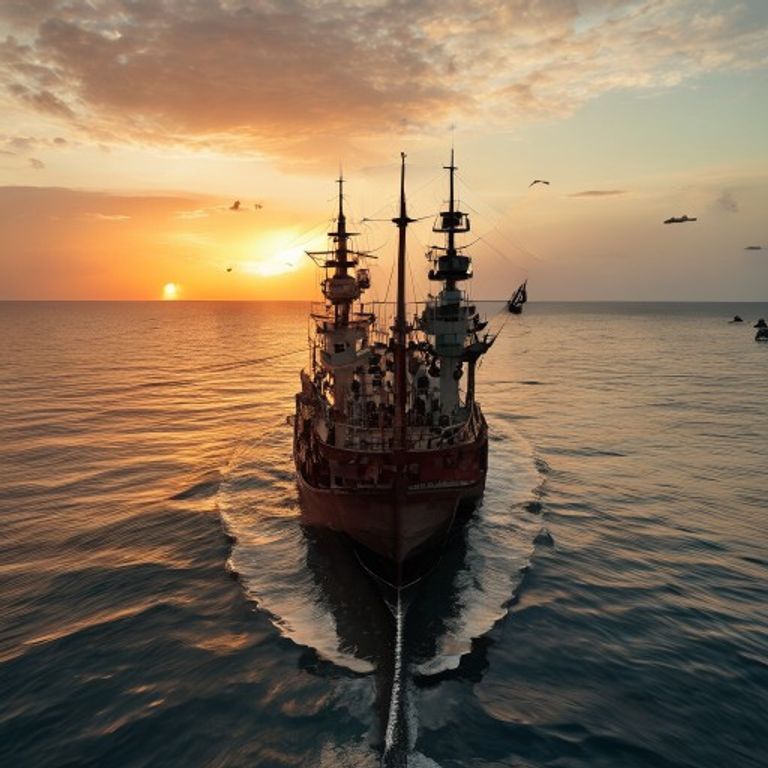
The entire crew of a cargo ship was found dead with expressions of pure terror, after sending a distress call stating that all officers had died.
⚠️ Research elaborated with the aid of Deep Research is subject to referential ambiguity.
🖥️Clean HTML code using a proprietary tool.
👥Research by Guilherme Felipe, Curation by Sílvio Lôbo
The Ghostly Whisper in the Strait of Malacca: Deciphering the SS Ourang Medan Enigma
In the vast and mysterious maritime landscape, few enigmas echo with the disturbing force of the case of the Dutch freighter SS Ourang Medan. A story that navigates between the factual and the legendary, between tragedy and the inexplicable, this incident, which occurred in 1947, continues to defy explanations, leaving a trail of unanswered questions in the turbulent waters of the Strait of Malacca.
1. The Context and the Incident: The Silent Scream of a Ghost Ship
The SS Ourang Medan, a Dutch merchant ship, was en route when, in the early hours of a fateful day in February 1947, a series of distorted and terrifying distress messages began to emanate from its radios. The signals, picked up by nearby ships and coastal stations in Sumatra, described an indescribable horror on board. Fragmented reports spoke of an entire crew dead, in grotesque positions, with expressions of pure terror frozen on their faces. The final cry, transmitted before absolute silence, was one of despair: "All dead... maybe I am too..."
Perplexity gripped the maritime community and authorities. A ship, operating in relatively busy waters, emitting such a harrowing distress call and then disappearing from the radio? The urgency of the situation prompted the American ship Silver Star to investigate. As they approached the Ourang Medan, the crew of the Silver Star found the ship adrift, in apparent disarray, but with no signs of external damage or fire. The discovery on board, however, was the apex of the mystery: the entire crew, including the captain, lay dead. Their bodies were rigid, eyes wide open, arms outstretched as if reaching for help or struggling against something invisible. The smell of sulfur hung in the air. The superficial investigation by the Silver Star was abruptly interrupted when smoke began to emanate from the hold, followed by explosions, forcing its crew to abandon the ship, which then mysteriously sank.
2. Timeline of Events: The Minutes That Turned into Centuries of Uncertainty
- Unconfirmed Date (February 1947): The SS Ourang Medan departs from an unknown port with its cargo.
- Hours before the incident: Unusual and fragmented distress messages begin to be transmitted. The first reported problems with the cargo and the crew's safety.
- Fateful Dawn: Final, terrifying messages are intercepted, describing the death of the entire crew. The cry "All dead... maybe I am too..." is the last recorded sign of life.
- The Next Morning: The American ship Silver Star, alerted by the messages, locates the SS Ourang Medan adrift in the Strait of Malacca.
- Onboard the Ourang Medan: The crew of the Silver Star finds the crew's bodies in horrifying positions, with no apparent signs of violence, but with expressions of terror. A strong smell of sulfur is detected.
- Shortly After: Smoke and explosions erupt from the Ourang Medan's hold, forcing the evacuation of the rescue team.
- Subsequently: The SS Ourang Medan sinks mysteriously.
3. Main Theories: Unveiling the Veil of Species
The absence of a complete forensic investigation and the fragmented details of the distress messages have given rise to a myriad of theories, some anchored in science, others floating on the borders of the inexplicable.
Scientific and Police Theories (Most Probable):
- Toxic Cargo Leak: This is the most widespread hypothesis and considered the most plausible by many. The Ourang Medan's cargo, not officially registered in many accounts, could have consisted of dangerous chemicals, such as potassium cyanide or phosphorus. An accidental leak would have released lethal gases that quickly incapacitated and killed the crew. The smell of sulfur could be a byproduct of chemical decomposition. The final explosion would be attributed to the spontaneous ignition of dangerous vapors.
- Volcanic Gases: The Strait of Malacca region has underwater volcanic activity. A sudden release of toxic volcanic gases, such as sulfur dioxide or hydrogen sulfide, could have invaded the ship, leading to asphyxiation and rapid death.
- Industrial Disaster/Accident Onboard: Although less specific, the possibility of a serious industrial accident in a closed compartment of the ship (such as a refrigerant gas leak or similar) that spread rapidly, causing the crew's death, cannot be entirely ruled out.
Alternative, Paranormal, and Conspiracy Theories:
- Chemical or Biological Weapons Attack: Given the era (shortly after World War II), some speculate about secret chemical or biological weapons tests that went terribly wrong. The undeclared cargo could have been experimental.
- Paranormal or Supernatural Phenomena: Reports of ghost ships and maritime hauntings are abundant. The macabre and inexplicable death of the crew, with no signs of visible struggle, fueled theories about a supernatural force or a curse that had struck the ship. The expressions of terror on their faces would be evidence of an encounter with the beyond.
- Alien Invasion or Extraterrestrial Experiments: One of the most fantastic theories, suggesting that an extraterrestrial life form entered the ship, killed the crew, and fled, possibly in a flying craft. The smell of sulfur and the rapid deaths could be attributed to unknown alien technology.
- The "Sea Demon" or Unknown Creature: Some maritime legends speak of terrifying sea creatures. The idea of a creature that invaded the ship and exterminated the crew in a brutal and rapid manner is another speculative possibility.
4. Controversies and Blind Spots: The Shadows of the Investigation
The case of the SS Ourang Medan is full of gaps and inconsistencies that fuel the mystery and hinder a definitive resolution.
- Incomplete or Missing Cargo Records: The official cargo manifest of the Ourang Medan is often cited as vague or non-existent, making it difficult to confirm a specific dangerous cargo.
- The Absence of Detailed Forensics: The Silver Star conducted a superficial inspection. The forced evacuation and subsequent sinking prevented a complete forensic investigation at the scene. There are no reliable reports of post-mortem examinations of the bodies.
- Conflicting and Vague Testimonies: The intercepted radio messages are fragmented and often cited inconsistently in different accounts. The exact description of the bodies and the environment on board also varies.
- Disappearance of Evidence: The ship itself and any potential evidence it might have contained were lost to the depths of the ocean.
- The "Silence" of the Authorities: Maritime authorities at the time did not issue conclusive statements about the incident, leaving the case open and subject to interpretation.
5. Curiosities and Legacy: A Tribute to Maritime Uncertainty
The case of the SS Ourang Medan has transcended the maritime sphere, becoming an icon of horror and mystery fiction. Its story has inspired countless books, articles, documentaries, and even films, capturing the imagination of generations.
- Cultural Impact: The ghost ship Ourang Medan is frequently cited in discussions about the greatest maritime mysteries and inspires fascination with the unknown that resides in the depths of the ocean.
- Current Status: The case remains officially unsolved. Although the toxic cargo leak theory is the most academically accepted, the lack of definitive evidence allows other theories to continue to thrive. There are no records of a formal reopening of the case, but it continues to be the subject of research and speculation by enthusiasts and researchers of unexplained phenomena.
- A Constant Reminder: The SS Ourang Medan serves as a grim reminder of human fragility in the face of nature's forces and the hidden dangers that can lie within seemingly harmless cargo. Its name is synonymous with a maritime mystery that, even decades later, continues to haunt us with its silent questions.





