



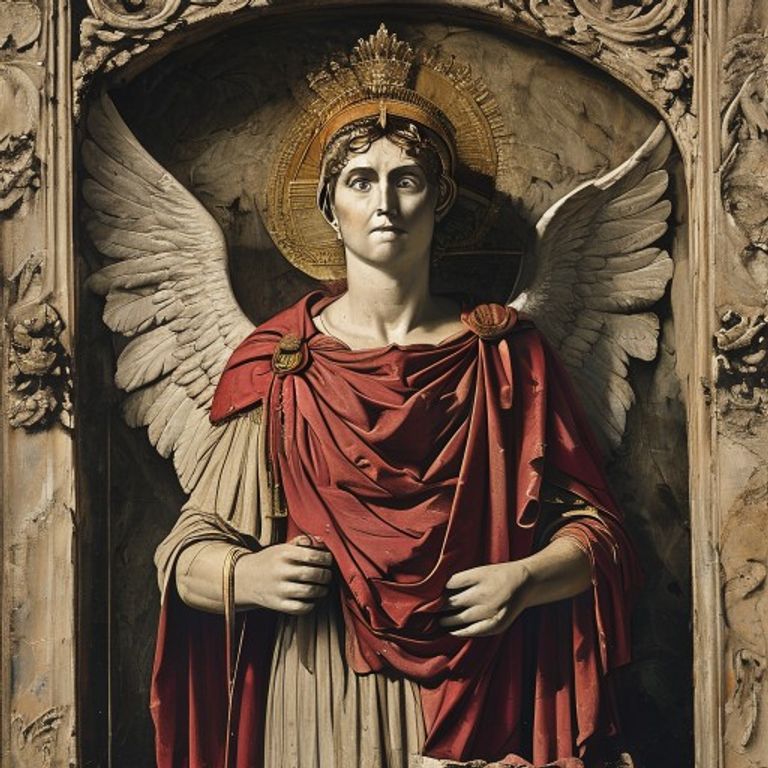
The long process of decline and disintegration of the greatest power of Antiquity, culminating in the deposition of the last Western emperor in 476 AD.
⚠️ Research conducted with the aid of Deep Research is subject to referential ambiguity.
🖥️ Clean HTML code using a proprietary tool.
👥 Research by Guilherme Felipe, Curation by Sílvio Lôbo
The Eternal Decline: Unraveling the Enigma of the Fall of the Roman Empire
By [Your Senior Investigative Journalist Name]
An empire that spanned centuries, shaped civilizations, and left an indelible legacy in human history. And yet, its disintegration was not a sudden cataclysmic event, but a complex and multifaceted process, punctuated by unknowns that continue to challenge modern historians and investigators. The Case of the Fall of the Roman Empire, more precisely its western portion, is not a mystery of a murder or a specific disappearance. It is the enigma of a giant that gradually succumbed, and whose causes remain in a minefield of theories, debates, and, at times, eloquent silences.
1. The Context and the Incident: Where, When, and How the Mystery Began
The setting of our "incident" is vast and unfolds over centuries. Ancient Rome, at its peak, dominated much of Europe, North Africa, and the Middle East. However, starting in the 3rd century AD, deep cracks began to appear in its colossal structure. The "incident" itself is not a single moment, but the process of deterioration and fragmentation that culminated in the deposition of the last Western Roman emperor, Romulus Augustulus, in 476 AD, at the hands of the Germanic leader Odoacer. This event, although symbolic, marked the end of an era and opened a range of questions about the factors that led such an absolute power to its ruin.
The mystery lies in the multiplicity of causes that intertwined, in the difficulty of assigning a definitive weight to each element, and in the absence of a conclusive final report. There is no single "crime scene," but a continent in transformation; there is no main "suspect," but a set of internal and external forces acting in concert.
2. Timeline of Key Events
Reconstructing the chronology of Rome's fall is an exercise in meticulous analysis of countless interconnected events. Below, we present a timeline of the most significant milestones that illustrate the decline:
- 3rd Century AD: Crisis of the Third Century, marked by civil wars, political instability, barbarian pressures on the borders, and economic crises. The division of the empire into the Tetrarchy (by Diocletian) and, later, the founding of Constantinople (by Constantine) indicate the first attempts to manage an increasingly difficult territory.
- 378 AD: Battle of Adrianople. A devastating defeat for the Roman army against the Visigoths, which demonstrated the vulnerability of the legions and the growing strength of the Germanic peoples.
- 410 AD: Sack of Rome by the Visigoths under the command of Alaric. A traumatic event that shook the Roman imagination and showed that the Eternal City itself was not invulnerable.
- 451 AD: Battle of the Catalaunian Plains. Although a victory for Rome and its allies against the Huns of Attila, it demonstrated Rome's dependence on Germanic allies and the fragility of its own resources.
- 455 AD: Sack of Rome by the Vandals. A sack even more destructive than that of 410, evidencing the impotence of imperial power to defend its own center.
- 476 AD: Deposition of Romulus Augustulus by Odoacer. Traditionally, this is considered the year of the fall of the Western Roman Empire, with Odoacer sending the imperial insignia to Constantinople, declaring that there was no longer a need for an emperor in the West.
3. The Main Theories: A Mosaic of Explanations
The debate over the causes of Rome's fall is as old as the fall itself. The absence of a single causal factor and the complexity of the events led to the development of a vast range of theories, from those most consensual among historians to the most speculative:
3.1. Classical and Historical Theories (Proven Facts and Strongly Supported Hypotheses)
- Barbarian Invasions and External Pressures: One of the oldest and most popular theories, focused on the impact of migrations and invasions by Germanic peoples (Goths, Vandals, Franks, etc.) and Huns. Roman military reports and historical chronicles of the time document these conflicts. The destabilization of the borders and the penetration capacity of the invaders are widely accepted facts.
- Political Instability and Corruption: Turbulent imperial succession, frequent civil wars, and the growing influence of corrupt generals and elites weakened the central government. Sources such as the writings of Tacitus, although predating the fall, already pointed to these problems. Mismanagement and the difficulty of maintaining loyalty in such a vast empire are widely documented.
- Economic and Social Crisis: Hyperinflation, currency devaluation, the tax burden on peasants, and the decay of cities led to impoverishment and disunity. Egyptian papyri and archaeological findings reveal economic difficulties. The decline of trade and the concentration of land in the hands of a few are also considered factors.
- Military Decay and Overstretch: The once-invincible Roman army underwent transformations. Growing dependence on mercenaries, lack of discipline, and the exorbitant cost of maintaining the legions made the empire's defense unsustainable. Analyses of Roman military organization and reports of lost battles corroborate this hypothesis.
- Division of the Empire: The administrative division between the Western Roman Empire and the Eastern Roman Empire, with their capitals in Rome/Ravenna and Constantinople, respectively, may have weakened the capacity for a unified response to crises. Although it facilitated administration in some aspects, it may also have diluted resources and priorities.
3.2. Alternative, Conspiracy, or Paranormal Theories (Speculation and Lack of Strong Evidence)
- Diseases and Epidemics: It is suggested that outbreaks of diseases (such as the Antonine Plague or the Plague of Cyprian) decimated the population, weakening the workforce and the army. Although epidemics occurred and affected the empire, direct and exclusive causality with the fall is difficult to prove. Archaeological and medical evidence is inconclusive regarding a decisive impact.
- Climate Change: Some theories point to a period of climatic instability that would have affected agriculture, leading to famine and forced migrations, exacerbating external pressures. Paleoclimatic studies suggest such fluctuations, but their direct link to the imperial fall is speculative.
- Moral Decay and "Amorality": A more philosophical view, which attributes the fall to the loss of civic and moral values, the dissolution of Roman society, and its surrender to futile pleasures. This theory is difficult to quantify and is based more on subjective interpretations than on concrete evidence. Moral critiques by thinkers of the time exist, but are not sufficient to explain an imperial collapse.
- Conspiracy Theories (e.g., Extraterrestrial Intervention, Secret Societies): These theories, devoid of any scientific or historical basis, postulate hidden or supernatural explanations for the fall of Rome. There is no evidence in declassified files, official reports, or archaeological findings to support such claims.
4. Controversies and Blind Spots: The Flaws in Historical Investigation
The "case" of the fall of Rome is marked by gaps and divergent interpretations, which fuel controversies:
- Fragmentation of Sources: A large part of the original documents was lost over the centuries. What remains is often incomplete, biased, or written by authors with specific agendas. The absence of contemporary official reports on crisis management aggravates the situation.
- Emphasis on a Single Factor: Many historians, in different eras, tended to overestimate a single factor (invasions, corruption, etc.) to the detriment of a more holistic analysis. The debate between those who emphasize internal and external causes is an example of this controversy.
- The Figure of Romulus Augustulus: The deposition of an adolescent emperor, often seen as a fragile figure, raises questions about the real extent of imperial power at the time of the fall. Was he a scapegoat or a symptom of the system's weakness?
- The Survival of the East: Why did the Eastern Roman Empire (Byzantine) survive for another thousand years? This disparity raises questions about the specificity of the factors that led to the fall of the West. Comparative analyses of the structures and resources of both empires are still a source of debate.
- "Missing" Evidence: As in any major investigation, there is a temptation to speculate about evidence that might have existed and was lost, such as more detailed records of imperial finances or precise maps of invasion routes.
5. Curiosities and Legacy: The Immortal Impact
The legacy of the Fall of the Roman Empire is immeasurable and continues to resonate in Western culture:
- Popular Culture: The fascination with the Roman Empire and its fall inspires films, books, games, and debates. The idea of a great empire crumbling is a recurring theme in historical fiction and political analysis.
- Historical Reference Point: The fall of Rome is a fundamental milestone for the transition from Antiquity to the Middle Ages in Western Europe, defining the emergence of new kingdoms and the reconfiguration of political and religious power.
- Current Questions: The causes of Rome's decline are frequently invoked in debates about the sustainability of modern great powers and empires, serving as a case study on the dangers of over-expansion, corruption, and failure to adapt to new realities.
- Current Status of the "Case": The Case of the Fall of the Roman Empire has not been "reopened" in a judicial sense, as it was never a criminal case. However, it remains actively under investigation by the academic community. New archaeological findings, data analysis, and interdisciplinary approaches continue to refine and, at times, challenge existing theories. The mystery, therefore, is not solved, but in constant evolution.
The study of the fall of Rome reminds us that even the most powerful structures are subject to the laws of time and change. And that, at times, the greatest enigmas are not those that hide a single secret, but those that reveal to us the complex web of factors that shape the destiny of civilizations.





