



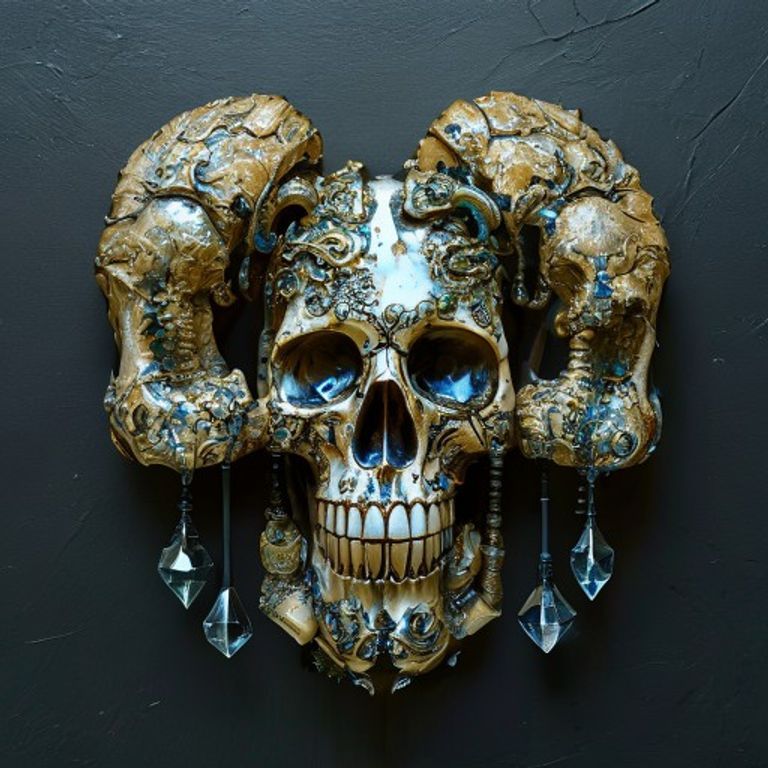
Incredibly polished quartz skull models, supposedly pre-Columbian, have been discovered surrounded by legends, though the methods of their creation and true age remain debated.
⚠️ Research elaborated with the aid of Deep Research is subject to referential ambiguity.
🖥️Clean HTML code using a proprietary tool.
👥 Research by Guilherme Felipe, Curation by Sílvio Lôbo
The Fascinating Enigma: Unraveling the Case of the Crystal Skulls
As a senior investigative journalist, I've delved into countless dusty archives and conducted interviews that defied logic. Few cases, however, hold the fascination and perplexity of what has become known as the "Case of the Crystal Skulls." This is not a work of fiction, but rather a series of events, objects, and narratives that, to this day, defy definitive explanation, blurring the lines between archaeology, legend, and, for some, the inexplicable.
1. The Context and the Incident: Where, When, and How the Mystery Began
The origin of the crystal skull mystery is diffuse, not limited to a single pinpoint incident, but rather an accumulation of discoveries and narratives that gained traction in the 19th and 20th centuries. The central idea revolves around human skulls carved from quartz crystal, supposedly of pre-Columbian origin, endowed with extraordinary properties and hidden in enigmatic locations.
The first reports to gain notoriety came from the British explorer Frederick Arthur Mitchell-Hedges, an adventurer with a notorious history of flamboyant tales. In 1924, he claimed to have discovered an extraordinary crystal skull in the ruins of Lubaantun, in the then British colony of Honduras (modern-day Belize). This discovery, according to his account, was made by his adopted daughter, Anna Mitchell-Hedges, under circumstances he described as mystical and with the help of local natives. The "Skull of Doom," as it became known, became the most famous and controversial of all.
Before Mitchell-Hedges, other crystal skulls had already appeared in collections and reports, many associated with the British Museum and the Musée du Quai Branly in Paris. However, the dramatic narrative and publicity surrounding the Lubaantun discovery catalyzed global interest and initiated a saga of speculation.
2. Timeline of Events
- Late 19th Century: First mentions and appearances of crystal skulls in European collections, often without clear information about their archaeological origin.
- 1924: Frederick Arthur Mitchell-Hedges claims the discovery of the "Skull of Doom" in Lubaantun, Belize. The discovery is formally attributed to his adopted daughter, Anna Mitchell-Hedges.
- 1930s-1950s: The "Skull of Doom" is exhibited and becomes an object of fascination and speculation. Reports about its origins and supposed powers begin to proliferate.
- 1970s: The popularity of crystal skulls grows, fueled by books, documentaries, and New Age culture. Several other crystal skulls begin to appear on the market.
- 1990s: More rigorous scientific analyses are applied to the most famous crystal skulls, especially the one in the British Museum.
- 2000s onwards: Most scientific research concludes that the most prominent crystal skulls are not of pre-Columbian origin, but rather 19th-century creations.
3. Main Theories: Between Science and the Supernatural
The case of the crystal skulls is fertile ground for theories, ranging from skeptical and scientific explanations to paranormal and conspiracy beliefs.
Scientific and Archaeological Hypotheses
- 19th-Century Creations: This is the predominant and most robust theory, supported by forensic and archaeological evidence. Optical and electron microscopy analysis of skulls like the one in the British Museum (dated around 1880) and the "Skull of Doom" revealed marks from modern tools, incompatible with the known lapidary techniques of ancient Mesoamerican cultures (such as the Maya or Aztecs). The hypothesis is that they were manufactured in Europe or elsewhere by skilled artisans, possibly to be sold as exotic antiquities.
- Hoax and Archaeological Fraud: Given the nature and sophistication of some skulls, it is plausible that they were intentionally produced to deceive collectors and archaeologists eager for unique artifacts, exploiting the fascination with the exotic and the antiquities market.
Alternative and Paranormal Theories
- Extraterrestrial or Atlantean Origin: One of the most popular theories in the New Age universe suggests that the skulls were not made by human hands, but by advanced civilizations, such as the Atlanteans, or even by extraterrestrial beings. It is believed that they contain cosmic knowledge, healing powers, and information about the history of Earth and the universe.
- Artifacts from Lost Civilizations: Similar to the Atlantean theory, it is postulated that the skulls belong to unknown and technologically advanced civilizations that existed in Earth's remote past, and that their properties are a legacy of those eras.
- Psychic and Healing Energy: Many who defend the authenticity and antiquity of the skulls attribute to them the ability to concentrate psychic energy, heal illnesses, promote clairvoyance, and even communicate telepathically. These beliefs are fundamental to the cultural appeal of the skulls in contemporary spirituality.
4. Controversies and Blind Spots
The case is rife with controversies, many of them centered on the figure of Frederick Arthur Mitchell-Hedges and the initial lack of scientific rigor.
- Lack of Clear Archaeological Context: The claim of discovery in Lubaantun has never been corroborated by independent archaeological findings or excavation records proving the skull's presence in the stratigraphic layer of an ancient civilization. Mitchell-Hedges' own expedition lacks rigorous scientific documentation.
- Conflicting Testimonies: Accounts of the discovery have varied over time, raising doubts about the veracity of the events.
- Controversial Analyses: While modern analyses point to 19th-century manufacturing, some enthusiasts and proponents of the skulls' authenticity argue that the techniques used were unable to identify certain ancient "signatures" of energy or manufacturing. However, these claims lack scientific validation.
- Disappearance of Evidence: In some cases, it is alleged that the original context of the discovery of certain skulls was lost or deliberately obscured, hindering subsequent investigations.
- The Role of Anna Mitchell-Hedges: The figure of Anna, who allegedly discovered the skull, is central, but her participation in details and her version of events are often filtered through her father's narrative.
5. Curiosities and Legacy
The cultural impact of the crystal skulls is undeniable, transcending the field of archaeology and penetrating popular culture and modern mysticism.
- Inspiration for Fiction: Crystal skulls have inspired countless books, films (notably "Indiana Jones and the Kingdom of the Crystal Skull"), and games, perpetuating the myth and mystery for new generations.
- Market and Collecting: Despite scientific conclusions, an active market for crystal skulls, both old and new, continues to exist, fueled by belief in their supposed properties.
- Current Status: For the scientific and archaeological community, the case of the crystal skulls is largely resolved: they are sophisticated 19th-century fakes. However, for proponents of alternative theories, the mysteries remain. There is no ongoing official effort to "reopen" the case in the sense of seeking new evidence of ancient authenticity, but the fascination and speculation continue to fuel debates and new interpretations. The enigma of the crystal skulls, with their gleaming surfaces and whispered histories, remains a testament to our relentless search for answers and the enduring power of mystery.





