



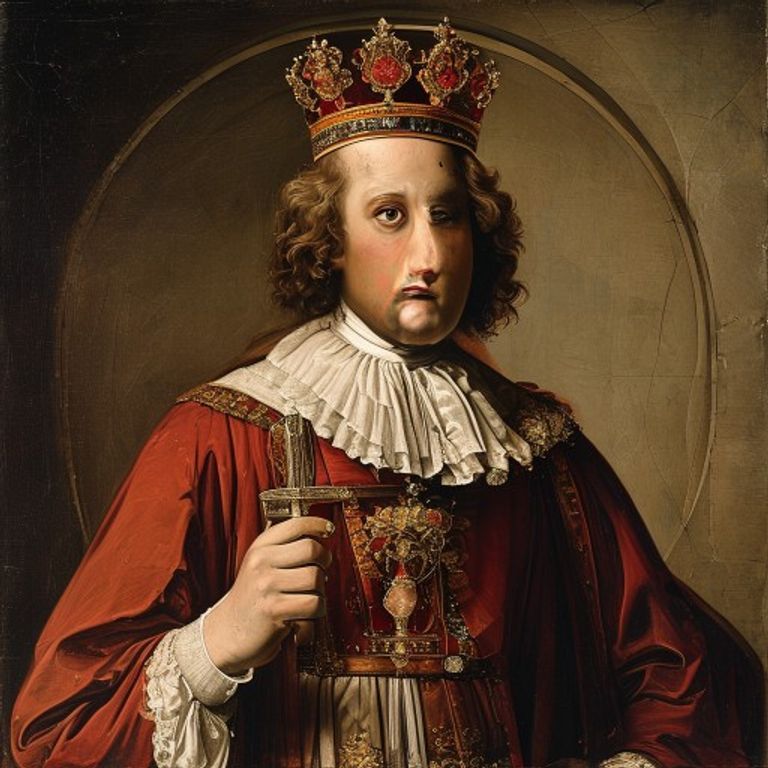
A mysterious 18th-century courtier and alchemist supposedly possessed the secret to immortality, with unconfirmed reports of his sightings spanning subsequent centuries.
⚠️ Research elaborated with the aid of Deep Research is subject to referential ambiguity.
🖥️Clean HTML code using a proprietary tool.
👥 Research by Guilherme Felipe, Curation by Sílvio Lôbo
The Immortal Enigma: Unraveling the Case of the Count of St. Germain
As an investigative journalist with decades dedicated to unearthing history's darkest secrets, few cases have fascinated and frustrated me as much as that of the Count of St. Germain. This is not a case of bloodshed, but of absence, a dematerialization that defies logic and fuels a centuries-old legacy of mystery. In a world saturated with simplistic explanations, the Count confronts us with the possibility that the inexplicable still lurks in the shadows.
1. The Context and the Incident: The Shadow of an Impossible Man
The mystery of the Count of St. Germain is not confined to a single isolated incident, but rather to the man's very existence. Emerging in European courts around the 1740s, the Count was an enigmatic figure: a fluent polyglot, a talented musician, a skilled alchemist, an exceptional diamond cutter, and, above all, a man who claimed to possess knowledge and experiences spanning centuries. His apparent longevity was the core of his enigma. Historical sources and contemporary accounts describe him in different courts and eras, often with the same vitality and youth, fueling the belief that he was more than a mere mortal. The initial "incident," therefore, is his very ascent onto the public stage, challenging conventional notions of time and mortality.
2. Timeline of Key Events: A Life Without Final Markers
Reconstructing a timeline for St. Germain is an exercise in patience and the distinction between fact and fiction. However, some milestones are undeniable:
- c. 1740s: First notable appearances in Paris, attracting the attention of high society and royalty with his vast culture and supposed longevity.
- 1760: Participation in political intrigues at the court of Louis XV and Madame de Pompadour.
- 1770s: Stay in Germany, where he became involved with Freemasonry and esoteric circles. Reports of his presence in various European cities simultaneously or with only a few months' interval are frequent and inexplicable.
- 1784: The last confirmed and widely documented appearance in Eckernförde, Germany, under the protection of Prince Karl of Hesse-Kassel. Official records from the Prince indicate that St. Germain was at his court.
- 1784 onwards: Multiple reports of sightings in different parts of Europe and even other continents. These appearances, however, lack robust documentary proof and quickly enter the realm of speculation.
- 1789: During the French Revolution, some claim to have seen him. Others, later, speculate that he was involved in the events.
- 19th and 20th Centuries: The figure of St. Germain becomes an icon of occultism and immortality, with appearances in secret societies and esoteric books.
3. Main Theories: Deciphering a Ghost
The absence of a proven death and the myriad of "sightings" have opened a vast array of theories, ranging from the pragmatic to the transcendental:
Scientific and Police Theories (Less Likely Given the Circumstances)
- Natural Death and Identity Confusion: The simplest hypothesis is that St. Germain did, in fact, die at some unknown point after 1784, and later reports are of different people taking advantage of the legend or simply being mistaken. However, the consistency in physical and behavioral descriptions over decades makes this theory less convincing.
- Fraud and Elaborate Deception: St. Germain could have been a master of dissimulation, using disguises, accomplices, and an information network to perpetuate the illusion of his longevity. This would explain his presence in multiple locations, but not his apparent youth and knowledge acquired over centuries.
Alternative and Paranormal Theories
- Alchemy and the Elixir of Life: The most popular theory among occultism followers is that St. Germain discovered the secret of the Philosopher's Stone and, consequently, the elixir of long life, allowing him to live for centuries. His knowledge of chemistry and his skill as a jeweler could have been used for alchemical purposes.
- Reincarnation or Soul Transmigration: Another school of thought suggests that St. Germain's soul continues to reincarnate, manifesting in different bodies over time. This view aligns with various spiritual traditions.
- Time Travel or Parallel Dimensions: In a more modern and speculative interpretation, some suggest that St. Germain could be a time traveler or someone capable of moving between parallel realities, explaining his appearances in different eras.
- Otherworldly Being/Immortal Being: The possibility that St. Germain was not human, but rather an entity of a higher nature or an immortal being, remains a hypothesis that transcends scientific logic.
4. Controversies and Blind Spots: Where the Light Doesn't Reach
The investigation into the Count of St. Germain is rife with blind spots and controversies that fuel the mystery:
- Missing Birth and Death Records: Paradoxically, for a man who supposedly lived so long and made such a mark, there are no definitive records of his birth or, crucially, his death. Ecclesiastical and civil archives from various eras and locations do not provide a concrete answer.
- Contradictory Testimonies: While some described him as a charming and erudite man, others reported enigmatic and sometimes arrogant behavior. The authenticity and weight of many of these testimonies are difficult to assess.
- Manipulated or Lost Evidence: The esoteric nature of many of the circles St. Germain frequented has led to speculation that important documents may have been deliberately hidden or destroyed to preserve the secrets associated with him.
- The Lack of a "Last Word": The fact that there was no deathbed, no public will, or any final communication from St. Germain leaves a void that no official investigation has ever been able to fill.
5. Curiosities and Legacy: The Count Who Never Died
The cultural impact of the Count of St. Germain is immense and lasting:
- Icon of Esotericism: He is a central figure in many currents of occultism, mysticism, and theosophy, often associated with spiritual masters, secret rituals, and ancient knowledge.
- Literary and Artistic Inspiration: His figure has inspired countless novels, plays, films, and even operas, solidifying his place in the popular imagination as the man who defied death.
- Secret Societies and Conspiracies: He is believed to have been a member or founder of various secret societies, fueling conspiracy theories about his role in historical events.
- Current Status: The case of the Count of St. Germain has not been "reopened" in a formal police sense, as there was never a specific crime to investigate. However, he remains alive in academia, historical research, and, most importantly, in the public's fascination with unsolvable mysteries. His story has become a case study on the fragility of historical documentation and the persistence of legend when confronted with the absence of definitive proof.
The Count of St. Germain, a man whose contours are lost in the mists of time, continues to challenge us. He is a reminder that, even in our age of instant information, there are mysteries that resist exploration, enigmas that, perhaps intentionally, have been left unsolved, so that the human imagination can continue to explore their infinite ramifications.





