



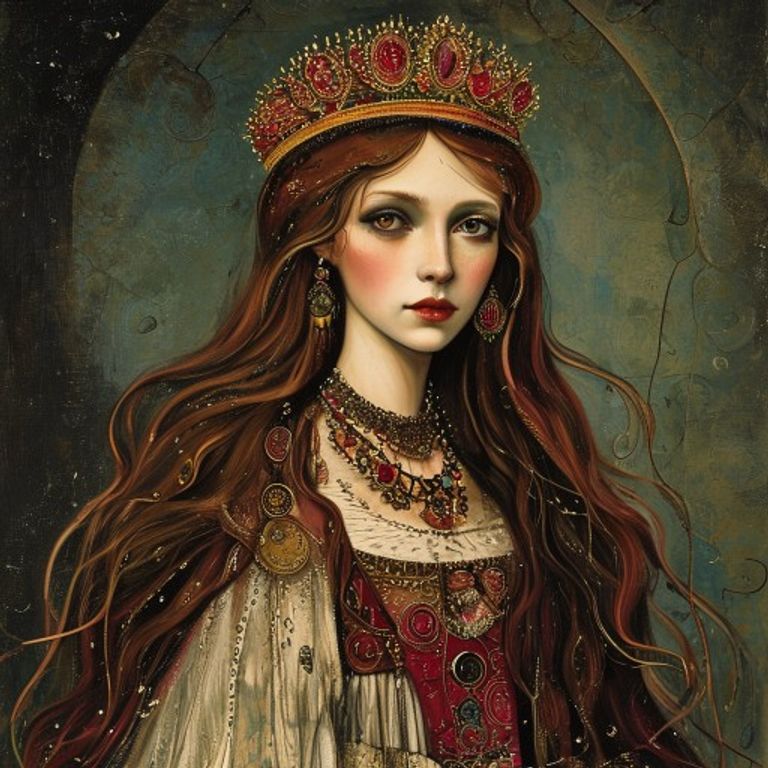
A mysterious woman from the eighteenth century declared herself the true heir to the throne of the Russian Empire, sparking a political crisis before being imprisoned and dying without ever revealing her true name.
⚠️ Research elaborated with the aid of Deep Research is subject to referential ambiguity.
🖥️Clean HTML code using a proprietary tool.
👥 Research by Guilherme Felipe, Curation by Sílvio Lôbo
The Enigma of Princess Tarakanova: A Ghost in the Waters of Saint Petersburg
The case of Princess Tarakanova is one of the most persistent and fascinating mysteries in Russian history, intertwining political intrigue, dubious identity, and a dark fate. The story, which flourished in the late 18th century, evokes images of betrayal, imprisonment, and an enigmatic female figure whose body was never definitively found, fueling centuries of speculation and legend.
1. The Context and the Incident: Where, When, and How the Mystery Began
The mystery unfolds during the turbulent reign of Catherine the Great, an empress known for her political acumen and her rise to power through a coup against her husband. In 1775, news of a mysterious woman presenting herself as Princess Tarakanova began to circulate across Europe. She claimed to be the legitimate daughter of Empress Elizabeth Petrovna, Catherine's predecessor, and therefore the rightful heir to the Russian throne. This claim was a direct threat to Catherine's legitimacy.
The supposed princess gained sympathizers and support in various European courts, especially in the court of Naples, where it was believed she was under the protection of some foreign powers. Russian intelligence, under the leadership of figures like Count Alexei Orlov, was tasked with investigating and neutralizing this threat. The crucial point of the mystery lies in how this figure was captured and what her ultimate fate was.
2. Timeline of Events
A chronological reconstruction of events is crucial to unraveling the veil of uncertainty:
- Before 1775: Emergence of a mysterious woman in Europe, claiming to be Princess Tarakanova, daughter of Empress Elizabeth Petrovna and, therefore, the legitimate heir to the Russian throne.
- 1775: Princess Tarakanova is in Venice, possibly seeking support for her cause. Count Alexei Orlov, a favorite of Catherine the Great, is dispatched to the region with the mission of capturing her.
- November 1775: Princess Tarakanova is lured to a meeting with Orlov in Venice, where she is arrested on a disguised Russian ship. Reports suggest she was deceived under the pretext of a marriage to Orlov himself.
- December 1775 - February 1776: The Princess is transported to Russia, under conditions that became the subject of intense debate.
- 1776: The Princess is imprisoned in the Shlisselburg Fortress, near Saint Petersburg. Official reports indicate her death there on February 4, 1776, from tuberculosis or another illness.
- Subsequent Centuries: The body was never exhumed or conclusively identified, fueling doubts about the veracity of her death in the fortress and giving rise to various theories.
3. The Main Theories
The fate of Princess Tarakanova has given rise to a myriad of explanations, ranging from the pragmatic to the supernatural:
Official Theory: Death in the Fortress
Logic: The official version, corroborated by archival reports and documents (although full declassification is subject to debate), maintains that the woman imprisoned was indeed Princess Tarakanova and that she died of natural causes, such as tuberculosis, in her cell at the Shlisselburg Fortress. The priority of the Russian court was to eliminate the political threat, and her death would confirm the end of the claim.
Anchoring Evidence: Fortress registration and death reports, testimonies of guards (albeit selective and possibly coerced).
Theory of Substitution or Hoax (Scientific/Police Hypothesis)
Logic: This is one of the most debated and investigated theories by historians and researchers. It suggests that the woman captured in Venice was not the true daughter of Empress Elizabeth, but rather an impostor. The Russian court, upon discovering the hoax, would have orchestrated a plan to discredit and silence the impostor, but also to avoid an international scandal that could expose the fragility of the claim and the audacity of Catherine's coup. The theory posits that the real "Princess" would have been secretly taken back to Europe after the impostor's capture, perhaps living under another name or dying in a distant, anonymous location. Alternatively, the captured impostor could have been secretly executed or exiled, and the announcement of her death in the fortress would be a smokescreen.
Anchoring Evidence: Inconsistencies in physical descriptions of the "princess" over time, the difficulty in tracing her previous movements with certainty, Catherine's need to eliminate the threat quickly and discreetly.
Theory of Survival and Escape (Alternative/Conspiracy Theory)
Logic: Some narratives suggest that the Princess, or whoever the imprisoned woman was, managed to escape from prison or that her death in the fortress was staged. This theory often depicts her living out her days in obscurity, possibly in convents or in prolonged exile, to avoid being found by Russian authorities. There are folk tales that associate her with enigmatic figures who appeared in different parts of Europe after 1776, fueling the idea that she survived.
Anchoring Evidence: Unconfirmed folk and folklore accounts, the lack of irrefutable evidence of her death.
Theory of the Ghost or Apparition (Paranormal Theory)
Logic: Over time, the story of Princess Tarakanova has acquired legendary contours. Some accounts, especially those associated with the Shlisselburg Fortress, speak of spectral apparitions or a restless spirit that haunts the dungeons. This theory falls more into the realm of folklore and the supernatural, where the absence of concrete evidence is replaced by belief in spiritual manifestations.
Anchoring Evidence: Reports of "ghost" sightings at the fortress, stories passed down orally through generations.
4. Controversies and Blind Spots
The investigation and narrative surrounding the case are fraught with blind spots and controversies:
- Real Identity: The central question remains: who was the woman captured, really? Physical descriptions varied in different accounts, and the absence of an unequivocal contemporary portrait increases ambiguity.
- The Capture in Venice: The details of the capture, orchestrated by Alexei Orlov, are often described as a work of deception and manipulation. Eyewitness accounts are scarce and often contradictory.
- Conditions of Imprisonment: The exact nature of the conditions under which the Princess was held at the Shlisselburg Fortress is uncertain. The description of a flooded cell in some versions of the legend may have a basis in real events, but the extent of torture or mistreatment is unclear.
- Selective Official Reports: Declassified archives and existing official reports appear to have been carefully selected, with significant gaps preventing a complete understanding of the events. The absence of a detailed autopsy report is a particularly problematic point.
- Missing Evidence: The possibility that documents or artifacts related to the case were destroyed or hidden over time cannot be ruled out, especially considering Catherine's need to protect her image and the throne.
- The Body: The lack of an exhumation and conclusive identification of the body, even in later periods, is one of the greatest enigmas. This fuels the idea that the death in the fortress may have been faked.
5. Curiosities and Legacy
The case of Princess Tarakanova has transcended the boundaries of history to become a cultural icon:
- Works of Art and Literature: The story has inspired countless works of art, novels, plays, and films. The famous painting "Princess Tarakanova" by Konstantin Makovsky, though romantic and not historically accurate, immortalized the image of a tragic and mysterious figure.
- Shlisselburg Fortress: The site of her alleged imprisonment and death has become synonymous with her story, attracting visitors and further fueling the mystery.
- Symbol of Ambiguity: The case has become an archetype of historical mystery, where truth is obscured by political interests, contradictory narratives, and the passage of time.
- Current Status: The case remains officially "resolved" with the declaration of death in the fortress. However, for independent historians and researchers, the enigma persists. There has been no official reopening of investigations, but academic and public interest remains alive, fueled by the unresolved nature of the ultimate fate of the enigmatic Princess Tarakanova.
The mystery of Princess Tarakanova is a vivid reminder of how history can be shaped by power, secrets, and the persistence of doubt. Until new concrete evidence emerges, she will continue to be a ghostly figure, wandering through the murky waters of Russian history.





