



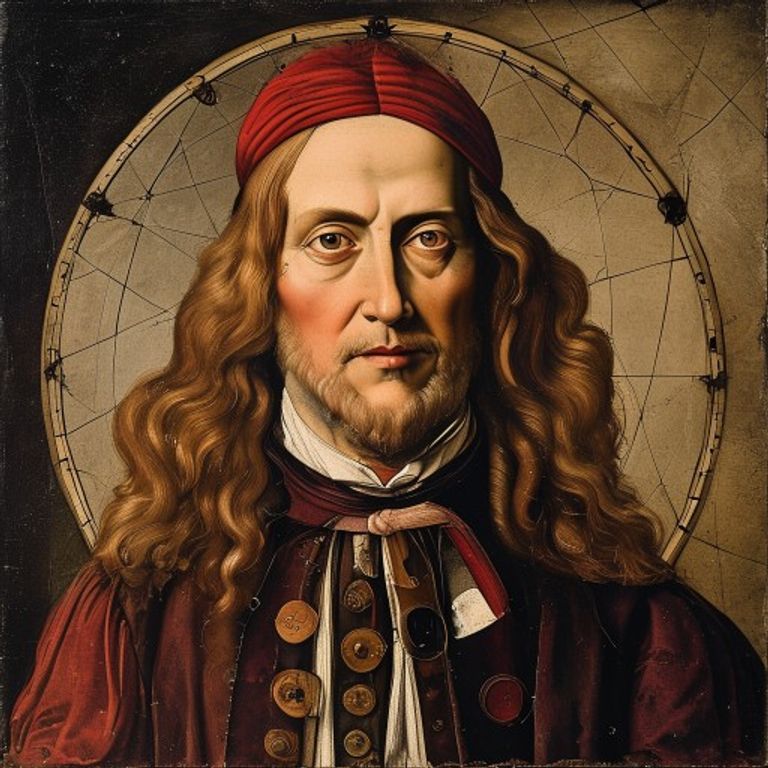
The publication of his work in 1543, which proposed the heliocentric model, challenging the millennial geocentric view and initiating the modern scientific revolution.
⚠️ Research conducted with the aid of Deep Research is subject to referential ambiguity.
🖥️ Clean HTML code using a proprietary tool.
👥 Research by Guilherme Felipe, Curation by Sílvio Lôbo
The Enigma of Nicolaus Copernicus: Science, Secrecy, and the Shadow of Disappearance
The history of science is dotted with figures whose lives and legacies transcend time. Among them, Nicolaus Copernicus, the Polish astronomer who dared to challenge the geocentric cosmos to propose a heliocentric universe, holds a prominent place. However, the twilight of his existence is shrouded in a mystery that defies the certainties of his scientific work. What really happened to the man behind the Copernican revolution in his final days? This article delves into the fragments of evidence, the theories, and the gaps that have turned the death of Copernicus into one of history's unsolved enigmas.
1. The Context and the Incident: The Shadow over Frombork
The mystery does not lie in a dramatic and sudden event, but rather in the absence of clear information regarding the final moments of Nicolaus Copernicus. He passed away on May 24, 1543, in Frombork, a city in northern Poland, then part of Royal Prussia, under the rule of the Teutonic Order. Unlike historical figures whose deaths are meticulously recorded, accounts of Copernicus's final days are sparse and contradictory. The exact date of his death itself has been a subject of debate for centuries.
Most intriguingly, in his final years, Copernicus, who was also a respected physician and ecclesiastical administrator, was already suffering from the effects of a debilitating illness, possibly a stroke that caused paralysis and speech difficulties. This physical frailty, combined with the climate of political and religious instability of the time, casts a fog over the narrative of his death, leaving room for speculation.
2. Timeline of Events
- c. 1473: Birth of Nicolaus Copernicus in Toruń, Poland.
- 1539: Copernicus's work, De Revolutionibus Orbium Coelestium (On the Revolutions of the Heavenly Spheres), is completed, although its publication is delayed.
- c. 1542: Copernicus begins to show signs of serious illness, including paralysis and communication difficulties.
- May 24, 1543: Traditionally accepted date for the death of Nicolaus Copernicus in Frombork. The publication of De Revolutionibus occurs in this same year, possibly shortly before or just after his death, thanks to the efforts of his protégé, Rheticus, and the editor Andreas Osiander.
- 19th and 20th Centuries: Copernicus's grave is lost, and the exact location of his remains becomes an enigma.
- 2005: A team of Polish archaeologists, led by Professor Krzysztof Szalała, begins the search for Copernicus's remains in Frombork Cathedral.
- 2008: The team announces the discovery of a skull and other bones that may belong to Copernicus. DNA analyses and comparisons with the remains of his relatives are inconclusive due to the degradation of the materials.
- 2014: A facial reconstruction based on the discovered skull is presented, closely resembling the image of Copernicus known from historical portraits.
3. The Main Theories: From Delirium to Intrigue
The sparse nature of information regarding Copernicus's death has opened up a range of theories, varying from the scientific to the fantastical.
3.1. The Medical Theory (Proven Facts and Reasonable Speculation)
Logic: The most accepted theory, supported by medical accounts of the time and Copernicus's own condition, suggests that he passed away due to complications from his chronic illness. The paralysis and communication difficulties may have been the result of a stroke (Cerebrovascular Accident) or another degenerative neurological disease. His death would have been a natural outcome, possibly with some of his family members or assistants present.
Evidence/Gaps: Period accounts mention his frailty. However, there is no detailed medical report, nor an exact description of the events that preceded his death. The state of preservation of the remains found in 2008 also limits definitive conclusions about the cause of death.
3.2. The Religious Controversy Theory (Low Probability Speculation)
Logic: Given that Copernicus's heliocentric theory directly challenged the prevailing theological view of the universe (Earth-centered, according to the literal interpretation of the Bible), some speculate that he could have been silenced or even assassinated by the Catholic Church, which viewed his work as heretical. The fact that the publication of De Revolutionibus was delayed and included an anonymous introduction (written by Osiander, who was trying to soften the impact of the work) would fuel this line of reasoning.
Evidence/Gaps: There is no documentary evidence to suggest any kind of active persecution against Copernicus by the Church in his final years. He himself was a canon and maintained good relations with ecclesiastical authorities. Osiander's introduction is widely interpreted as an attempt to protect the work and himself from potential criticism, rather than a sign of persecution against Copernicus.
3.3. The Secrecy Theory (Medium to High Probability Speculation)
Logic: Copernicus kept his work hidden for decades, fearing scientific and perhaps theological repercussions. It is possible that his death was shrouded in a certain secrecy to avoid the interference of elements that could compromise the publication of De Revolutionibus. The unstable political environment, with conflicts between Poland and the Teutonic Order, could have added an element of caution and discretion to the final events.
Evidence/Gaps: Copernicus's own reluctance to publish his work is the primary evidence. The lack of detailed accounts of his death can be interpreted as a consequence of this cautious mindset, which extended to the end of his life.
3.4. Alternative Theories (Very Low Probability Paranormal/Conspiracy Speculation)
Logic: On a more speculative level, theories arise regarding extraterrestrial influence, time travel, or even more obscure conspiracies, which attempt to explain the "lack of information" as a result of non-terrestrial or secret interference. These theories lack any empirical basis.
Evidence/Gaps: No evidence, only pure conjecture.
4. Controversies and Blind Spots
The main controversy lies in the very scarcity of reliable data regarding Copernicus's final days. Modern investigations into his remains have also brought up blind spots:
- Dating: Although the date of May 24, 1543, is widely accepted, some sources suggest he may have passed away on slightly different dates.
- Authenticity of the Remains: Despite the 2008 discovery, the DNA analysis was inconclusive. Facial reconstruction is a valuable tool, but not definitive proof. The possibility that the remains belong to someone else buried in the same location cannot be entirely ruled out.
- Contradictory Accounts: The lack of a single, detailed account from reliable eyewitnesses for Copernicus's final moments is a major blind spot. The few accounts that exist are fragmented and written later.
- The Lost Diary? It is plausible that Copernicus kept some kind of diary or notes about his health status and final thoughts, but such documents have never been found.
5. Curiosities and Legacy
The mystery surrounding the death of Nicolaus Copernicus does not in any way diminish his colossal scientific legacy. His work De Revolutionibus Orbium Coelestium, which presented the heliocentric model, triggered a scientific revolution that forever changed human understanding of the universe.
Cultural Impact: The debate over his death has become a fascinating case study for historians, archaeologists, and mystery enthusiasts. The discovery and the attempt to identify his remains generated great media and scientific interest, demonstrating the enduring relevance of Copernicus's figure.
Current Status: The case of Nicolaus Copernicus's death remains, for the most part, an unsolved mystery. Although the theory of death by illness is the most probable, the absence of definitive proof allows speculation to continue. Archaeological and scientific research has brought significant advances, but the gaps remain, fueling the aura of enigma surrounding one of history's greatest thinkers.





