



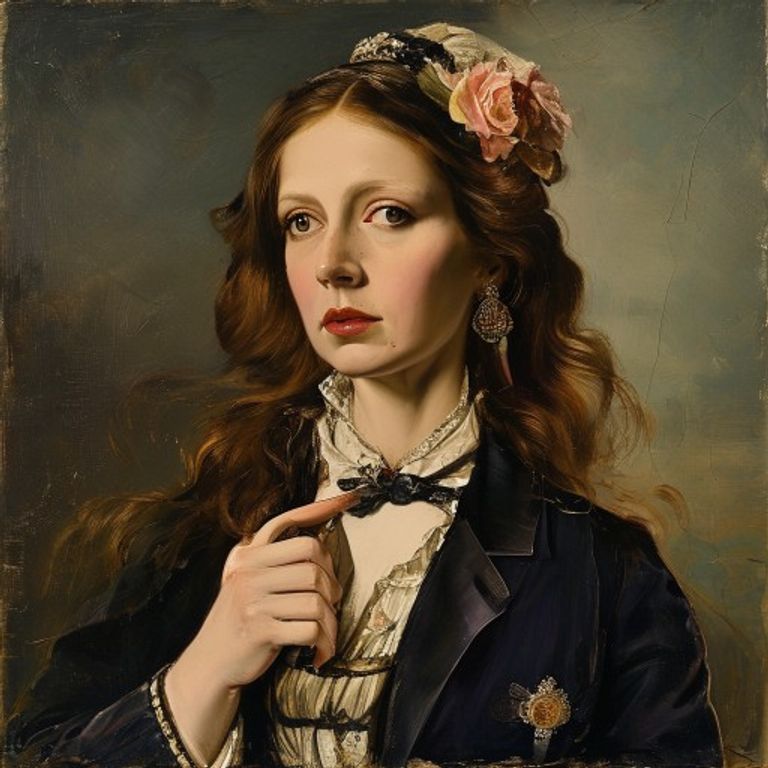
A woman found dead in the Seine River in the nineteenth century, whose serene face was transformed into a famous death mask and used in the design of CPR mannequins.
⚠️ Research conducted with the aid of Deep Research is subject to referential ambiguity.
🖥️ Clean HTML code using a proprietary tool.
👥 Research by Guilherme Felipe, Curation by Sílvio Lôbo
L'Inconnue de la Seine: The Enigma of the Smiling Lady of the Seine
At some point in the late 19th century, the cold and turbulent waters of the Seine River in Paris washed up a body that would become one of the greatest unsolved mysteries in history. It was a young woman, unidentified, but with a peculiar countenance: an enigmatic, almost serene smile that defied the tragedy of her apparent death. Her face, immortalized in death masks, echoed through art salons and curious minds, generating a fascination that persists to this day. This is the case of L'Inconnue de la Seine, the Unknown Woman of the Seine.
The Context and the Incident: Where, When, and How the Mystery Began
The exact details of the time and place where the body was found are obscure, shrouded in fragmented reports and temporal inaccuracies that have worsened over the decades. Most sources point to the banks of the Seine River, possibly near the Pont Neuf or the area known as the Quais de la Rive Gauche in Paris. The date most frequently cited for the discovery is 1886, although some accounts suggest the body may have been recovered slightly earlier or later. What is known is that a police inspector, while inspecting bodies recovered from the river at that time, noticed the young woman's unusual beauty and serenity, despite the likely hypothermia and drowning. There were no obvious signs of violence or struggle, and the state of preservation of the body allowed her face to be molded in plaster, a common procedure at the time for identification purposes.
Timeline of Events (Factual and Speculative Reconstruction)
- Late 19th Century (Estimate: 1886): Recovery of the body of an unidentified young woman from the waters of the Seine River, Paris.
- Post-Recovery Period: Post-mortem examination performed, which revealed no signs of violence and suggested death by drowning. The victim's serene countenance draws attention.
- After Recovery: A death mask maker, inspired by the beauty and enigma of the unknown woman's face, creates a plaster death mask.
- Following Decades: The death mask of the "Unknown Woman of the Seine" gains popularity and becomes a cult item. It is reproduced on a large scale and sold in souvenir shops and art galleries in Paris.
- Mid-20th Century: The French writer and poet Albert Camus refers to the mask in his work, further fueling the mystery.
- Recent Years: Various articles, documentaries, and online discussions revisit the case, seeking new interpretations and possible identities.
The Main Theories: Hypotheses for the Enigmatic Smile
The lack of identification and the unusual serenity of the young woman's face gave rise to a myriad of theories, ranging from the scientific to the mystical:
1. Classic Suicide
Logic: The most plausible and frequently accepted theory by authorities of the time. In a period where the Seine River was a common site for suicides, the absence of signs of struggle and the serenity on the face could be interpreted as the peaceful resignation of someone who decided to end their own life. Drowning, in many cases, can lead to a sense of euphoria or tranquility in the final moments.
2. Homicide with Concealment of Evidence
Logic: Although there are no explicit signs of violence, the possibility of murder cannot be ruled out. An experienced criminal could have drowned the victim in a way that minimized marks, or the water could have obscured any injuries. The lack of identification would facilitate the concealment of the crime.
3. Accidental Death
Logic: The young woman could have accidentally fallen into the river, perhaps while intoxicated, under the influence of some substance, or simply slipped. The subsequent drowning would have led to loss of consciousness and, eventually, death, with the face maintaining an expression of tranquility.
4. Flight or Voluntary Disappearance
Logic: A less common hypothesis, but one that considers the possibility that the young woman faked her death to escape an unwanted situation, such as an arranged marriage, debts, or an unwanted pregnancy. "Suicide" would be a way to disappear without leaving a trace.
5. Alternative and Paranormal Theories
- The Inspiring Muse: Some speculate that the young woman was not a victim, but an ethereal figure, a river nymph, or a muse who inspired the artists of the time. The serenity would be a reflection of her non-earthly nature.
- Transcendental Experience: The serene expression could be the result of a near-death experience or a profound inner peace in the face of the end, something that transcends scientific understanding.
- Connection to the Supernatural: In more mystical circles, theories about spirits, hauntings, or dimensional portals could be raised, although without any concrete factual basis.
Controversies and Blind Spots: The Gaps in the Investigation
The main controversy lies in the lack of detailed official records regarding the discovery of the body and subsequent investigations. The absence of a complete, declassified police report makes verifying the facts difficult. Blind spots include:
- True Identity: The impossibility of determining the young woman's true identity is the core of the mystery. No corresponding disappearance was recorded at the time, making identification impossible.
- Circumstances of Death: Without an in-depth forensic examination and detailed records, the exact cause of death and whether or not there was third-party intervention remain open.
- Origin of the Mask: Although it is widely accepted that a mask maker created the piece, the details about who this individual was and the exact date the mask was made are also imprecise.
- Testimonies: The lack of clear and documented statements from potential witnesses makes reconstructing the events difficult. Reports from river guards or passersby are scarce and often contradictory.
Curiosities and Legacy: An Immortal Icon
The legacy of L'Inconnue de la Seine transcends tragedy. Her death mask has become one of the most recognizable objects in the art world, inspiring painters, sculptors, and writers. The serenity of her smile, which contradicts the violence of death by drowning, has captured the collective imagination. She is often cited as the "most beautiful suicide of Paris" and has become a symbol of romanticism, mystery, and the ephemeral beauty of life.
Currently, the case remains officially filed as an unsolved mystery. There are no active efforts to reopen the investigations, as the lack of evidence and the passage of time make such an endeavor fruitless from a criminal standpoint. However, the legend of L'Inconnue de la Seine continues to live on, fueled by insatiable human curiosity to uncover secrets and the eternal fascination with a face that, even in death, smiles at eternity.





