



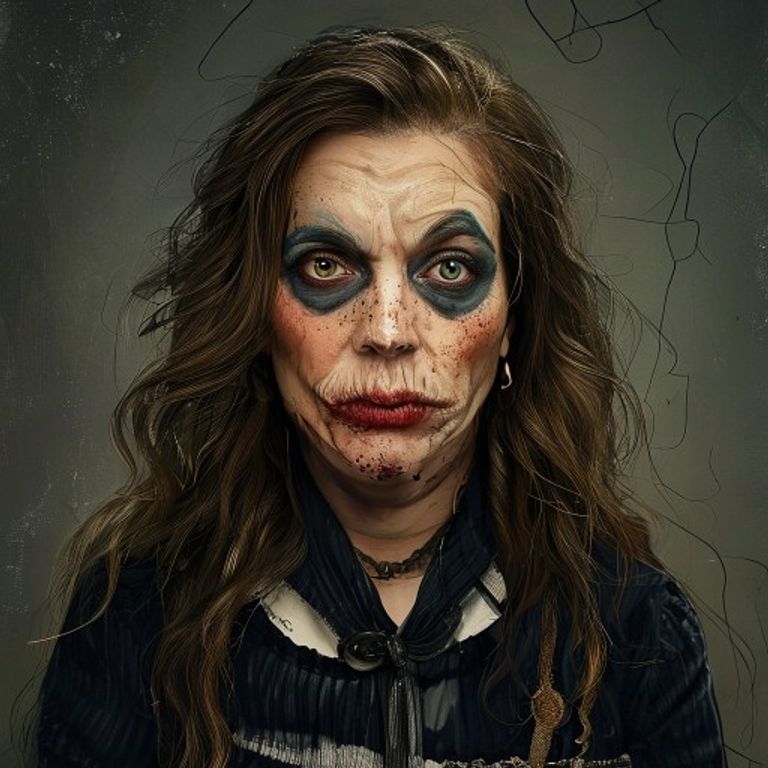
A notorious serial killer mutilated and terrorized women in the foggy, dark streets of Whitechapel in London without ever being caught by the police.
⚠️ Research elaborated with the aid of Deep Research is subject to referential ambiguity.
🖥️Clean HTML code using a proprietary tool.
👥 Research by Guilherme Felipe, Curation by Sílvio Lôbo
Jack the Ripper: A Dark Echo in Whitechapel
The autumn of 1888 brought with it a chilling terror that would settle upon the dark, labyrinthine streets of Whitechapel, in London's East End. The name that would echo through the centuries, personifying the most insidious evil, would be that of Jack the Ripper. A serial killer whose identity, motivations, and the exact number of victims remain, to this day, one of the most persistent and disturbing mysteries in criminal history.
The Context and the Incident: The Beginning of the Nightmare in Whitechapel
The district of Whitechapel, in 1888, was a cauldron of poverty, overcrowding, and despair. A place where life was cheap and the line between survival and destitution was thin. It was in this setting that a series of brutal and shocking murders began to terrorize the local population, predominantly women of easy virtue, forced by misery into prostitution.
The first murder widely accepted as the work of the Ripper occurred in the early morning of August 31, 1888. The body of Mary Ann Nichols was found in Buck's Row (now Durward Street). The brutality of the scene, with significant mutilations to the neck and abdomen, shocked the police and the public, signaling the beginning of an unprecedented reign of terror.
Timeline of Key Events
- August 31, 1888: Murder of Mary Ann Nichols in Buck's Row. First victim widely associated with the Ripper.
- September 8, 1888: Murder of Annie Chapman in the courtyard of Hanbury Street. The mutilations become more elaborate, indicating anatomical knowledge.
- September 30, 1888: The night of the "double murder." Elizabeth Stride is found dead in Berner Street, and a few minutes later, Catherine Eddowes is found a few hundred yards away, in Mitre Square, in the City of London. The mutilations on Eddowes are particularly brutal.
- October 1, 1888: A letter sent to the Central News Agency, signed by "Jack the Ripper," claims responsibility for the crimes and includes a piece of human kidney. This letter, and others later, fueled the media frenzy.
- October 9, 1888: Police chief Sir Charles Warren receives a letter titled "From Hell," containing half of a preserved human kidney.
- November 9, 1888: Murder of Mary Jane Kelly in Miller's Court. This is the most brutal and disturbing murder attributed to the Ripper, with the victim's body almost unrecognizable. After this crime, the murders with the Ripper's characteristics abruptly ceased.
Main Theories: Unraveling the Enigma
Over more than a century, countless theories have been proposed to identify the infamous killer. These range from suspects based on circumstantial evidence and testimonies to more audacious speculations, often driven by fame and mystery.
Police and Scientific Theories (Based on Evidence and Investigation)
- Aaron Kosminski: A Polish Jewish immigrant with a history of mental illness, who lived in Whitechapel. He is believed to have been a likely suspect for the police at the time. More recent reports, based on DNA analysis of a shawl allegedly belonging to a victim, have pointed to Kosminski, but this evidence is widely contested by the scientific and forensic community.
- Severin Klosowski (George Chapman): A Polish immigrant who became a notorious poisoner in London years later. The police at the time considered his possible connection to the murders, but the nature of the crimes (mutilation versus poisoning) seemed to be an obstacle to this line of investigation.
- Montague John Druitt: A lawyer and teacher who disappeared and died shortly after the last murder. The police considered him a suspect, but the evidence was scarce and based on a statement from an inspector that was later questioned.
Alternative and Conspiracy Theories
- Royal Conspiracy Theory: Suggests that the killer was a member of the British royal family, possibly Prince Albert Victor (Eddy), grandson of Queen Victoria. The logic behind this theory is that the police would have concealed the killer's identity to avoid a royal scandal. This theory lacks concrete evidence and is widely rejected by historians and criminologists.
- Surgeon/Doctor Theory: Due to the precise mutilations and the anatomical knowledge displayed, it is speculated that the killer was a doctor, surgeon, or butcher. This theory is based on the technical skill with which the cuts were made.
- Artist Theory: Walter Sickert, an impressionist painter, has been suggested as a suspect, particularly due to his paintings depicting scenes of violence and possibly inspired by the murders.
- Female Killer Theories: Although less common, some theories suggest that the killer could have been a woman, possibly a midwife or nurse who knew anatomy and could have acted out of revenge or ideological motives.
Paranormal Theories
While not based on traditional investigative methods, some theories suggest the involvement of supernatural forces or non-human entities, driven by the terror and inexplicability of the crimes.
Controversies and Blind Spots: Ignored Clues and Investigation Failures
The investigation of Jack the Ripper was marked by a series of challenges and contradictions, many of which are reflected in police reports and accounts from the time.
- Number of Victims: The exact number of victims attributed to the Ripper is a point of debate. While the "canonical five" (Nichols, Chapman, Stride, Eddowes, Kelly) are widely accepted, other murders in Whitechapel at that time were speculatively linked to him, but without concrete proof.
- Missing or Ignored Evidence: There are reports that some important evidence may have been lost or not properly analyzed, which would have hampered the investigation.
- Communication with the Killer: The series of letters sent to the press and police, some signed by "Jack the Ripper," generated a media frenzy, but the authenticity of many of them is questioned. The police at the time even believed some letters were fake.
- Contradictions in Testimonies: Key witnesses often presented conflicting descriptions of the suspect, making it difficult to create a reliable profile. The lack of effective communication between different police departments (Metropolitan Police and City of London Police) was also a significant obstacle.
- The Role of the Press: The sensationalist coverage by the press contributed to the spread of fear and the creation of the "Jack the Ripper" myth, making the investigation more complex and pressured.
Curiosities and Legacy: An Icon of Eternal Fear
The case of Jack the Ripper has transcended time, becoming an icon of popular culture, an archetype of the serial killer, and a lasting symbol of inexplicable fear.
- Cultural Impact: The Ripper has inspired countless books, films, plays, and documentaries, fueling a constant fascination with the mystery of his identity. His figure has become synonymous with urban terror and fruitless police investigations.
- Forensic Science: The case, despite its limitations, spurred the development of forensic science. The need to identify and capture an elusive criminal led to improvements in evidence collection and analysis techniques.
- Current Status: The case remains officially unsolved. Although the police at the time had suspects, no formal charges were ever filed, and the files, for the most part, were archived as unsolved. A formal reopening of the case is unlikely, but speculation and academic research remain active, keeping the flame of mystery alive. The identity of Jack the Ripper remains a dark echo in the streets of Whitechapel, an enigma that refuses to be fully unraveled.





