



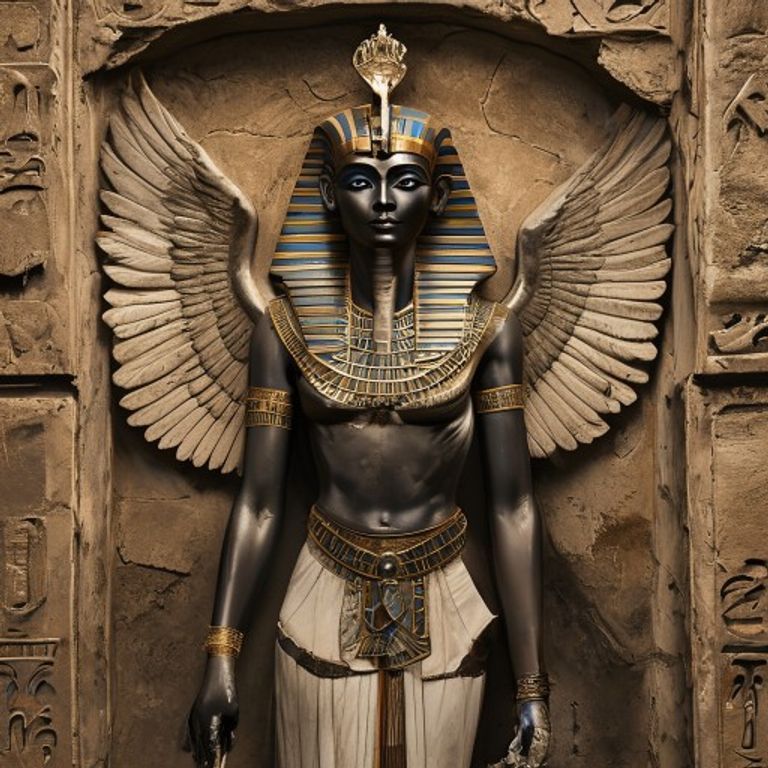
The final resting place of the famous Egyptian queen and Roman general Mark Antony remains one of the most sought-after and elusive archaeological finds in all of human history.
⚠️ Research elaborated with the aid of Deep Research is subject to referential ambiguity.
🖥️Clean HTML code with the use of a proprietary tool.
👥 Research by Guilherme Felipe, Curation by Sílvio Lôbo
The Enigma of Cleopatra's Tomb: A Legacy Lost in the Sands of Time
For millennia, the name of Cleopatra VII has resonated with fascination and mystery. Queen of Egypt, lover of Julius Caesar and Mark Antony, her life and death were shrouded in legend. But what happened after her tragic departure? Where do her mortal remains lie? The "Case of Cleopatra's Tomb" is not a modern crime with forensic clues and flesh-and-blood suspects, but rather a historical and archaeological puzzle of monumental proportions, a mystery that challenges historians, archaeologists, and, for some, even the supernatural.
This article aims to unravel what is known, what is speculated, and what remains obscure about one of antiquity's most enduring enigmas: the whereabouts of the last royal tomb of Ptolemaic Egypt.
1. The Context and the Incident: Where the Mystery Began
The mystery of Cleopatra's tomb is not an "incident" in the traditional sense, but rather the absence of a definitive and unquestionable burial site. The end of the Egyptian queen's life occurred in Alexandria in 30 BC, after the defeat of her forces by Octavian (later Emperor Augustus).
Historical tradition, based on accounts by Plutarch and Dion Cassius, suggests that Cleopatra and her lover, Mark Antony, who had also died, were buried together in a grand tomb, ordered by herself. The exact location, however, has never been clearly identified or conclusively marked in historical records. The fall of Egypt under Roman rule and the subsequent change in power and administration of the city of Alexandria contributed to the obliteration of many important landmarks, including, possibly, the royal tomb.
2. Timeline of Crucial Events
- 30 BC: The defeat of Mark Antony and Cleopatra against the forces of Octavian at Actium.
- August 30 BC: The death of Mark Antony, followed shortly after by the death of Cleopatra in Alexandria. It is believed she committed suicide, possibly by the bite of an asp (venomous snake), to avoid the humiliation of being paraded in a Roman triumph.
- Roman and Byzantine Periods: Sparse historical accounts mention a joint tomb for Cleopatra and Antony, but without precise geographical details. The location seems to have become increasingly obscure over the centuries and with the urban transformations of Alexandria.
- 19th and 20th Centuries: Numerous archaeological expeditions and treasure hunts in Egypt, focused on Alexandria and its surroundings, failed to locate Cleopatra's tomb.
- Present Day: The whereabouts of the tomb remain one of archaeology's great unsolved mysteries.
3. Main Theories: Seeking Answers in Multiple Scenarios
The absence of concrete evidence has fueled a myriad of theories, ranging from the plausible to the purely speculative.
3.1. Scientific and Archaeological Hypotheses
- The Tomb in Alexandria, but Submerged or Destroyed: The most widely accepted theory among historians is that the tomb existed in Alexandria but was lost to time and the geological changes of the region. Alexandria, a port city, has suffered from coastal erosion and rising sea levels over the centuries. Large parts of the ancient city are, in fact, submerged. The tomb could have been destroyed by natural events, such as earthquakes, or intentionally dismantled and its materials reused, as was common in Roman times.
- The Site Was Less Monumental Than Imagined: It is possible that the tomb was not the colossal monument one would expect for a queen like Cleopatra. The need for discretion, especially in the face of Octavian's rising power, may have led to a more modest burial site, which would have been more easily erased from history.
- Future Discoveries: With the advancement of archaeological prospecting technologies (such as sonar, ground-penetrating radar) and the continuous scrutiny of known and yet-to-be-explored archaeological sites in Alexandria, the hope for a future discovery persists.
3.2. Alternative and Conspiracy Theories
- Tomb in Another Location: Some theories suggest that the tomb could be outside Alexandria, in a secret location chosen by Cleopatra or her most loyal followers. Locations such as the Nile Delta or even Rome itself have been speculated, although without any solid documentary or archaeological basis.
- Cleopatra's Escape: A more fanciful but recurring theory in popular culture is that Cleopatra did not die in 30 BC but rather faked her death and fled to a safe haven, taking treasures and possibly political secrets with her. Her remains would be in a tomb somewhere "unknown" because she would be alive.
- The Roman Conspiracy to Erase Cleopatra: The idea that Octavian, in his quest to consolidate his power, deliberately erased any trace of Cleopatra's tomb to extinguish her memory and legacy. This would explain the lack of concrete information.
3.3. Paranormal or Mystical Theories
Although without any scientific or factual basis, the mystery of Cleopatra's tomb frequently attracts speculation of a paranormal nature:
- Mystical Protection: Some believe that the tomb is protected by curses or supernatural forces that ward off curious individuals and desecrators.
- Extraterrestrial Concealment: In more esoteric circles, theories involve the concealment of the tomb by advanced civilizations or extraterrestrials who may have had contact with Cleopatra.
4. Controversies and Blind Spots: Gaps in Historical Investigation
The main blind spot in the "Case of Cleopatra's Tomb" is the absence of primary and definitive evidence. The most detailed historical accounts of her death come from authors who wrote decades or centuries after the events, based on sources that may have been lost or distorted.
- Confidential Accounts: Plutarch, for example, relied on stories that circulated but was not present in Alexandria at the time. His description of the suicide and the desire for a joint burial is the most detailed, but still subject to interpretation.
- Focus on Other Discoveries: Archaeology in Alexandria has, over the years, been more successful in unearthing temples, palaces, and other remnants of daily life in the Ptolemaic and Roman city, but the royal tomb, if not destroyed, has remained elusive.
- Scarcity of Roman Records: Octavian, after consolidating his power, had every interest in erasing Cleopatra's memory as a threat and rival. The deliberate absence of detailed mentions of her burial's fate in official Roman archives can be interpreted as a political strategy.
- Lost Evidence: The very dynamic nature of Alexandria, with its history of fires (like that of the Library of Alexandria), invasions, and reconstructions, means that countless material and documentary evidences from antiquity have been irretrievably lost.
5. Curiosities and Legacy: An Enigma That Continues to Fascinate
The case of Cleopatra's tomb transcends the boundaries of history and archaeology, permeating popular culture indelibly.
- Inspiration for Fiction: The legend of the lost tomb has inspired countless books, films, and documentaries, fueling the fascination with the Egyptian queen and the search for lost treasures.
- The Symbol of Elusive History: The mystery of Cleopatra's tomb has become a symbol of the fragility of historical memory and the difficulty of fully unraveling the past.
- Constant Search: Despite centuries of searching, the case has not been officially "reopened" or "closed," as there has never been a formal investigation to be concluded. It remains an open field for research, speculation, and the hope of a discovery that could finally shed light on the fate of Egypt's last great pharaoh.
- A Legacy of Mystery: Just as her life was marked by intrigue and passion, Cleopatra's death and the whereabouts of her tomb are a final testament to a legacy that, even after two millennia, still eludes us, maintaining its aura of mystery and power.





