



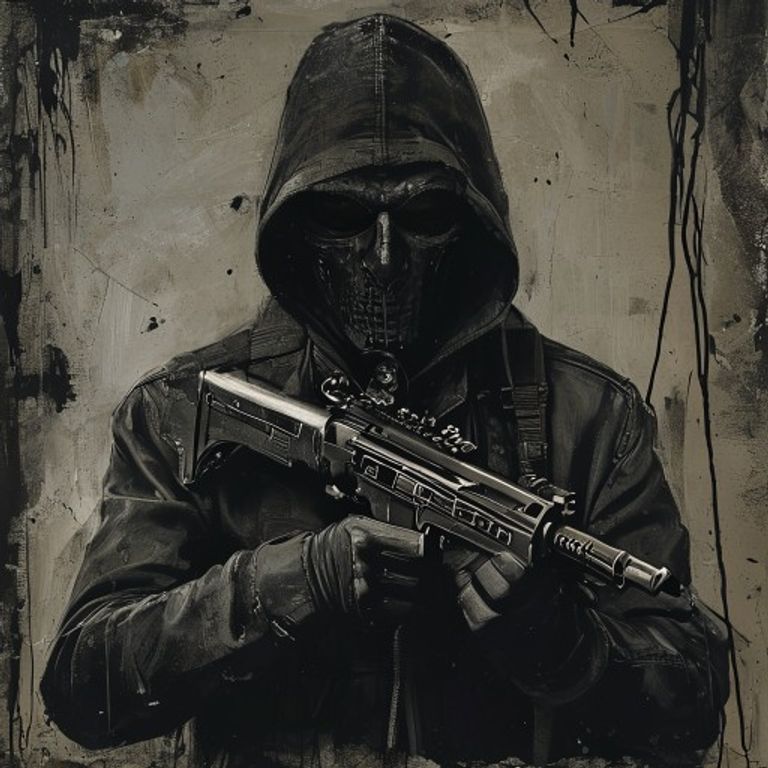
A hooded criminal attacked several couples on isolated roads on the Texas-Arkansas border in 1946, serving as inspiration for the famous urban legend of the 'hook man'.
⚠️ Research conducted with the aid of Deep Research is subject to referential ambiguity.
🖥️Clean HTML code using a proprietary tool.
👥 Research by Guilherme Felipe, Curation by Sílvio Lôbo
The Whisper of the Night: Unraveling the Mystery of the Texarkana Moonlight Killer
By [Your Name/Senior Investigative Journalist Pseudonym]
The night in Texarkana, Texas, was rarely marked by fear before 1946. A quiet town, immersed in the routine of the post-war era, saw its sleep torn apart by a shadow that crept through the suburban streets, leaving a trail of terror and unanswered questions. The case of "The Moonlight Killer" became one of the darkest and most persistent unsolved mysteries in American criminal history, an enigma that the police struggled to decipher, and which endures in the community's memories and dusty archives to this day.
1. The Context and the Incident: Where, When, and How the Mystery Began
Texarkana, divided by the river and the state line between Texas and Arkansas, was a place where life unfolded at a calm pace. However, in the spring of 1946, this serenity was brutally interrupted. Fear took hold as a series of violent and brutal attacks began to plague the city, perpetrated by an unknown assailant whose actions were often associated with the presence of the full moon or nights of intense moonlight. The attacks were characterized by atrocious cruelty, often involving rape and homicide, leaving victims in disfigured states.
The nature of the attacks, the apparent selectivity of the victims, and the audacity of the criminal created widespread panic. Authorities found themselves facing an elusive adversary, capable of appearing and disappearing in the shadows of the night without leaving conclusive clues. The name "Moonlight Killer" was born not only from the temporal coincidence of the crimes with the moon phases but also from the atmosphere of dread that the night, once a refuge, came to represent.
2. Timeline of Events
The chronology of the crimes is crucial to understanding the escalation of terror and the investigation attempts:
- January 1946: The first signs of unusual activity begin to emerge, although they were not initially linked to each other.
- February 1946: The violent nature of the attacks becomes more apparent with incidents that shock the community.
- March 14, 1946: The first attack widely recognized as the work of the "Moonlight Killer." Betty Lou Edmonds and Richard May are attacked in their car, a common spot for young couples at the time. Edmonds survives and describes an attacker, but the description is vague.
- March 22, 1946: Margaret and Charles Estes are attacked. Margaret is severely injured. The brutality of the attacks increases the urgency of the investigation.
- April 10, 1946: The first homicide. Vera Sue Wood is murdered in her home. The crime is shocking due to its violence and invasion of privacy.
- April 24, 1946: Mary Jeanne Larey and her fiancé, Floyd Powell, are attacked. Larey, injured, manages to escape and alert the authorities.
- May 3, 1946: Kathryn and Charles Griffin are attacked. Both die. This becomes one of the most brutal and complex cases.
- May 6, 1946: Peggy and Virgil Allen are attacked in their car. Peggy dies. Investigations intensify.
- May 22, 1946: Emma Lou Smith is attacked. She survives and provides crucial, though confused, descriptions of the assailant.
- Fall 1946: The attacks abruptly cease. The "Moonlight Killer" disappears as mysteriously as he appeared.
3. Main Theories
Over the decades, numerous theories have been proposed to explain the identity and motive of the Moonlight Killer. Some are based on police investigations, others on speculation, and in some cases, on conspiracy theories:
Most Probable Police and Scientific Theories
- A single aggressor with specific patterns: The police's initial hypothesis. The aggressor acted alone, possibly in moments of impulsivity or under severe psychological stress. The victims appeared to be young couples or lone women, suggesting a pattern of opportunity or a sexual preference. The lack of advanced forensic expertise at the time makes confirmation difficult.
- The criminal moved away or was arrested for other crimes: The most pragmatic theory. The killer may have left the region, changed identity, or been detained for unrelated crimes that were not connected to the Texarkana case. Declassified reports mention the investigation of several suspects, but none were conclusively linked.
Alternative and Conspiracy Theories
- A group of criminals: While less likely due to consistency in certain aspects of the attacks, the possibility of more than one assailant acting together was not entirely ruled out, especially in crimes where brute force was evident.
- Involvement of prominent local figures: A recurring conspiracy theory, fueled by the silence and apparent ineffectiveness of the investigation. It suggests that someone with influence in the community may have been protected or that the investigation was intentionally suppressed to avoid scandal. This theory lacks any concrete evidence.
- Complex psychological motivations: Psychiatrists and criminologists speculate about personality disorders, paraphilias, and the possibility that the killer had a hidden history of violence. The lack of access to detailed psychological profiles from the era limits this analysis.
Paranormal Theories
- Supernatural or alien intervention: Although popular in mystery circles, these theories are not based on any factual or scientific evidence. The frequency of attacks on nights with intense moonlight may have been a coincidence or a biased observation that fueled local folklore. There is no mention in official reports of supernatural elements.
4. Controversies and Blind Spots
The investigation of the Moonlight Killer was marked by failures and ambiguities that allowed the mystery to persist:
- Conflicting witness descriptions: The physical descriptions of the assailant varied considerably among survivors, often due to trauma and fear. This made creating a reliable composite sketch a challenge.
- Lack of advanced forensic expertise: In 1946, forensic techniques were rudimentary. The collection and analysis of DNA, detailed fingerprints, and other crucial evidence were limited, preventing the definitive identification of the criminal.
- Suspects not adequately investigated: There are allegations that several suspects were identified, but the official investigation was not deep enough to conclusively confirm or dismiss them. One name that frequently emerges is that of Fenton Phillips, a man who mysteriously disappeared and whose movements at the time of the crimes are nebulous. However, no concrete evidence has linked him to the murders.
- Lost or uncollected evidence: It is plausible that, with the passage of time and the lack of resources at the time, important evidence that could have been collected at the crime scene was lost or never properly preserved.
- Public pressure and media coverage: Widespread panic generated immense pressure on the police to find the culprit, which, in some cases, may have led to less methodical approaches and more focus on "solving the case" quickly.
5. Curiosities and Legacy
The impact of the Moonlight Killer on Texarkana was profound and lasting. The city lived under a veil of fear for months, and the psychological scars left by the crimes endure:
- Cultural impact: The case has inspired books, documentaries, and countless conspiracy theories, becoming an icon of American criminal folklore. The figure of the Moonlight Killer has become an archetype of nocturnal terror and anonymous evil.
- The "Curfew Law": During the height of the panic, many families imposed a voluntary curfew on their children, and police presence on the streets increased dramatically.
- Current status of the case: The Texarkana Moonlight Killer case remains officially unsolved. While there may have been informal investigations over the years and renewed public interest, there is no indication that it has been officially reopened with new conclusive evidence.
- The "ghost" of Texarkana: The uncertainty about the criminal's identity has allowed him to become an almost mythical figure, a specter that haunts the city's history, a grim reminder that, sometimes, evil hides in plain sight, or in this case, under the moonlight, and escapes without a trace.
The Texarkana Moonlight Killer is more than just a criminal case; it is a case study on the limits of investigation, the fragility of security, and the enduring power of mystery when answers are lost in the shadows of history. The moonlight, once synonymous with romance and tranquility, became forever associated with fear and a question that echoes through the decades: who was the man who terrorized Texarkana, and why?





