



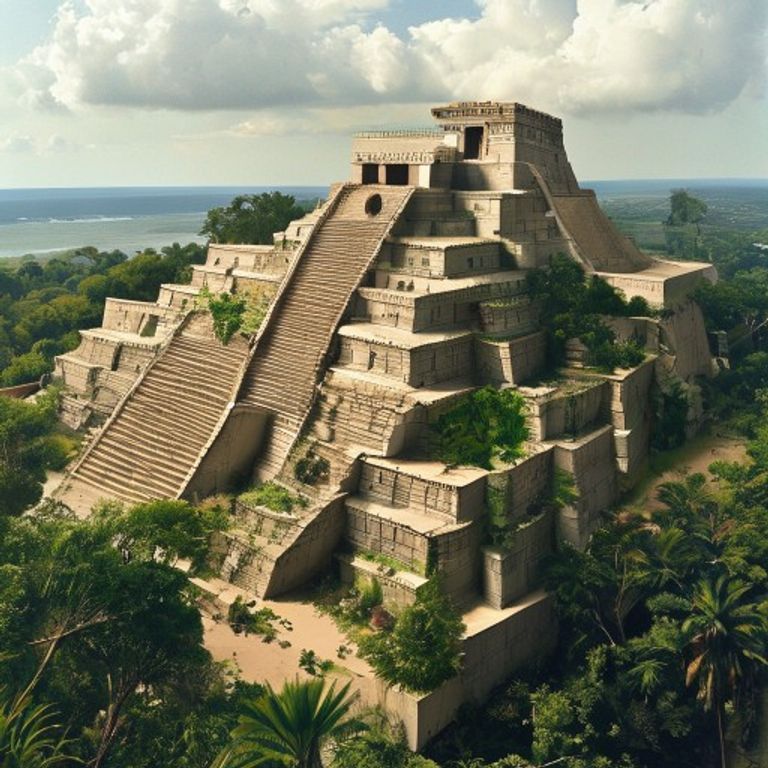
A monumental Mesoamerican city filled with perfectly aligned pyramids was built by a mysterious ancient civilization long before the arrival of the Aztecs.
⚠️ Research elaborated with the aid of Deep Research is subject to referential ambiguity.
🖥️Clean HTML code using a proprietary tool.
👥 Research by Guilherme Felipe, Curation by Sílvio Lôbo
The Teotihuacan Enigma: A Silent Echo in the Pyramid of Souls
In the heart of Mexico, where ancient dust carries secrets and the wind whispers through ancestral monuments, lies a mystery that transcends time and human understanding. The Teotihuacan Case, as it is subtly known in circles investigating unsolved cases, does not refer to a modern crime, but to an event that, according to accounts and vestiges, may have silenced an entire civilization, leaving behind only whispers in stone and the eternal question about the fate of its inhabitants.
1. The Context and the Incident: An Abrupt End in a Flourishing Empire
The city of Teotihuacan, meaning "place where men become gods" in Nahuatl, flourished on a monumental scale in the central region of Mexico, reaching its peak between the 1st and 7th centuries AD. It was a vibrant metropolis, a cultural, religious, and economic center of Mesoamerica, rivaling Rome in size and influence. However, around the 6th or 7th century AD, this grand civilization suffered an abrupt and inexplicable collapse. There were no signs of large-scale invasion, nor a gradual and predictable decline. The city, for the most part, was abandoned, with many of its buildings left intact, as if its inhabitants had simply vanished in an instant.
The "incident" that gave rise to the mystery is not a singular, dated event, but the very mass disappearance. Archaeological evidence suggests a rapid social disintegration, marked by signs of ritualistic violence and widespread fires in specific areas of the city, notably around the Citadel and the Pyramid of the Sun. The absence of large-scale human remains, in contrast to the visible destruction, is one of the pillars of this enigma.
2. Timeline of Events: The Deconstruction of an Empire
Although an exact timeline is impossible to trace due to the nature of the collapse, archaeological evidence allows us to infer a sequence of events:
- 1st to 6th Centuries AD: Peak of Teotihuacan. The city reaches its maximum extent and power, with the construction of the monumental Pyramid of the Sun, Pyramid of the Moon, and Avenue of the Dead.
- Around the 6th/7th Century AD: Beginning of the decline. Archaeological evidence indicates an increase in social tension and internal conflicts. There are signs of vandalism against temples and statues of deities, suggesting a crisis of faith or a revolt against the ruling elite.
- Period of Collapse (imprecise dating): Widespread fires. Specific sectors of the city, especially the centers of power and religion, are set ablaze. The nature and extent of these fires are crucial points of debate.
- The Great Silence: Abandonment of the city. The population drastically decreases or disappears. The abandonment is not accompanied by signs of prolonged warfare or planned evacuation.
- Post-Collapse: Teotihuacan becomes a ruin. Other Mesoamerican cultures, such as the Toltecs and Aztecs, come to venerate the site and attribute its construction to mythical beings or a previous generation of "giants."
3. Main Theories: Unveiling the Veils of the Past
The collapse of Teotihuacan has been the subject of intense research and speculation, generating a range of theories, from the most scientifically solid to the most fantastic:
3.1. Scientific and Archaeological Hypotheses
- Drought and Agricultural Crisis: The most accepted theory suggests that a prolonged and severe drought affected the region, devastating agriculture and leading to famine, social disorder, and the eventual abandonment of the city due to resource scarcity. Paleoclimatic evidence corroborates periods of intense drought at the time.
- Social Conflicts and Internal Revolt: The destruction of symbols of power and ritualistic violence may indicate a revolt of the oppressed classes against the theocratic elite or an internal civil war. The possibility of minor external invasions, which took advantage of an already weakened society, is not ruled out.
- Climate Change and Environmental Degradation: In addition to drought, other climate changes may have impacted the local ecosystem, making the city's sustainability unsustainable. Deforestation for construction and fuel may also have played a role.
- Epidemic: Although there is no direct evidence of a major pandemic, a devastating disease could have decimated the population, leading to the collapse of social order.
3.2. Alternative, Conspiracy, or Paranormal Theories
- Extraterrestrial Intervention: Some conspiracy theorists suggest that the civilization of Teotihuacan was "collected" by extraterrestrial beings, explaining the sudden disappearance and the absence of signs of struggle. The astronomical precision in their constructions is often cited as evidence of advanced knowledge.
- Dimensional or Temporal Displacement: More esoteric theories propose that the inhabitants of Teotihuacan may have discovered a way to travel to other dimensions or to the future/past, using some kind of technology or energy portal hidden within their structures.
- Unexplained Natural Cataclysm: The idea of a sudden and devastating natural event, such as an earthquake of epic proportions or an unrecorded meteor impact, that would have decimated the population without leaving obvious traces in some areas.
- The Curse of the Gods: Religious and mystical interpretations suggest that divine displeasure or a curse cast upon the city led to its abrupt end.
4. Controversies and Blind Spots: The Elusive Clues
The Teotihuacan Case is full of controversies and blind spots that fuel debate and prevent a definitive conclusion:
- The Nature of the Fires: Excavation reports, such as those conducted by Alfredo Barrera Rubio and Ruben Cabrera, document extensive fires, particularly in the Citadel and the Pyramid of the Sun. However, the origin of these fires – whether they were accidental, intentional acts of ritualistic destruction, or part of a conflict – remains obscure. The lack of evidence of large-scale warfare weapons also raises doubts.
- The Absence of Human Remains: One of the greatest enigmas is the scarcity of human remains compared to the estimated population of the city at its peak. If there was an epidemic or a conflict, where are the dead? Some discoveries of specific burials, such as those found in ritual offerings, do not explain the disappearance of thousands of inhabitants.
- Vandalism and Symbolic Destruction: The deliberate destruction of statues and altars, particularly of deities like the Water Goddess (Chalchiuhtlicue) and the Storm God (Tlaloc), suggests a profound religious or social crisis, but the exact extent and motive remain ambiguous.
- Ignored or Lost Clues: Over decades of excavations and research, it is plausible that some crucial evidence may have been misinterpreted, lost, or discarded without due attention. The lack of a complete and unified record of all discoveries may be a significant obstacle.
- Subsequent Testimonies and Records: Although the Aztecs found Teotihuacan in ruins and wrote about it, their narratives are laden with myths and legends, making it difficult to separate fact from fiction regarding the original founding and collapse.
5. Curiosities and Legacy: The Eternal Whisper
The Teotihuacan Case is not just an archaeological mystery; it is a powerful symbol of the fragility of civilizations and humanity's capacity for self-destruction or succumbing to greater forces.
- Cultural Impact: Teotihuacan continues to fascinate the world. Its architectural grandeur and the enigma of its end inspire books, documentaries, and academic debates. The site is a UNESCO World Heritage Site, attracting millions of visitors who seek to connect with this ancient greatness.
- Current Status: The Teotihuacan case has not been "reopened" in a police sense, as it does not involve a modern crime. However, archaeological research remains active, with new technologies and analytical methods seeking to shed more light on the collapse. Each new discovery is a fragment added to a colossal puzzle.
- The "Pyramid of Souls": A nickname given by some researchers to the Pyramid of the Sun, unofficially, due to theories of disappearance and the mystical energy that the site emanates.
- Similar to Other Collapses: The mystery of Teotihuacan echoes other ancient civilization collapses, such as the Maya and Easter Island, raising universal questions about the limits of growth and historical cycles.
Until new evidence emerges from the depths of the earth or science offers us new tools of interpretation, the fate of Teotihuacan's inhabitants will remain one of the most persistent and intriguing enigmas in human history. The city, once a beacon of civilization, is today a silent monument to an end that we have not yet fully comprehended.





