



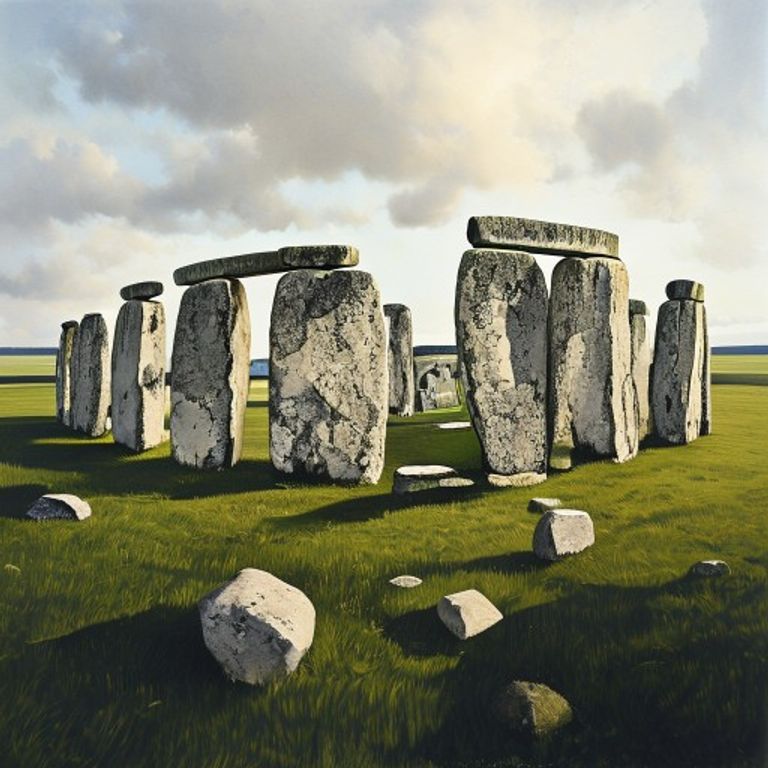
A monumental stone circle weighing tons was erected on the English plain in prehistoric times, and the method of transporting the enormous blocks and the purpose of the site remain obscure.
⚠️ Research conducted with the aid of Deep Research is subject to referential ambiguity.
🖥️Clean HTML code using a proprietary tool.
👥 Research by Guilherme Felipe, Curation by Sílvio Lôbo
Stonehenge: The Stone Enigma That Defies Time and Reason
Stonehenge, the colossal prehistoric stone circle erected in the heart of Wiltshire, England, is not merely a testament to ancient human ingenuity but also a stage for one of history's most enduring mysteries. While most of the fascination surrounding Stonehenge centers on its construction and purpose, a specific event, a peculiar incident involving its preservation and interpretation in the 20th century, casts a shadow of mystery over its modern history. This article investigates the "Stonehenge Case," an informal term for the controversies, theories, and blind spots that surround the understanding and protection of this iconic site.
1. The Context and the Incident: Where, When, and How the Mystery Began
The mystery surrounding Stonehenge is not a single, unique event like in a common crime, but rather a constellation of interconnected enigmas that have accumulated over centuries. The site itself, dating from approximately 3000 BC to 2000 BC, evokes questions about its origin, function, and the construction methods used by its anonymous creators. However, when we speak of an "incident" in the more journalistic sense, the focus shifts to the interpretations and actions taken in more recent eras, especially from the 19th century onwards, when scientific and public interest in the monument intensified.
The "mystery began" to form with the first attempts to explain Stonehenge in scientific terms, gradually moving away from Arthurian legends and popular Druidic associations, but not without leaving behind a legacy of speculation. The excavations and research carried out over the centuries, often with less rigorous methods by current standards, raised more questions than answers, introducing inconsistencies and "blind spots" that have persisted. The incident, therefore, is the persistent inability of science to provide a complete and incontestable narrative about the site.
2. Timeline of Events (Key Interpretations and Discoveries)
While there isn't a specific "incident" like a crime with victims and suspects, the timeline of the "Stonehenge Case" is marked by archaeological discoveries, proposed theories, and controversies related to its preservation:
- Neolithic and Bronze Age (c. 3000 BC - 1500 BC): Construction and remodeling of the monument in various phases. The exact purpose and construction methods remain a mystery.
- Antiquity and Middle Ages: Stonehenge is associated with legends, such as that of Merlin and the giants who supposedly transported the stones from Hy Brasil (account by Geoffrey of Monmouth, c. 1136).
- 17th Century: John Aubrey proposes a Druidic origin in his work "Monumenta Britannica," a theory that would gain traction later.
- 18th Century: William Stukeley, one of the first to conduct systematic studies, reinforces the connection with the Druids and describes the site in more detail.
- 19th Century: Initial excavations, such as those by William Cunnington, begin to unearth artifacts, but with interpretations often influenced by prevailing theories.
- 1901: The first major scientific excavation under the direction of William Flinders Petrie, using more modern methods, reveals new information about the structure and construction phases.
- 1919-1926: Excavations by Lt. Colonel William Hawley reveal the "Bird Track" and the "Circular Ditch," but his conclusions about the final construction phase are contested.
- 1950s: Radiocarbon dating studies provide more accurate estimates of the ages of different phases.
- 1950s-1960s: Fred Hoyle's controversial theory of Stonehenge as an astronomical observatory gains popularity.
- 1970s and 1980s: Increased awareness of the importance of preservation and the emergence of counter-culture movements claiming the site, such as the "Wanderers of Stonehenge" and modern Druids.
- 1980s: Incidents of vandalism and the need for greater access control lead to restrictions on direct circulation within the monument.
- 2000s onwards: Advances in technologies such as LiDAR and ground-penetrating radar allow for new visualizations of the subsurface and surrounding structures, revealing a much larger landscape complex than previously imagined.
3. Main Theories (Scientific, Alternative, and Paranormal)
Attempts to unravel the purpose of Stonehenge have resulted in a range of theories, each with its logic, evidence (or lack thereof), and degree of scientific acceptance.
Scientific and Archaeological Theories:
- Astronomical Observatory: Popularized by Fred Hoyle and supported by Gerald Hawkins, this theory suggests that Stonehenge was built to predict astronomical events such as solstices and equinoxes. The accuracy of the alignment of certain stones with the rising sun on the summer solstice is often cited as evidence. However, critics point out that statistical randomness may explain some of the alignments.
- Healing Site: Recent excavations have revealed evidence of individuals with injuries and illnesses who were healed at Stonehenge, suggesting the site may have been a pilgrimage center for healing. The bluestones from Preseli Hills, from which some stones were transported, are known for their healing properties in Welsh folk tradition.
- Site of Rituals and Ceremonies: This is the most widely accepted theory and encompasses various possibilities. Stonehenge could have served as a center for religious rituals, rites of passage, harvest celebrations, or fertility rites. The presence of human remains and offerings suggests a sacred role.
- Territorial Marker and Center of Power: The monumental construction could have been a demonstration of power and social organization by a specific community or tribe, marking their territory and sphere of influence.
- Ancestry and Life Cycles: The connection between the dead and the living, and the celebration of the cycles of birth, life, and death, may have been a central component of its function, linking the monument to the landscape and generations.
Alternative and Paranormal Theories:
- Druidism: Although the direct link to Iron Age Druids is questioned by archaeology (the stones were erected millennia earlier), the theory of Aubrey and Stukeley has persisted. Modern Druids continue to use Stonehenge for their ceremonies, but there is no archaeological evidence directly connecting them to its construction.
- Aliens and Advanced Technology: A popular theory in pop culture, but without any scientific basis, posits that extraterrestrial beings used advanced technology to build Stonehenge, given the difficulty of transporting and erecting the stones without modern tools.
- Lost Civilizations (Atlantis, etc.): Similarly, some theories suggest that advanced ancient civilizations, such as Atlantis, could have been responsible for the construction.
4. Controversies and Blind Spots
The investigation and interpretation of Stonehenge are fraught with controversies and gaps that fuel the mystery:
- Construction Methods: The exact way in which the enormous stones (some weighing over 40 tons) were transported over hundreds of kilometers and erected remains an enigma. Theories range from wooden sleds and rollers to earth ramps, but no definitive explanation satisfies everyone.
- Contradictory Interpretations of Excavations: The conclusions of excavators like Lt. Colonel William Hawley were later contested by archaeologists such as Professor G.P. Grigson, who questioned the chronology and construction phases identified. This led to debates about the reliability of some collected reports and evidence.
- Loss of Evidence: Over time and through initial excavations, it is possible that important artifacts were lost, miscataloged, or destroyed, resulting in significant gaps in the archaeological record.
- Influence of Popular Legends: Arthurian and Druidic legends, although lacking concrete evidence, profoundly influenced early scientific interpretations, distorting objectivity in some cases.
- The Surrounding Landscape: For a long time, the focus was solely on the monument itself. Recent discoveries of a vast complex of settlements, roads, and other monuments around Stonehenge reveal that the site was part of a much larger ritualistic landscape, whose full purpose is still unknown.
5. Curiosities and Legacy
The legacy of Stonehenge is immense, shaping culture and popular imagination in profound ways.
- Cultural Impact: Stonehenge has inspired countless works of art, literature, music, and film. It has become a symbol of England and a global icon of mysterious antiquity. Every summer solstice, it attracts thousands of visitors, including Druids and neopagans seeking to reconnect with ancient traditions.
- Current Status: Stonehenge is a UNESCO World Heritage Site and one of the UK's most visited monuments. Since the late 20th century, rigorous preservation measures have been implemented, including the construction of a visitor center and the restriction of direct access to the monument to protect it from mass tourism and vandalism.
- Continuous Investigations: Although the "case" has not been reopened in a forensic sense, archaeological research and investigation into Stonehenge have never ceased. New technologies continue to unveil layers of mystery, but it is likely that the fundamental enigma of its purpose and construction will remain, fueling fascination with this unique place. The "Stonehenge Case" is not a crime to be solved, but a perpetual investigation into the depths of the human past and the mind's capacity to unravel the unknown.





