



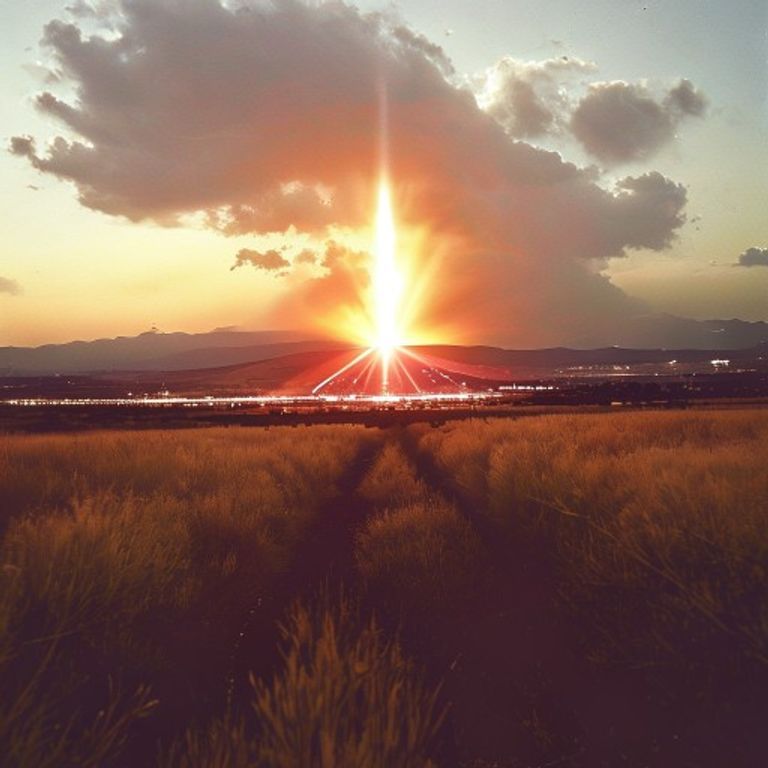
The alleged crash of a flying saucer in New Mexico generated the biggest government and alien cover-up theory in history.
⚠️ Research elaborated with the aid of Deep Research is subject to referential ambiguity.
🖥️Clean HTML code using a proprietary tool.
👥Research by Guilherme Felipe, Curation by Sílvio Lôbo
Roswell: The Debris That Changed the World or Just a Broken Balloon?
The New Mexico desert, in July 1947, was the stage for an event that, decades later, would continue to fuel heated debates, conspiracy theories, and popular imagination. What began as a report of an unidentified flying object (UFO) sighted by a local rancher quickly turned into one of the greatest unsolved mysteries of modern history: the Roswell Incident.
The Context and the Beginning of the Mystery
In early July 1947, the Cold War was in its early chapters, and the fear of invasions or advanced technologies was palpable. The region around Roswell, New Mexico, was remote and housed a strategic military base, the Roswell Army Air Field (RAAF). It was on one of its ranches, that of Mr. W.W. Brazel, that something unusual was found.
Brazel, while inspecting his fields after a strong storm, spotted what he described as "pieces of a kind of metallic rubber" and "sparks." He reported the find to local authorities, who, in turn, contacted the RAAF. What followed was a rapid military mobilization, the collection of debris, and an initial official silence that would only increase fascination and speculation.
Timeline of Events: A Crucial Chronology
An accurate reconstruction of the events is one of the biggest challenges in the Roswell case, due to conflicting reports and the evolution of the official narrative over the years. However, an approximate timeline, based on declassified documents and testimonies, can be drawn:
- Early July 1947: A strong storm hits the Roswell area.
- First Week of July 1947: W.W. Brazel finds debris on his ranch.
- July 8, 1947: The Roswell Army Air Field (RAAF) issues a press release stating that it has recovered a "flying saucer." The news makes national headlines.
- July 8, 1947 (same day): General Roger Ramey, commander of the Eighth Air Force, at a press conference in Fort Worth, Texas, presents the wreckage as belonging to a high-altitude weather balloon, part of a secret project called "Project Mogul". He displays photographs of the wreckage, which appear consistent with a balloon.
- Following Days and Weeks: The "flying saucer" story is quickly overshadowed by the official explanation of the weather balloon. Witnesses who reported seeing other objects or who described the debris in an unusual way are ignored or discredited.
- Decades of Silence and Resurgence: The case falls into obscurity for many years, resurfacing in the 1970s and 1980s with renewed interest in UFOs, driven by researchers and the release of books and documentaries that questioned the official version.
- 1990s: The U.S. Air Force releases two reports (1994 and 1997) detailing investigations into the incident, reiterating the conclusion that the debris was from a Project Mogul balloon and suggesting that some reports of "alien bodies" might have resulted from confusion with mannequins used in high-altitude drop tests.
The Main Theories: From Scientific to Paranormal
The Roswell mystery has generated a myriad of theories, each trying to explain the inexplicable. They range from the most conventional explanations to the most fantastic:
Scientific and Official Theories:
- The Project Mogul Balloon: This is the official explanation reiterated by the U.S. Air Force. Project Mogul was a secret high-altitude balloon project designed to detect Soviet nuclear tests. The debris found would have belonged to one of these balloons, made of unusual materials for the time, such as metallic foil and wooden rods with strange symbols (which some claim are hieroglyphs). The theory explains the initial confusion and subsequent cover-up due to the project's secret nature.
- Other Secret Military Projects: In addition to Project Mogul, other hypotheses suggest that the debris could belong to other secret military experiments of the time, such as advanced drones or experimental aircraft, whose knowledge was restricted.
- Confusion with Aircraft Debris: In a post-war period, it is possible that debris from aircraft shot down elsewhere was confused or mixed with the material found, leading to more elaborate reports.
Alternative and Conspiracy Theories:
- Crash of an Extraterrestrial Craft: This is the most popular and enduring theory. It argues that a flying object of non-terrestrial origin crashed or fell in the region. The rapid military mobilization, aggressive cover-up, and witness reports describing unknown technology and even bodies of non-human beings support this hypothesis.
- The Massive Government Cover-Up: A crucial aspect of the alien theory is the belief in an elaborate government cover-up to hide the truth about an extraterrestrial visit. This would involve media manipulation, intimidation of witnesses, and the creation of false stories to mislead public opinion.
- Experiments with Mannequins and Human Beings: Some theories suggest that the "alien bodies" described by some witnesses were actually high-altitude mannequins used in drop tests, or even results of secret medical or military experiments involving humans.
Paranormal Theories:
- Unusual Natural Phenomena: Although less common, some theories attempt to attribute the sighting to rare natural phenomena or optical illusions amplified by the atmosphere and the fear of the time. However, the physical nature of the debris reported by many witnesses makes this explanation difficult.
Controversies and Blind Spots: The Gaps in the Investigation
Despite official efforts to end the debate, the Roswell case is full of controversies and blind spots that fuel skepticism and the continuation of alternative theories:
- The Change in the Official Version: The drastic change from the declaration of a "flying saucer" to a "weather balloon" on the same day generated immediate distrust. Why would the RAAF declare something so extraordinary only to quickly backtrack?
- Destruction or Disappearance of Evidence: Several reports indicate that the collected debris was unusual and possessed strange properties (such as shape memory, resistance to fire, etc.). The claim that much of this debris was destroyed or lost over time raises suspicions about what was actually collected and why it is no longer available for independent analysis.
- Conflicting and Discredited Testimonies: Over the decades, many witnesses who reported seeing debris, craft, or "beings" were discredited, humiliated, or silenced. The testimonies of rancher Brazel, Sheriff George Wilcox, and RAAF personnel often contradicted each other or changed over time, making it difficult to form a unified picture.
- The 1994 Air Force Report: Although it attempted to clarify the incident, the 1994 report was criticized for not addressing all testimonies and for relying on information that was not fully transparent or accessible for external analysis. The explanation of mannequins, for example, emerged only years after the initial reports of alien bodies.
- "The Mystery of the Hieroglyphs": Some of the described debris contained strange markings, which some interpret as hieroglyphs or alien symbols. The official explanation that they were just manufacturing marks from balloons did not convince everyone.
Curiosities and Legacy: The Gaze That Never Tired of Looking at the Sky
The Roswell Incident transcended the realm of historical mystery to become a pillar of pop culture and a lasting symbol of humanity's search for answers about the unknown and the possibility of life on other planets.
- Cultural Impact: Roswell has inspired countless films, television series, books, and documentaries. The city of Roswell, New Mexico, has embraced its legacy, becoming a tourist destination with museums dedicated to the incident and annual "UFO Days" celebrations.
- Continued Investigation and Interest: Despite official reports, the case has never truly been "closed" for many. Groups of independent researchers continue to investigate, unearth documents, and interview potential witnesses, searching for new clues.
- The Power of Narrative: The Roswell case is a fascinating example of how a narrative can evolve and solidify, even in the face of official explanations. The persistence of alternative theories demonstrates the yearning for answers and the distrust of official versions, especially when they involve government secrets.
- The Legacy of Doubt: The Roswell Incident forces us to confront our own limits of knowledge and to question the information presented to us. It reminds us that, in some cases, the questions can be more important and lasting than the answers, leaving a legacy of doubt and an eternal invitation to look at the sky and wonder: are we alone?
To this day, the debris resting in some military file drawer, or what remains of it, continues to be the epicenter of one of the most intriguing debates of the 20th century. The truth about Roswell, whether it be a simple technological failure or a glimpse of something that defies our understanding, remains a persistent enigma, echoing in the vastness of the desert and in the imagination of a world that longs for answers.





