



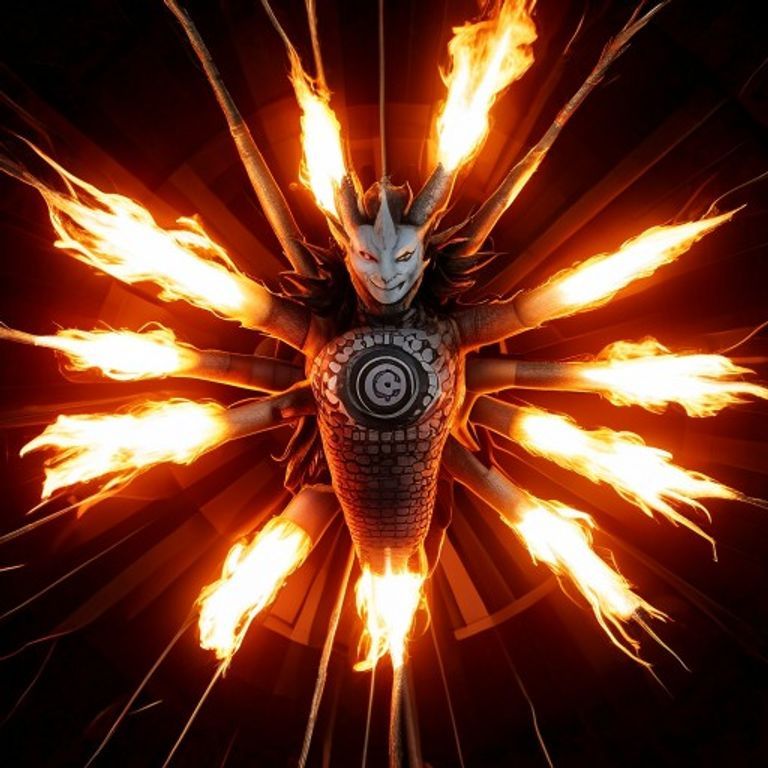
Countless and mysterious glowing spheres silently emerge from the waters of the Mekong River and inexplicably rise into the sky every year.
⚠️ Research conducted with the assistance of Deep Research is subject to referential ambiguity.
🖥️Clean HTML code using a proprietary tool.
👥 Research by Guilherme Felipe, Curation by Sílvio Lôbo
The Whispering Enigma of the Naga Fireballs: An Unsolved Mystery on the Thai Border
The Mekong River, winding majestically through the Southeast Asian landscape, is not merely a channel of life and commerce, but also a stage for one of the 20th century's most persistent and visually spectacular mysteries: the Naga Fireball Incident. What for many is a folkloric tradition, for others represents an inexplicable phenomenon that defies logic and conventional explanations, leaving a trail of fascination and frustration for investigators and the local community.
1. The Context and the Incident: Where, When, and How the Mystery Began
The phenomenon, known locally as "Bang Fai Phaya Nak" (Fireballs of the Naga Lord), gained international notoriety primarily in the Nong Khai province of Thailand, along the banks of the Mekong River. Although stories of luminous apparitions associated with mythical creatures have existed for centuries, it was from the 1970s onwards that the incident began to attract the attention of the media and researchers, especially after the establishment of a more concrete date and location for the observations:
- Location: Primarily the Thai banks of the Mekong River, in provinces such as Nong Khai, Bueng Kan, and Nakhon Phanom.
- Period of Occurrence: Traditionally associated with the end of the third month of the Buddhist calendar (usually in October), coinciding with the end of the rainy season and the disappearance of fog on the river.
- The Nature of the Incident: Witnesses report the ascent of luminous spheres of various colors (usually red, pink, or orange) directly from the Mekong River. These spheres float at different altitudes, some reaching hundreds of meters, before disappearing into the sky. The intensity and number of these appearances vary annually, but the phenomenon attracts thousands of eager spectators each year.
Popular belief attributes these lights to the mythical creature of the Naga, a divine water serpent venerated in Buddhist and Hindu traditions, which, according to folklore, releases these "fireballs" in celebration or as a sign of its presence.
2. Timeline of Events
While the origins of the folklore are ancient, the chronology of the incident as a phenomenon of mass observation and an object of investigation is more recent:
- Previous Centuries: Existence of legends and beliefs about aquatic entities and luminous phenomena in the Mekong River.
- 1970s: Increased media interest and popularization of the event, with more consistent and documented reports of annual appearances. Journalists and researchers begin to actively take an interest in the phenomenon.
- 1990s - 2000s: Several scientific expeditions and independent investigations are conducted, often sponsored by the media or by enthusiasts of paranormal phenomena. The publication of articles and documentaries increases global visibility.
- 2000s - Present: The event becomes an annual tourist attraction, drawing thousands of people. The debate between scientific and supernatural explanations continues, with new theories emerging and old ones being re-examined.
3. Main Theories
The Naga Fireball Incident is fertile ground for speculation, housing a range of theories from pragmatic scientific explanations to more esoteric perspectives:
3.1. Scientific and Police Hypotheses (Most Likely)
- Phosphine and Methane (Dominant Theory): This is the most widely accepted scientific explanation by the academic and investigative community. The theory suggests that the decomposition of organic matter (plants and animals) at the bottom of the river, in low-oxygen conditions, releases gases such as methane (CH₄) and phosphine (PH₃). Phosphine, in particular, is a pyrophoric gas, meaning it can spontaneously ignite upon contact with air. The release of these gases in bubbles rising to the surface could generate the observed luminous apparitions.
- Arguments in favor: Conducive environmental conditions (riverbed rich in organic matter, active decomposition during the rainy season). The color and behavior of the lights can be consistent with gas ignitions.
- Counter-arguments: The consistency of the coloration (often described as a vibrant red) and the altitude reached by the spheres are not always fully explained by this theory. The lack of a strong, characteristic odor of phosphine (although it may not be perceptible in low concentrations) is also a point of questioning.
- Reflections and Optical Illusions: Another scientific explanation considers that the lights could be reflections from external sources (such as boats, distant cities, or even the moon's reflection under specific conditions) which, combined with dense morning fog or light refraction in the water, create the illusion of luminous spheres originating from the river.
- Arguments in favor: Atmospheric and refraction phenomena can create deceptive visual effects.
- Counter-arguments: The consistency of observations over decades and the detailed description of the spheres emerging directly from the water make this theory less convincing for many witnesses.
- Natural Phenomena Related to Volcanic or Geological Activity: Although less likely for the specific region of the Mekong, the possibility of releasing luminous gases or plasma from subterranean geological sources has been raised in other contexts of similar phenomena.
- Arguments in favor: Could explain the "out of nowhere" origin and the intensity of the lights.
- Counter-arguments: Lack of geological evidence to support this hypothesis for the Mekong Riverbed.
3.2. Alternative, Conspiracy, or Paranormal Theories
- Extraterrestrial Activity (UFOs): The unusual nature of the lights and their behavior, sometimes described as "intelligent" or controlled, leads some to speculate about the possibility of extraterrestrial spacecraft using the river as an observation point or refueling station.
- Arguments in favor: Unidentified luminous phenomena are often associated with UFOs.
- Counter-arguments: No concrete evidence of alien technology has been found. The annual periodicity and the link to local folklore weaken this hypothesis.
- Paranormal or Supernatural Phenomena (Naga Folklore): The most popular explanation among locals and the one that gives the event its name. They believe the fireballs are literal manifestations of the mythical Naga creature, which inhabits the depths of the river. They could be signs of its presence, rituals, or celebrations.
- Arguments in favor: Strong cultural and religious basis, with countless reports of sightings consistent with mythology.
- Counter-arguments: Lack of scientific or empirical evidence proving the existence of Nagas.
- Secret Military Experiments or Unknown Technology: A conspiracy theory suggesting that the lights could be the result of tests of unconventional weapons, advanced drones, or other secret military devices operating in the region.
- Arguments in favor: The region has historically been geopolitically sensitive. Lack of transparency in certain governments can fuel such speculation.
- Counter-arguments: Absence of any declassified documents or leaks suggesting such activity. The pattern of appearances seems too naturalistic to be a military test.
4. Controversies and Blind Spots
The persistence of the Naga Fireball mystery is intrinsically linked to the controversies and blind spots that have marked attempts at investigation:
- Inconsistencies in Official Investigations: Official investigations, when conducted, have often tended to prioritize simpler explanations or dismiss testimonies without necessarily providing definitive answers. The lack of a centralized and continuous body for investigation has contributed to the fragmentation of efforts.
- Ignored Clues and Missing Evidence: On some occasions, witnesses claim to have seen elements that did not fit the proposed scientific explanations, such as lights exhibiting directed movement or apparent intelligence. However, these observations were rarely systematically recorded or analyzed.
- Conflicting Testimonies: The description of the color, size, altitude, and behavior of the fireballs can vary considerably among testimonies, which is common in mass observation phenomena but also leaves room for doubt about the accuracy of the reports.
- The Role of Media and Tourism: The growing popularity of the event as a tourist attraction, driven by the media, may have led to some sensationalism, making it difficult to distinguish between genuine reports and exaggerations. On the other hand, the media has also been instrumental in bringing the case to global attention and funding some research.
- Difficulty in Collecting Robust Scientific Evidence: The ephemeral and sporadic nature of the phenomenon makes it extremely difficult for scientists to collect samples or conduct real-time analyses. Equipment installed for monitoring does not always manage to capture the crucial moments.
5. Curiosities and Legacy
The Naga Fireball Incident has transcended the realm of mystery to become a cultural icon and an economic driver for the region:
- Cultural Impact: The event has solidified the belief in the Naga as a real and powerful entity for many Thais and Laotians. It fosters a sense of local identity and connects communities with their ancestral traditions. The image of the fireballs is recurrent in festivals, art, and popular culture.
- Tourist Attraction: The Naga Fireball observation festival is now one of Thailand's most important tourist events. Thousands of national and international tourists travel annually to the banks of the Mekong in the hope of witnessing the phenomenon, boosting the local economy.
- Current Status: The case remains "open" in the sense that there is no universally accepted explanation. The phosphine and methane theory is the most accepted by science, but the Naga folklore remains alive and influential. New sightings continue to be reported annually, keeping the mystery in the spotlight.
- Ongoing Research: Despite the lack of definitive conclusions, academic and enthusiast interest persists. New monitoring technologies and more sophisticated analyses of environmental conditions are constantly proposed, in the hope of one day fully unraveling the whispering enigma of the Mekong River.
As science struggles to find an empirical answer and faith clings to ancient legends, the Naga Fireballs continue to dance over the dark waters of the Mekong, a vivid reminder that, even in an increasingly explained world, there is still room for mystery and the inexplicable.





