



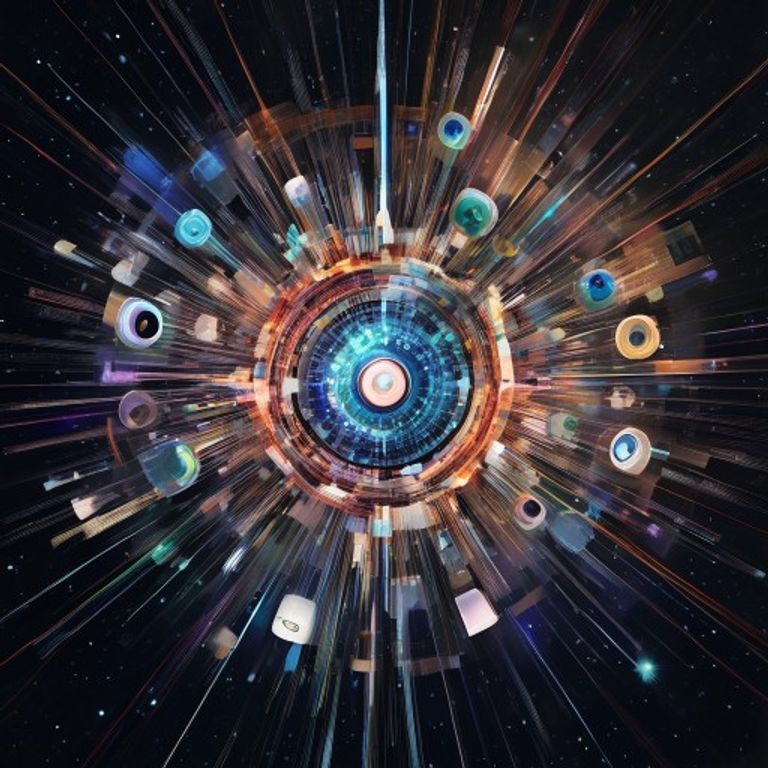
The scientific hypothesis that our universe is just one among infinite others, each with different physical laws and histories, coexisting in parallel dimensions.
⚠️ Research conducted with the aid of Deep Research is subject to referential ambiguity.
🖥️ Clean HTML code using a proprietary tool.
👥 Research by Guilherme Felipe, Curation by Sílvio Lôbo
The Enigma of the "Multiverse Case": Facts, Speculations, and the Veils of Reality
By [Your Senior Investigative Journalist Name]
There are mysteries that haunt the annals of history not because of their brutality or the fame of those involved, but because of their intrinsically disconcerting nature. What has come to be known as the "Multiverse Case" falls precisely into this category. A tangle of reports, disappearances, and phenomena that defy conventional explanations, fueling a fierce debate between skeptical science and the possibility of parallel realities.
1. The Context and the Incident: Where, When, and How the Mystery Began
The epicenter of the "Multiverse Case" dates back to the quiet and isolated town of Willow Creek, in the interior of the United States. During the first fortnight of June 1987, a series of bizarre events began to unfold, initially dismissed as tragic coincidences or mass hysteria. It all started with the disappearance of three residents in a period of just seven days, without any trace or concrete clue.
The first to vanish was Arthur Pendelton, a retired watchmaker known for his methodical routine. His house, found locked from the inside, showed signs of an interrupted meal, and his wristwatch, an object of immeasurable sentimental value, lay on the kitchen table, stopped at 3:17 AM. Four days later, Sarah Jenkins, a young art student, disappeared from her studio, leaving behind an unfinished painting that depicted a vortex of vibrant colors and abstract geometric shapes. Finally, Robert Miller, a professor of theoretical physics who was visiting the town to study local magnetic anomalies, evaporated from his hotel room, with his notebooks scattered, containing complex equations and speculative diagrams about the nature of space-time.
2. Timeline of Events
- June 10, 1987: Disappearance of Arthur Pendelton. Local police begin the investigation, without success.
- June 14, 1987: Disappearance of Sarah Jenkins. Local media begins covering the events with greater intensity.
- June 17, 1987: Disappearance of Robert Miller. The FBI is notified, but the initial investigation does not progress.
- June 20-25, 1987: Isolated reports of strange phenomena in Willow Creek: inexplicable lights in the sky, temporal distortions perceived by some residents (objects appearing or disappearing briefly, clocks running fast or slow for no apparent reason), and a low, constant hum felt in certain areas.
- August 1987: A small group of independent researchers, led by an eccentric retired physicist, Dr. Alistair Finch, arrives in Willow Creek to investigate the phenomena, but their reports are largely ignored by the authorities.
- 1990: The case is officially archived as "unsolved disappearances," with few conclusive leads.
- 2005: Declassification of some preliminary FBI reports and testimonies collected at the time, which reveal more details about the strange reports.
3. The Main Theories
The absence of concrete answers opened a range of speculations, varying from the plausible to the downright fantastic.
3.1. Probable Scientific and Police Hypotheses
- Voluntary Flight/Complex Kidnapping: The most conventional theory suggests that the disappearances were orchestrated, possibly in conjunction. The lack of signs of forced entry into the residences could indicate that the victims knew their tormentors or were taken under subtle coercion. However, the absence of any demand, financial motivation, or evidence of flight makes this explanation difficult.
- Secret Laboratory Accident (Miller's Theory): Some speculate that Robert Miller was involved in experiments with theoretical physics that went terribly wrong. His notebooks could contain clues that he was testing theories about space-time manipulation or even the existence of dimensional portals. The possibility that he accidentally transported himself to another dimension or point in space-time is, although radical, a logical inference from his studies.
- Geographic/Environmental Anomalies: Willow Creek is located in an area with historical records of unusual geological activity and electromagnetic interference. The theory suggests that a natural anomaly, perhaps amplified by some unknown factor (such as Miller's visit), was responsible for the disappearances, perhaps creating a force field or a transport phenomenon.
3.2. Alternative, Conspiracy, or Paranormal Theories
- Interdimensional Travel (The Multiverse Theory): This is the hypothesis that gave the case its name. It is based on Robert Miller's equations and reports of perceptual distortions. The theory posits that the missing persons had, in some way, crossed over into a parallel dimension. The vibrant colors in Sarah Jenkins' painting would be a visual manifestation of that other reality. Arthur Pendelton's house, found locked from the inside, could indicate that he "simply left" for another plane, without leaving a physical trace.
- Secret Government Experiments: A branch of the conspiracy theory suggests that the US government, or some secret agency, was conducting experiments with dimensional travel or teleportation technology in the Willow Creek region. The disappearances would be an "accident" or a failed "field test," with the victims serving as test subjects. The rapid intervention of the FBI, followed by a swift archiving, would fuel this distrust.
- Extraterrestrial Phenomena/Non-Human Intelligence: Another paranormal branch suggests that an entity or alien civilization was involved, using Willow Creek as a point of interest for abductions or interdimensional experimentation. The luminous phenomena and the humming sounds could be associated with alien technologies or presences.
- Artificial Intelligence or Simulated Reality: In a more modern interpretation, some speculate that the events could be a glitch in a simulated reality, or an experiment by an advanced artificial intelligence, manipulating the perception and existence of individuals.
4. Controversies and Blind Spots
The official investigation of the "Multiverse Case" is full of gaps and questions:
- Incomplete Evidence: The forensic analysis of the victims' residences was superficial, focusing on traditional methods that were not equipped to deal with "out of the ordinary" scenarios. Sarah Jenkins' painting, considered a valuable clue by some, was little analyzed in terms of its artistic composition and possible symbolism.
- Ignored Testimonies: Several Willow Creek residents reported strange phenomena during the period of the disappearances. Many of these testimonies, especially those that spoke of momentary "displacements" or feeling "out of place," were recorded briefly and, apparently, were not taken seriously by the investigation team, which prioritized the search for physical traces of conventional crimes.
- FBI Actions: The arrival of the FBI, although it brought more resources, also marked a period of greater secrecy. The subsequent declassification of some files revealed that the agency seemed more interested in ruling out the possibility of government experiments than in finding the missing persons. There are indications that some radio and communication records were "lost" during the transfer to the federal archive.
- The Legacy of Miller's Notebooks: Robert Miller's notebooks, considered the most promising scientific clue, were returned to his family after the investigation, but with several pages blank or with deliberately illegible notes, citing the researcher's "emotional instability." Unofficial reports suggest that crucial parts were removed.
5. Curiosities and Legacy
The "Multiverse Case" transcended police and scientific investigation circles to become a pillar of ufological pop culture and unsolved mysteries. Its elusive nature turned it into fertile ground for the imagination.
- Inspiration for Media: The case inspired books, documentaries, episodes of TV series about the paranormal, and conspiracy theories, each offering its own interpretation of what really happened in Willow Creek.
- Interdisciplinary Debate: The possibility of parallel realities and the complexity of Robert Miller's equations keep the debate alive among theoretical physicists, philosophers, and pseudoscience enthusiasts.
- Current Status: The "Multiverse Case" remains officially archived as a set of unsolved disappearances. However, the declassification of documents in recent years has reopened the discussion in some independent research forums. There has been no official reopening of the investigation, but public fascination and the search for answers persist. The town of Willow Creek, although affected by the story, tries to move on, but the shadow of the inexplicable hangs over its streets, a constant reminder that, perhaps, reality is more complex than we can conceive.
While science seeks explanations within the limits of human knowledge, the "Multiverse Case" forces us to contemplate the boundaries of the possible. With each passing year, new theories emerge, but the victims remain missing, their stories intertwined with an enigma that may, who knows, extend beyond the dimensions we understand.





