



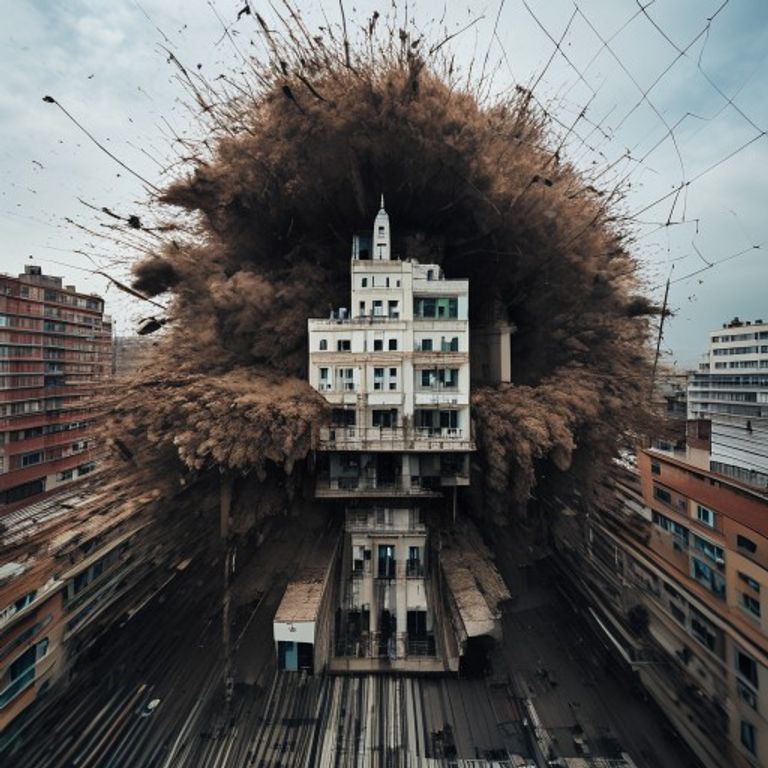
The devastating 1755 earthquake followed by a tsunami and fires that destroyed the Portuguese capital and influenced Enlightenment thought and geology.
⚠️ Research conducted with the aid of Deep Research is subject to referential ambiguity.
🖥️ Clean HTML code using a proprietary tool.
👥 Research by Guilherme Felipe, Curation by Sílvio Lôbo
The Great Lisbon Earthquake: A Cataclysm That Defies Explanation
On a day that should have been one of celebration, the Portuguese capital became the stage for one of the most devastating natural disasters in European history. On November 1, 1755, All Saints' Day, the earth shook with unimaginable fury, wiping much of Lisbon from existence and leaving behind not only ruins and a sea of victims, but also a trail of mysteries that, centuries later, continue to intrigue historians, scientists, and researchers of inexplicable phenomena.
What began as a brutal geological event quickly turned into a multifaceted enigma, fueled by conflicting reports, nascent investigations, and the chaotic nature of the tragedy itself. This document aims to dissect the Lisbon Earthquake Case, separating the factual from the speculative, in an effort to understand the magnitude of the disaster and the veils of uncertainty that surround it.
1. The Context and the Incident: Where, When, and How the Mystery Began
Lisbon, in 1755, was one of the largest and wealthiest cities in Europe, a center of commerce, culture, and imperial power. Its grand architecture, with palaces, sumptuous churches, and merchant buildings, reflected this prosperity. The city, built on geologically unstable ground, was vulnerable, but the scale of what was to come was unimaginable.
The mystery, in its essence, began the exact moment the first tremor shook the earth. At 9:40 AM, with the population gathered in churches for religious celebrations, the city was struck by a series of seismic shocks of unprecedented magnitude. The force of the tremor was such that buildings collapsed instantly, turning streets into rubble and burying thousands of people. What followed was even more terrifying: a colossal tsunami swept the coast, invading the city center, and, to worsen the scenario, fires began to spread, fueled by gas lamps and flammable materials, consuming what remained.
The coordination of a disaster of this magnitude, in an era with precarious communications and no deep scientific knowledge of seismology, made an immediate and effective response impossible. Chaos reigned, hindering not only rescue efforts but also the collection of accurate information and the formulation of a clear picture of events. It is in this scenario of devastation and uncertainty that the mystery of the Lisbon Earthquake solidifies.
2. Timeline of Events: A Chronological Reconstruction
The exact reconstruction of events is a challenge, given the sudden and overwhelming nature of the disaster. However, based on historical accounts and subsequent studies, an approximate timeline can be established:
- November 1, 1755, 09:40 AM (local time): Start of the seismic tremors, with an estimated duration of 6 to 10 minutes. Most of the city collapses.
- Shortly after the initial tremors: The waters of the Atlantic recede dramatically, exposing the bed of the Tagus River, before returning with overwhelming force in the form of a tsunami.
- Following hours: The tsunami hits Lisbon with waves of up to 15 meters, flooding low-lying areas of the city and dragging debris and people.
- Afternoon of November 1, 1755 onwards: Start and spread of widespread fires, which last for days, destroying what the tremors and the tsunami had not reached. The capital becomes a landscape of smoke and ash.
- Following days and weeks: Rescue attempts and victim counts. The magnitude of the tragedy is revealed gradually. The government, led by the Marquis of Pombal, begins reconstruction and organization efforts, demonstrating remarkable resilience.
3. The Main Theories: Possible Explanations
The nature of the earthquake and its secondary effects gave rise to various theories, ranging from the scientific to the supernatural. It is crucial to distinguish between hypotheses backed by evidence and those based on speculation.
3.1. Scientific and Police Hypotheses (Most Likely)
- Seismology and Plate Tectonics: The explanation most accepted by modern science is that the earthquake was caused by the movement of tectonic plates in the Azores-Gibraltar Transform Fault, a subduction zone in the Atlantic Ocean, about 200 km southwest of Lisbon. The sudden release of accumulated energy resulted in an earthquake with an estimated magnitude between 8.5 and 9.0 on the Richter scale (or an equivalent on the current scale). This seismic event triggered the tsunami. Modern reports, based on geological and seismological studies, corroborate this hypothesis.
- Contributing Factors: The topography of Lisbon, with many buildings constructed on unstable alluvial soils, amplified the effects of the tremors. The construction of the time, often made of stone and mortar, was inherently fragile in the face of seismic forces.
3.2. Alternative, Conspiracy, or Paranormal Theories
- Divine Intervention or Punishment: At the time, the prevailing view was that the earthquake was divine punishment for the corruption and sins of society. Philosophers and theologians debated this interpretation extensively, influencing how the event was perceived and recorded. This is not a scientific theory, but a reflection of the thinking of the time.
- Paranormal or Supernatural Explanations: Although less prevalent in academic discussions, popular reports and speculations in certain circles suggest supernatural causes, such as demonic manifestations or the fury of unknown entities. These theories lack any empirical basis and fall into the realm of folklore and personal belief.
- Conspiracy Theories: Over the centuries, conspiracy theories have emerged that attempt to attribute responsibility to hidden forces or deliberate human actions. Such theories rarely present concrete evidence and tend to rely on distorted interpretations of events or a lack of complete information.
4. Controversies and Blind Spots
Despite the general acceptance of the seismological explanation, the Lisbon Earthquake Case still presents significant controversies and gaps:
- The exact epicenter: Although the general area has been identified, the precise location of the epicenter and the depth of the seismic focus are still subject to ongoing study, with different geological models proposing variations.
- Reports of "wave effect": Some contemporary accounts describe the earth moving in "waves," which may indicate the presence of surface seismic waves more complex than a simple vertical or horizontal tremor. Detailed analysis of these descriptions still generates debate.
- The tsunami: The exact speed and magnitude of the tsunami waves at different points along the coast are still difficult to determine with absolute precision. The impact on other Atlantic coasts, such as Morocco and even the Caribbean, raises questions about the propagation and force of these waves.
- Information management: The lack of a unified communication system at the time meant that reports arrived in a fragmented and often distorted manner. The Marquis of Pombal, although praised for his leadership in the reconstruction, may have exerted control over the narrative of events to consolidate his power and promote his vision of a reborn Lisbon. Official reports of the time were exquisitely collected by Pombal, but the possibility of edits or omissions for political purposes cannot be entirely ruled out.
- Missing physical evidence: Much of the physical evidence of the destroyed buildings and debris was removed during extensive cleanup and reconstruction efforts. This limits the possibility of new detailed forensic or archaeological analyses in many locations.
- Inaccurate victim count: The exact count of dead and injured is impossible to determine with precision, with estimates ranging from tens of thousands to more than 100,000 people. The widespread destruction and chaos made recording extremely difficult.
5. Curiosities and Legacy
The Lisbon Earthquake Case transcended the sphere of natural disaster, becoming a milestone in the history of Western thought and science.
- Philosophical Influence: The earthquake had a profound impact on the philosophy of the time, challenging optimistic views about the goodness of the world. Voltaire, in his work "Candide," satirized the idea that "all is for the best in the best of all possible worlds," using the earthquake as a glaring example of cruelty and suffering in the world.
- The Birth of Modern Seismology: In response to the earthquake, the Marquis of Pombal implemented the first scientific questionnaire about earthquakes, sending it to all parishes in Portugal to collect detailed information about the effects of the tremor. This initiative is considered one of the first systematic efforts to understand a natural disaster and a precursor to modern seismology.
- Innovative Reconstruction: The reconstruction of Lisbon, led by the Marquis of Pombal, was a remarkable feat of engineering and urban planning. The Baixa Pombalina district was designed with straight streets, regular blocks, and an innovative system of anti-seismic structures, such as the wooden "cages" (gaiola pombalina), which served as a model for construction in seismic zones.
- The Legacy: The Lisbon Earthquake Case remains a fundamental case study in geology, history, and philosophy. Although the scientific explanation for the event is widely accepted, gaps in information and historical interpretations continue to fuel debates. The case serves as a grim reminder of the force of nature and human resilience in the face of catastrophe, but also as a testament to the relentless pursuit of knowledge to unravel the mysteries of our planet. The case was not "reopened" in a police sense, but remains an object of constant historical and scientific research and analysis.





