



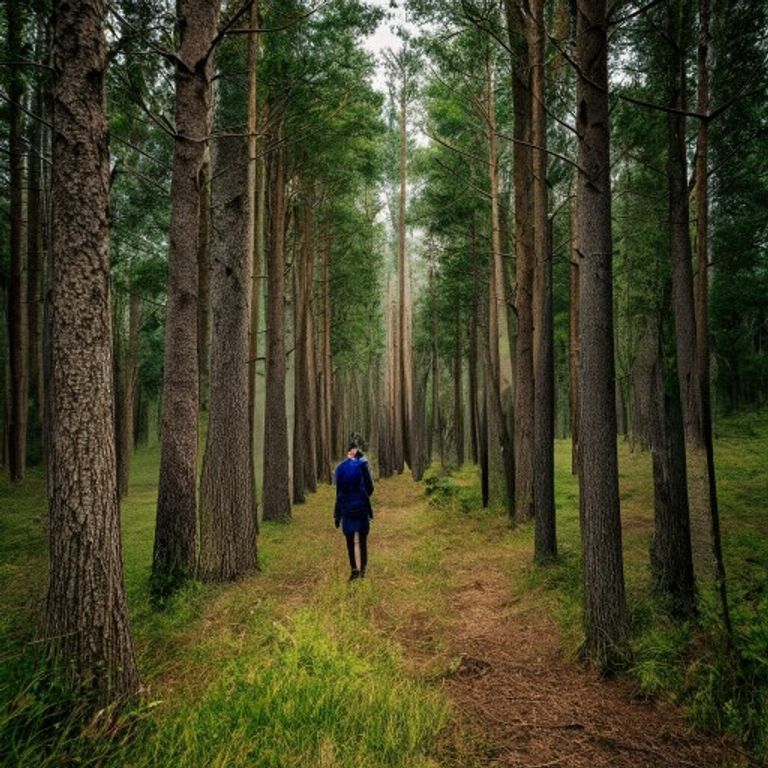
Located in Romania, it is known for vegetation with distorted shapes, electronic equipment failures, and inexplicable disappearances, earning it the nickname 'Bermuda Triangle of Transylvania'.
⚠️ Research elaborated with the aid of Deep Research is subject to referential ambiguity.
🖥️Clean HTML code with the use of proprietary tools.
👥 Research by Guilherme Felipe, Curation by Silvio Lobo
The Dark Silence of Hoia Baciu Forest: A Mystery in Transylvanian Lands
In the heart of Transylvania, a region immortalized by Count Dracula and his dark legends, lies a mystery of a different, yet equally disturbing, nature. Hoia Baciu Forest, a place of wild beauty and intriguing arboreal density, has become the stage for one of Romania's most enigmatic cases, a tangle of disappearances, inexplicable sightings, and a silence that defies reason. This article aims to unravel, with investigative rigor, the veils that cover the truth, separating the factual from the speculative.
1. The Context and the Incident: Where, When, and How the Mystery Began
Hoia Baciu Forest, near the city of Cluj-Napoca in Romania, is not just a wood; it is an ecosystem charged with a peculiar atmosphere. It is believed that the mystery began to take on clearer and more worrying contours from the 1960s onwards, a period when reports of strange phenomena began to multiply. Initially, these involved perceptions of anomalous lights, sounds with no apparent origin, and a general feeling of discomfort and disorientation experienced by those who ventured along its trails. However, what transformed the forest into a center of investigative attention were the disappearances.
The incident that catapulted Hoia Baciu Forest into the popular imagination, solidifying its status as a cursed or inexplicable place, was the disappearance of a shepherd and his 200 sheep, which occurred in the mid-20th century. Although the exact circumstances and precise date are difficult to determine due to the lack of detailed official records from that era, this event became a landmark, fueling the narrative that the forest "swallows" life without leaving a trace.
2. Timeline of Key Events
Reconstructing an exact timeline for Hoia Baciu Forest is challenging, as many events are based on anecdotal reports and unformalized testimonies. However, the key milestones appear to be:
- 1950s/1960s: Intensification of reports about strange phenomena: inexplicable lights, unidentified sounds, feelings of disorientation, apparitions. The disappearance of the shepherd and his sheep becomes a central story.
- 1968: Military sergeant Alexandru Sift, an enthusiast of paranormal phenomena, is said to have conducted expeditions in the forest, documenting various occurrences. His reports, although not fully declassified officially, circulate and fuel the location's mythology.
- 1970s-1980s: Continuation of reports and the emergence of new urban legends associated with the forest, including the story of a peasant woman who entered the forest and was never seen again.
- Late 20th and Early 21st Centuries: Hoia Baciu Forest attracts the attention of ufologists, parapsychologists, and tourists seeking supernatural experiences. The area becomes a point of interest for documentaries and independent investigations.
- Present Day: The forest maintains its reputation as one of Romania's most mysterious places, attracting visitors and generating debates about its origins and the events that occur within it.
3. The Main Theories: A Mosaic of Explanations
The multiplicity of events and the scarcity of concrete evidence have given rise to a diverse range of theories, spanning from the scientific to the esoteric.
3.1. Scientific and Police Hypotheses (The Most Probable, Yet Incomplete)
- Geological and Environmental Factors: The region of Hoia Baciu Forest exhibits unusual geological characteristics, including deposits of rocks and soil with magnetic properties. Some theorize that these anomalies could generate electromagnetic fields that affect compasses, electronic equipment, and even human perception, causing disorientation and hallucinations. The presence of certain gas emissions or underground activities cannot be ruled out as causes of physical discomfort.
- Misunderstood Natural Phenomena: Phenomena such as dense and persistent fogs, light plays caused by solar reflections under specific atmospheric conditions, or even the propagation of sounds in valleys and rock formations, could be misinterpreted as paranormal manifestations.
- Local Dangers and Human Factors: The forest is dense, and in some areas, the terrain is rugged. Natural disorientation, encounters with wild animals (though rare), or the human propensity to get lost in unfamiliar environments could explain some disappearances. The possibility of crimes and the concealment of bodies in remote areas is a standard police investigation line for any isolated location, although the lack of concrete evidence is the crucial point.
3.2. Alternative and Paranormal Theories (The Heart of the Mystery)
- Extraterrestrial Activity (Ufology): The persistence of reports of anomalous lights in the sky, described as unidentified flying objects (UFOs), has led many to speculate about extraterrestrial visits. The forest would be a landing site or an observation area for alien spacecraft, and the disappearances would be consequences of abductions.
- Paranormal Activity and Ghosts: Legend has it that the forest was the site of ancient pagan rituals and that the spirits of those who died violently or without peace haunt the place. The apparitions, sounds, and strange sensations would be manifestations of disembodied entities.
- Interdimensional Portals or Rifts in Time: Some more speculative theories suggest that Hoia Baciu Forest harbors portals to other dimensions or that time and space behave irregularly in certain areas. This would explain the sudden disappearance of people and objects, as if they had been "sucked" into another place or time.
- Crop Circles and Telluric Energies: The appearance of circular formations (similar to crop circles) in some areas of the forest, although often attributed to hoaxes, fuels the idea of external interferences (whether technological or energetic) that shape the vegetation. The belief in "telluric energies" or Earth's ley lines converging at the site is also common.
4. Controversies and Blind Spots: Where the Truth Hides
The biggest obstacle in elucidating the mystery of Hoia Baciu Forest lies in the remarkable lack of robust and conclusive official investigations.
- Lack of Detailed Official Records: For many of the older incidents, there are no police or investigative reports accessible to the public. The disappearance of the shepherd and his sheep, for example, is repeatedly cited, but the absence of an official document detailing the search and findings (or lack thereof) leaves a void of information.
- Amateur and Anecdotal Evidence: A large part of the "archive" about the forest comes from personal accounts, low-quality photographs of alleged UFOs or luminous phenomena, and diaries of paranormal enthusiasts, such as those of Alexandru Sift. The credibility of this evidence is questionable by rigorous investigative standards, given the ease of manipulation or misinterpretation.
- Conflicting Testimonies: Over the years, different witnesses have reported varied experiences. Some describe extreme fear and disorientation, while others claim to have seen lights or heard sounds without feeling any disturbance. This disparity could indicate different phenomena occurring at different times or, simply, subjectivity in perception.
- Ignored or Unfollowed Leads: There is no concrete information about extensive and systematic police investigations that have been conducted in all relevant areas of the forest. Lack of resources or interest in cases classified as "disappearances in natural environments" may have led to the premature abandonment of potential leads.
- The Nature of "Disorientation": Reports of people entering the forest and completely losing their sense of direction or notion of time are recurrent. If confirmed and not attributable to psychological factors or the density of the location, they could be a crucial clue, but the lack of systematic scientific measurements during these episodes prevents in-depth analysis.
5. Curiosities and Legacy: The Forest That Continues to Haunt
Hoia Baciu Forest has transcended the scope of disappearances and isolated phenomena to become a cultural icon of Romania, a symbol of the inexplicable, and a magnet for mystery tourism.
- The 'Bermuda Triangle of Romania': Frequently compared to the famous Bermuda Triangle for the number of mysteries and disappearances, the forest has informally consolidated its nickname.
- Twisted Trees and Absence of Life: One of the most notable characteristics of the forest is the presence of trees with visibly twisted trunks and branches, in a pattern that defies natural botanical explanations. Furthermore, some areas appear devoid of animal life, a silence that contributes to the sinister atmosphere.
- Mystery Tourism: The forest attracts thousands of tourists every year, many of whom go in search of thrills, seeking to experience the supposed phenomena. Local guides often tell stories and point out areas considered "more active."
- Impact on Popular Culture: The mystery of Hoia Baciu Forest has inspired books, documentaries, films, and episodes of TV series about the supernatural. Its fame contributes to Transylvania's image as a land of legends and secrets.
- Current Status: The case of Hoia Baciu Forest has not been formally reopened by Romanian authorities as a specific criminal or paranormal case. It remains in limbo, a historical mystery and an environmental enigma that continues to fascinate and generate questions, without definitive answers. The forest remains a silent testament to events that defy human understanding, an eternal invitation to investigation and speculation.





