



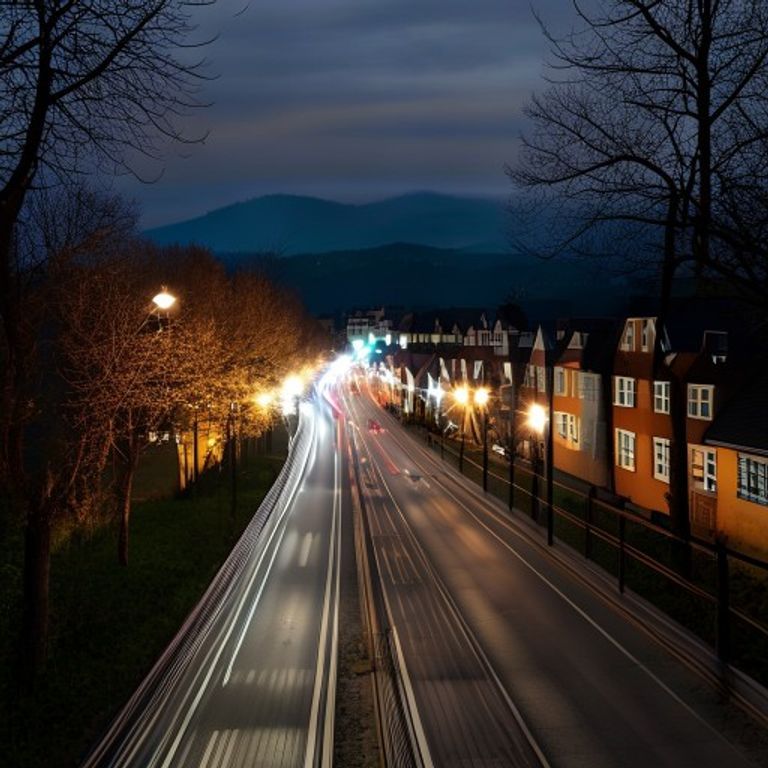
Mysterious luminous spheres of various colors flash and fly erratically in the skies of a valley in Norway with no definitive scientific explanation.
⚠️ Research elaborated with the aid of Deep Research is subject to referential ambiguity.
🖥️Clean HTML code using a proprietary tool.
👥 Research by Guilherme Felipe, Curation by Sílvio Lôbo
The Luminescent Enigma of Hessdalen: A Mystery Burning in the Norwegian Mountains
For decades, the quiet village of Hessdalen, nestled in the deep valleys of Central Norway, has been the stage for a phenomenon that defies conventional explanations. Strange lights, with inexplicable behaviors, hover over the valley, intriguing residents, scientists, and skeptics alike. What began as isolated sightings has evolved into one of the world's most persistent and studied mysteries of unidentified aerial phenomena.
This article delves into the Hessdalen Lights Incident, unraveling its context, reconstructing its timeline, exploring the theories that attempt to make sense of the inexplicable, and examining the controversies surrounding this fascinating case.
1. The Context and the Incident: Where, When, and How the Mystery Began
The history of the lights in Hessdalen is not a singular event but a series of observations that gained momentum starting in January 1981. The area, marked by its rugged topography and geographical isolation, is crossed by a high-voltage power transmission line, and a specific geological structure – the Hessdalen Field (Hessdalen-feltet), rich in minerals, including heavy metals and sulfur. These geological and technological factors would later be considered by some theories.
The first detailed reports emerged in February 1983, when a significant number of sightings were recorded. Local residents described luminous objects of different sizes and colors, moving at unusual speeds and patterns. The lights were often described as pulsating, emitting beams, and in some cases, appearing to interact with each other or the terrain.
The attention of the media and the scientific community grew as more people reported witnessing the phenomena. What was initially attributed to rumors and popular imagination began to gain credibility with consistent testimonies and, eventually, with the attempt at more systematic studies.
2. Timeline of Key Events
The timeline of the Hessdalen Incident is marked by peaks of activity and periods of relative calm, but with a constancy that fuels the mystery:
- 1970s-1980s: Sporadic reports of anomalous lights in the region.
- January 1981: The beginning of a wave of more intense and frequent sightings.
- February 1983: A drastic increase in the number of reports, attracting national and international attention.
- 1983-1984: The start of the first independent studies and research. The "Hessdalen Light Project", an initiative led by scientists and enthusiasts, begins monitoring the area.
- 1985: Eyewitness accounts describe lights that appear to have mass and emit sound.
- 1980s-1990s: Period of high sighting activity. Reports of objects moving at very high speeds, changing direction abruptly, and exhibiting complex flight patterns.
- 2000s onwards: Continuity of sightings, albeit with less intensity. Establishment of automated monitoring stations by the Project Hessdalen, using cameras, radiation sensors, and radar.
- 2014: Release of a report by Project Hessdalen, presenting analyses of collected data and suggesting the possibility of a physical phenomenon not yet understood.
3. Main Theories: Deciphering the Puzzle
Over the decades, various theories have been proposed to explain the Hessdalen lights, ranging from the scientific to the paranormal:
3.1. Scientific and Official Explanations
- Natural Atmospheric Phenomena:
- Ball Lightning: A common explanation for spherical and erratic lights, although the movement patterns and long duration of sightings in Hessdalen are difficult to reconcile with this hypothesis.
- Gas Emission from the Ground: The theory suggests that the mineral-rich soil of the region may emit flammable gases that, upon contact with air or electrical currents, create luminescence. The presence of minerals such as sulfides and heavy metals is cited as a potential factor.
- Geological Activity: The proximity of geological faults and the possibility of releasing underground energy or gases could generate luminescence.
- Electromagnetic and Industrial Phenomena:
- Static Electricity and Discharges: The high-voltage line crossing the valley could generate intense electromagnetic fields. The interaction of these fields with the atmosphere or the ground could result in luminescent phenomena, especially under specific weather conditions. Reports of electromagnetic interference during sightings reinforce this line of thought.
- Electric Potential Differences: The variation in electric potential between the atmosphere and the ground, exacerbated by local geological characteristics, could create visible discharges.
- Military Equipment or Secret Tests: While less likely given the duration and nature of the sightings, the possibility of tests of unconventional aircraft or military devices has never been entirely ruled out by authorities, but there is no concrete evidence to support this idea for the specific case of Hessdalen.
3.2. Alternative, Conspiracy, or Paranormal Theories
- Alien Technology: The most popular hypothesis among ufology enthusiasts. The unusual characteristics of the lights – intelligent flight, sudden changes in direction, absence of audible sound in many reports – lead to speculation about the extraterrestrial origin of the objects.
- Paranormal/Psychic Phenomena: Some less conventional theories suggest that the lights could be manifestations of psychic energy or interdimensional phenomena. These hypotheses lack significant empirical support.
- "Light Pollution" or Hoaxes: Although most skeptics initially considered these options, the number of independent witnesses and the analysis of monitoring data make this explanation less plausible for the entirety of the sightings.
4. Controversies and Blind Spots: The Shadows of Investigation
The investigation of the Hessdalen lights is not without controversies and blind spots that fuel the mystery:
- Lack of Conclusive Evidence: Despite decades of observation and data collection, there is no single piece of irrefutable physical evidence (such as wreckage or a recovered object) that corroborates any of the theories.
- Disappearance of Evidence: Sporadic reports of video tapes that were allegedly lost or damaged, or equipment that failed at crucial moments, contribute to the feeling that "something" may have been deliberately hidden or simply lost.
- Interpretation of Data: The interpretation of data collected by Project Hessdalen, while rigorous in its methodology, can be subject to different views. The mainstream scientific community remains skeptical of accepting conclusions that point to genuinely unknown phenomena.
- External Interference and Initial Disbelief: Initial disbelief and the way early reports were treated by some authorities and the media may have led to the neglect of important clues or a lack of interest that prevented a more in-depth investigation in its initial stages.
- Fluid Nature of Phenomena: The variability in the descriptions and behaviors of the lights over time makes it difficult to create a single, consistent explanatory model.
5. Curiosities and Legacy: A Mystery That Continues to Shine
The Hessdalen Lights Incident has transcended Norway's borders, becoming an icon in popular culture and a landmark in the study of anomalous phenomena:
- The Hessdalen Project: An unprecedented civilian initiative that maintains a permanent monitoring station and continuously collects data. Its work is a testament to the enduring fascination with the mystery.
- Cultural Impact: The case has inspired documentaries, books, and articles, and is frequently cited in discussions about ufology and unexplained science.
- Ongoing Study: The Hessdalen lights remain an active field of study, with scientists and researchers exploring new methodologies and technologies to unravel their enigma.
- Local Heritage: The village of Hessdalen has embraced its mystery, becoming a destination for the curious and researchers, and keeping the flame of investigation alive.
To this day, the Hessdalen lights continue to dance in the Norwegian night skies, a persistent invitation to reflect on the limits of our knowledge and the wonders that may lie hidden in the darkest and most forgotten corners of our planet. The mystery, far from being solved, continues to challenge and intrigue, a vivid reminder that not everything can be explained by conventional science.





