



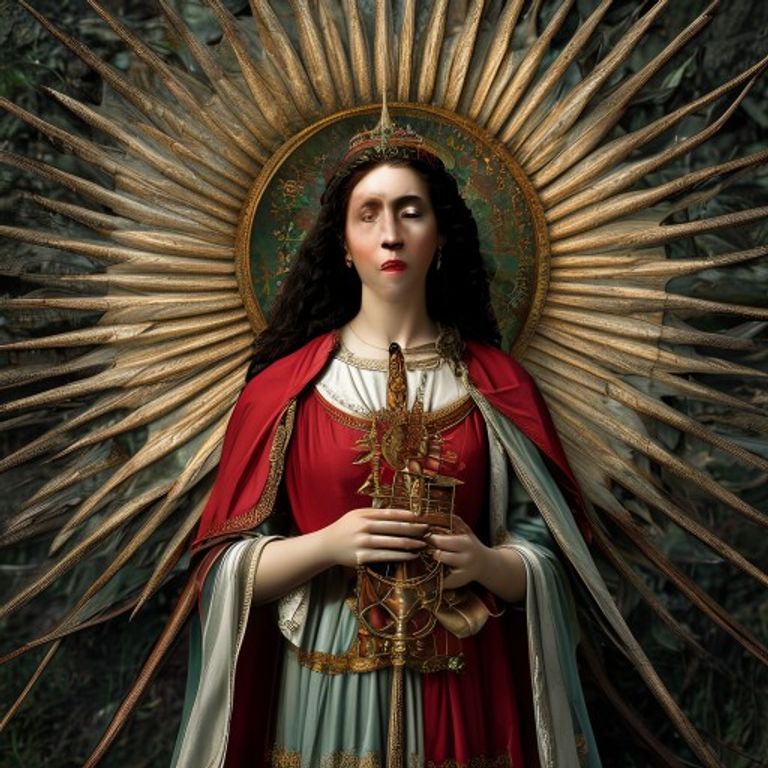
Thousands of people in Portugal reported seeing the sun move chaotically in the sky, a massive phenomenon that generates intense debates between science and religion.
⚠️ Research conducted with the aid of Deep Research is subject to referential ambiguity.
🖥️Clean HTML code using a proprietary tool.
👥 Research by Guilherme Felipe, Curation by Sílvio Lôbo
The Miracle or Mystery of Fatima: Unraveling the Layers of a Historical Enigma
Amidst the religious fervor and political turmoil of early 20th-century Europe, a small village in Portugal would become the epicenter of an event that, decades later, continues to defy logical explanations and fuel a heated debate between faith, science, and speculation. The Fatima Incident, as it became known, is not a crime to be solved by the police, but rather a complex historical enigma whose reverberations have shaped the faith of millions and infiltrated conspiracy theories and paranormal studies.
1. The Context and the Incident: Where, When, and How the Mystery Began
The mystery began in 1917, amidst World War I and in a Portugal plagued by political and social divisions. In the small village of Fatima, Santarém district, three children – Lúcia Santos (10 years old), her brother Francisco Marto (9 years old), and his sister Jacinta Marto (7 years old) – claimed to have had a series of apparitions of a celestial figure. The first apparition is said to have occurred on May 13, 1917, on a rural property known as Cova da Iria.
The children described the apparition as a "Lady brighter than the Sun," dressed in white and holding a rosary. According to their accounts, the Lady asked them to return to the same spot on the 13th of each month for six months to deliver messages and prophecies. The first apparition was reportedly followed by initial fear, but it quickly transformed into a sense of duty and admiration on the part of the young seers.
2. Timeline of Events: A Chronological Reconstruction
The narrative of the apparitions unfolded in a sequence of events that captivated and divided public opinion:
- May 13, 1917: First reported apparition by the three children in Cova da Iria. The celestial figure reportedly asked them to return the following month.
- June 13, 1917: Second apparition. The children reported that the Lady asked them to learn to read and to recite the rosary for peace.
- July 13, 1917: Third apparition. The Lady reportedly revealed three "secrets" to the children. Lúcia, in particular, narrated visions of a terrifying hell and prophecies about war, famine, and persecution of the Church.
- August 13, 1917: The children were prevented from attending because they were detained by the local civil administration, under suspicion of fraud. The apparition reportedly occurred in a different location, a field of olive trees, in their absence.
- September 13, 1917: Fourth apparition. The Lady reportedly promised a miracle for the month of October.
- October 13, 1917: The main apparition. Hundreds of witnesses reported seeing a phenomenon in the sky, described as a "dancing sun," a shimmering disc of light that seemed to spin and change color before returning to its normal position. This event became known as the "Miracle of the Sun."
3. Main Theories: Unraveling the Layers of Explanation
The Fatima Incident has generated a mosaic of theories, from the most earthly to the transcendent:
3.1. Religious and Paranormal Explanations (Vision of the Seers and the Catholic Church)
The official explanation, adopted by the Catholic Church after a canonical investigation, is that the apparitions were genuine and that the figure was the Virgin Mary, the Mother of Jesus. The messages delivered, known as the "Messages of Fatima," focused on prayer, penance, and conversion, warning about the spiritual consequences of sinful acts and global conflicts. The "secrets" revealed to the children, in particular, were interpreted as prophecies of significant historical events, such as World War II and the rise of atheist communism. The Church considers the phenomena to be supernatural.
3.2. Psychological and Sociological Explanations
One line of investigation suggests that the event may have been the result of a phenomenon of collective suggestion and mass hallucination, exacerbated by the context of war-induced fear and uncertainty. The children's strong belief in faith and the social pressure to believe in Marian apparitions could have contributed to the perception of extraordinary phenomena. Lúcia herself, in later interviews, expressed the intensity of her experiences, which could be interpreted from a psychological perspective.
3.3. Scientific and Natural Explanations for the "Miracle of the Sun"
The "Miracle of the Sun" is one of the most controversial and, paradoxically, best-documented points. Scientific theories seek explanations for the visual phenomenon:
- Atmospheric phenomena: Some scientists suggest that the event could have been a combination of unusual solar reflections, dust clouds in the atmosphere, or even an optical effect caused by prolonged observation of the sun, known as "solar retinopathy."
- Mirages: The possibility of atmospheric mirages, which can distort the perception of objects in the sky, is also considered.
- Collective hysteria with a visual component: The expectation of a miracle could have led people to "see" what they expected to see, combining suggestion with altered perception due to lighting conditions.
3.4. Conspiracy and Alternative Theories
As is common in events of great repercussion, conspiracy theories have flourished:
- Social engineering or manipulation: Some theories suggest that the event may have been orchestrated by groups with specific political or religious interests to influence public opinion or the Church.
- Extraterrestrial phenomena: On more fringe lines, there are those who speculate about the intervention of disguised extraterrestrial civilizations or the use of unknown technologies.
- Manipulation of the "secrets": A persistent theory is that the "secrets" of Fatima, especially the third one, were manipulated or partially revealed by the Church to omit crucial or inconvenient information.
4. Controversies and Blind Spots: Inconsistencies and Omissions
Despite the deep faith surrounding the case, there are persistent question marks and controversies:
- Confidentiality of the "secrets": The third secret of Fatima remained secret for decades, officially revealed only in 2000. The delay and the manner of its revelation fueled suspicions that something important was hidden, with the official interpretation about the assassination of a "bishop dressed in white" being questioned by many.
- Conflicting testimonies: Although most accounts of the Miracle of the Sun are similar, there are variations in the details, which is common in collective testimonies, but can raise questions about the uniformity of the experience.
- Investigations by the civil administration: The detention of the children by civil authorities in August 1917, under the accusation of "fraud," demonstrates the resistance and skepticism of part of society and the authorities of the time, contrasting with the growing religious fervor. Official reports of this detention could offer a counterpoint to the religious narratives.
- Loss of evidence? As in many historical cases, the possibility of loss or disappearance of documents or evidence over time cannot be ruled out, although there is no concrete proof of intentional file manipulation.
5. Curiosities and Legacy: The Lasting Impact of Fatima
The Fatima Incident transcended the borders of Portugal and Catholicism:
- Global phenomenon: The Sanctuary of Fatima has become one of the world's leading Marian pilgrimage sites, attracting millions of faithful annually.
- Political influence: The prophecies of Fatima have often been interpreted in relation to global political events, including the Cold War and the collapse of the Soviet Union, giving them an almost prophetic weight.
- Continuous studies: The case continues to be the subject of study by theologians, historians, psychologists, and even ufologists, each seeking to unravel the layers of mystery surrounding it.
- Current status: The Fatima Incident has not been "reopened" or "closed" in a police sense. The Catholic Church maintains its official position on the authenticity of the apparitions, while academic and speculative debate remains open, fueled by the intrinsically enigmatic nature of the event.
The Fatima Incident remains a testament to the complexity of faith, the human capacity to seek meaning in extraordinary events, and the persistence of mysteries that defy definitive explanations. Whether a divine miracle, an unexplained natural phenomenon, or a complex interplay of psychological and social factors, the story of three children in a Portuguese field in 1917 continues to resonate, echoing in questions and hopes that transcend time and space.





