



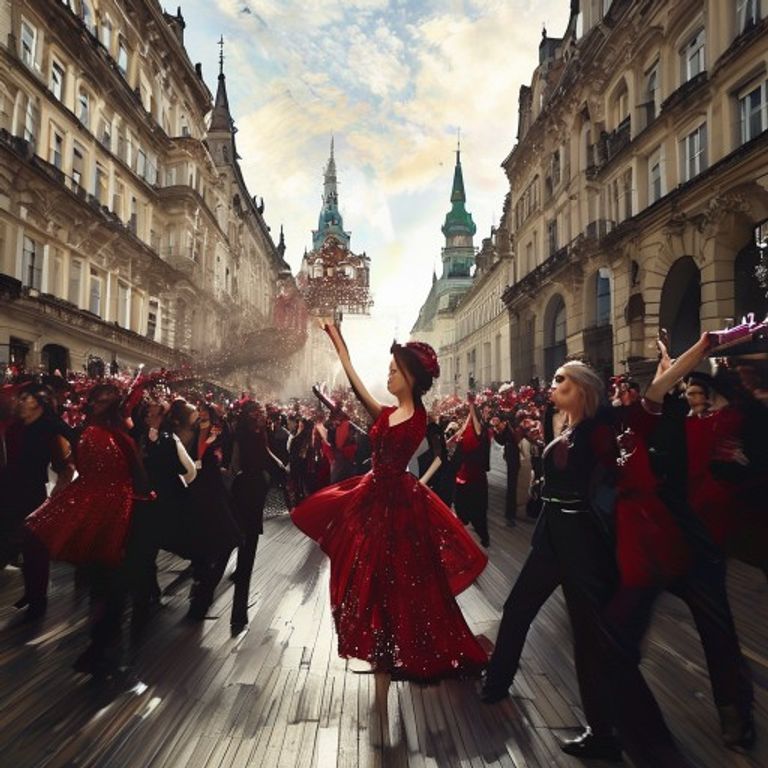
Hundreds of people in the city of Strasbourg began to dance uncontrollably for days on end in the 16th century, resulting in the deaths of several of them.
⚠️ Research elaborated with the aid of Deep Research is subject to referential ambiguity.
🖥️Clean HTML code using a proprietary tool.
👥Research by Guilherme Felipe, Curation by Sílvio Lôbo
The Enveloping Mystery of the Dancing Plague: An Endless Rehearsal
Amidst the hustle and bustle of urban life, some events are etched into collective memory not only for their peculiar nature but for the stubbornness with which they defy explanation. The so-called "Dancing Plague," which occurred in Strasbourg in the 16th century, is one of those enigmas that, even centuries after its peak, continue to make us question the limits of human understanding, between the real and the inexplicable.
1. The Context and the Incident: The Shadow in Strasbourg
The stage for the macabre spectacle of the Dancing Plague was the city of Strasbourg, then an important commercial and cultural center of the Holy Roman Empire. The summer of 1518 was particularly scorching, but the physical heat was far from being the only disturbing element. It was in July of that year that the city was gripped by a bizarre and frightening phenomenon: people began to dance uncontrollably, without rest, for days on end.
The incident, according to historical accounts such as those by the poet and chronicler Daniel Specklin and the physician Paracelsus, who later studied the event, began with a single woman, identified by some as Frau Troffea, a resident of the Strasbourg Cathedral area. She reportedly began to dance frantically in a street, driven by a compulsion that prevented her from stopping. In a short time, other individuals joined her, and the number of incessant dancers began to grow exponentially, turning the city streets into a stage of despair.
2. Timeline of Events: The Incessant Dance
Reconstructing a precise timeline for an event of this nature is a challenge, but available accounts allow us to trace an approximate course:
- July 1518 (early): Frau Troffea begins to dance uncontrollably in the streets of Strasbourg.
- July 1518 (mid): The number of dancers increases to dozens, attracting the attention of local authorities and the population.
- July 1518 (late): The "plague" reaches its peak, with hundreds of people, according to estimates, afflicted by the compulsive dance. The situation becomes public and worrying.
- August 1518: The authorities of Strasbourg, desperate with the situation and fearing a greater evil, implement drastic measures. Believing that the dance was a symptom of "hot blood" and excess energy, they encouraged the practice of dancing, believing that exhaustion would lead to recovery. They set up stages and hired musicians to entertain the dancers.
- September 1518: The phenomenon begins to gradually subside after weeks of continuous dancing. Reports indicate that many of the dancers succumbed to exhaustion, dehydration, heart attacks, or strokes.
3. Main Theories: Seeking a Rational (and Other) Explanation
Over the centuries, various theories have attempted to unravel the mystery of the Dancing Plague. The difficulty in obtaining concrete evidence and the bizarre nature of the event have fueled both scientific hypotheses and more fanciful speculations.
Scientific and Psychological Theories:
- Food Poisoning (Ergotism): One of the most cited hypotheses suggests that the uncontrollable dancing was caused by the ingestion of bread contaminated with the fungus Claviceps purpurea (ergot), which grows on cereals like rye. Ergot can produce toxins that cause hallucinations, muscle spasms, and abnormal behaviors, including tremors and, theoretically, involuntary movements similar to dancing. However, the uniformity of symptoms (specific dancing) and the lack of other typical ergotism symptoms (such as gangrene) raise doubts.
- Mass Hysteria (Mass Somatization Disorder): This theory proposes that the Dancing Plague was an outbreak of mass hysteria, a psychological condition where social anxieties and fears manifest in physical symptoms. In a time of famine, disease, and superstition, stress and belief in supernatural influences could have led a group of people to manifest symptoms contagiously. The belief that dancing was a remedy, ironically, may have encouraged the behavior.
- Rare Neurological Disease: Some researchers suggest the possibility of a neurological condition not yet identified or understood at the time, which could induce involuntary and prolonged movements.
Alternative, Conspiracy, and Paranormal Theories:
- Curse or Spell: In the Middle Ages and Renaissance, belief in curses and spells was widespread. Some believed that the dancing was the result of an evil enchantment cast upon the city.
- Supernatural or Demonic Intervention: The church and the general population could have interpreted the events as a manifestation of the influence of demons or the devil, who would be inducing people to dance for their own damnation.
- Religious Cult or Protest: A less common theory suggests that the dancers might have been involved in some form of fervent religious ritual or, alternatively, in a desperate protest against the social or religious conditions of the time.
4. Controversies and Blind Spots: The Cracks in the Narrative
The investigation into the Dancing Plague, even if informal, presented several inconsistencies and gaps that fuel the mystery:
- Lack of Detailed Records: Although accounts exist, many are fragmentary or written years after the events, relying on memory and interpretation. The lack of detailed medical expertise or autopsy records prevents a conclusive scientific analysis.
- Conflicting Testimonies: Accounts vary in details, such as the exact number of people affected, the duration of the "plague," and the immediate causes of death.
- Authorial Interpretations: The way contemporary chroniclers interpreted the events – often through the lens of religion or mysticism – may have distorted the objectivity of the facts. Paracelsus himself, when investigating the case later, offered his own interpretations, sometimes linked to humoral medicine, which sound archaic today.
- The Authorities' Reasoning: The authorities' decision to encourage dancing as a "remedy" reflects the limited understanding of diseases and psychological phenomena at the time, but also suggests a lack of alternatives or a panic that led to unorthodox decisions.
5. Curiosities and Legacy: The Dance That Doesn't Stop
The Dancing Plague of Strasbourg left an indelible mark on popular culture and history.
- Cultural Impact: The event has inspired countless works of art, poems, stories, and even ballets and operas. It has become an archetype for stories of psychological horror and inexplicable outbreaks.
- A Warning Sign? Some historians view the Dancing Plague as a symptom of deeper social malaise, a desperate cry from an oppressed and suffering population.
- Current Status: The case of the Dancing Plague of Strasbourg remains officially unresolved. It has not been reopened in a forensic sense but continues to be an object of fascination and study for historians, psychologists, and the curious in general. The mystery, like the dance of its protagonists, seems to continue, without a definitive end.
While the archives of Strasbourg keep their dusty secrets, the Dancing Plague of 1518 echoes through the centuries, a grim reminder that, even in our age of scientific advancement, some mysteries remain, dancing on the border between reason and the inexplicable.





