



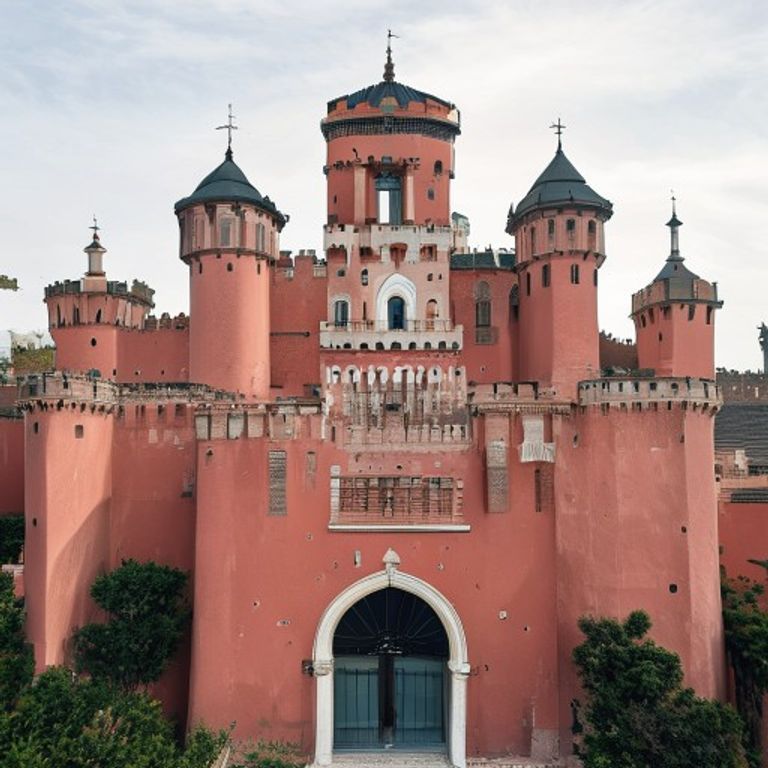
An immigrant single-handedly and secretly built a massive monument of stones weighing tons using methods no one has ever understood.
⚠️ Research conducted with the assistance of Deep Research is subject to referential ambiguity.
🖥️Clean HTML code using a proprietary tool.
👥 Research by Guilherme Felipe, Curation by Sílvio Lôbo
The Enigma of Coral Castle: A Shadow in Florida's History
Amidst the tropical heat of Florida, a monument of love, hard work, and for many, an unsolvable mystery, hovers over the swamps of Homestead. Coral Castle, the monumental work of a solitary man, Edward Leedskalnin, hides a secret that transcends mere engineering and delves into questions of lost love, inexplicable ingenuity, and the very limits of human knowledge. This article seeks to unravel, with investigative rigor, what truly happened with this stone enigma, separating the facts whispered by the rocks from the theories that echo in popular imagination.
1. The Context and the Incident: A Promise of Love and an Inexplicable Monument
The mystery of Coral Castle is not a crime in itself, but rather an architectural and existential enigma that began to form in the early 20th century. Edward Leedskalnin, a Latvian immigrant, arrived in the United States in 1904. According to reports, he was engaged to a young woman named Agnes Scuffs, who left him days before the wedding. Devastated, Leedskalnin vowed to build a monument for his beloved, a "castle" that would demonstrate his eternal love and his ability to create something grand.
Initially, Leedskalnin began his work in Florida City, but in 1936, due to land disputes, he moved to the current location in Homestead, taking the enormous coral stones with him. What followed was the construction of a complex of structures made entirely of coral stone blocks, some weighing several tons, assembled with a precision and technique that defy conventional explanations. The incident, if we can call it that, is not a singular event, but rather the very act of construction and Leedskalnin's existence as an ingenious hermit in his stone domain.
2. Timeline of Key Events
- 1904: Edward Leedskalnin emigrates from Latvia to the United States.
- Early 1920s: Leedskalnin buys land in Florida City and begins construction of what would become the first Coral Castle.
- 1936: Following land use disputes, Leedskalnin begins transferring his work to the new location in Homestead, a process that took years and involved the transport of hundreds of tons of coral stone.
- 1940s: Coral Castle begins to attract local attention due to its uniqueness and the apparent ease with which Leedskalnin moved and erected the heavy stones.
- 1951: Leedskalnin passes away in Miami under natural circumstances, according to medical reports of the time. The construction of the castle remained unfinished in some aspects.
- Post-1951: Coral Castle is sold and eventually opened to the public as a tourist attraction, perpetuating the mystery and drawing visitors from around the world.
3. The Main Theories: Unraveling the Stone Enigma
The fascination with Coral Castle lies largely in the inexplicability of its construction. Theories range from pragmatic explanations to speculations bordering on the fantastic:
-
The Police/Scientific Hypothesis: Human Ingenuity and Hidden Techniques
This theory, the most probable and accepted by authorities and the scientific community, attributes the construction to the ingenuity and persistence of Edward Leedskalnin. The logic is that, although the exact methods are not fully understood, he used basic principles of leverage, counterweights, and possibly rudimentary pulley systems and ramps. Witness accounts indicate that he worked alone, often at night, which heightened the mystery. Leedskalnin's lack of modern tools and his silence on his methods were crucial in fueling speculation. Subsequent analyses, though limited by the lack of remnants of the exact techniques, found no evidence of advanced technology or external intervention.
-
Conspiracy Theories: External Help and Government Secrets
Some theories suggest that Leedskalnin did not act alone. There is speculation about the possibility of help from individuals with advanced engineering knowledge or even the involvement of secret organizations. Some say he may have had access to experimental military technologies or that his work was part of a secret project. The lack of detailed documents about his life and the origins of his knowledge fuels these narratives.
-
Paranormal and Extraterrestrial Theories: The Manipulation of Matter
Perhaps the most popular and intriguing theories involve the manipulation of matter by inexplicable means. The idea that Leedskalnin used sonic levitation, telluric energy, or even extraterrestrial technology to move and shape the coral stones is frequently discussed. The explanation lies in the apparent absence of brute force or heavy machinery, and the precision with which the stones fit together. The peculiar nature of coral stones themselves, with their porous structure, is sometimes cited as a factor that could allow for such manipulation. However, there is no concrete evidence to support these hypotheses, which remain in the realm of speculation and folklore.
-
The Love Theory: The Power of Motivation
A more poetic, yet no less relevant, theory is that of the transformative power of love and motivation. Leedskalnin, driven by deep heartbreak, dedicated decades of his life to a monumental project. This motivational force, combined with his intelligence and relentless dedication, may have led to discoveries and techniques that, while human, seem superhuman to modern observers. This viewpoint emphasizes the resilience and creative capacity of the human spirit when faced with emotional adversity.
4. Controversies and Blind Spots: The Gaps in the Narrative
The investigation into Coral Castle is marked by several gaps and blind spots that perpetuate the mystery:
-
Lack of Detailed Documentation:
Edward Leedskalnin was a man of few words and little documentation. He rarely spoke about his construction methods, preferring to communicate through pamphlets and writings he published. There are no detailed architectural plans, construction diaries, or engineering records that explain the process.
-
Disappearance of Clues:
With the passage of time and changes in ownership, some of Leedskalnin's original tools and possessions may have been lost or discarded, hindering more in-depth forensic analysis.
-
Conflicting or Vague Testimonies:
The few witnesses who reported seeing Leedskalnin working often described fleeting glimpses or conditions of poor visibility, making their accounts difficult to corroborate.
-
The Nature of the Stone:
The exact origin and composition of the coral stones used are frequently discussed. The porosity and relative lightness of some types of coral compared to denser rocks may have aided in manipulation, but the scale of the feat is still impressive.
5. Curiosities and Legacy: An Icon of Inexplicable Ingenuity
Coral Castle has transcended its original purpose as a monument of love to become a cultural icon of Florida and a symbol of human ingenuity and mystery. Its peculiarities and the story of its creator have inspired books, documentaries, and urban legends.
-
Cultural Impact:
The castle attracts thousands of visitors annually, who come to admire the work and speculate about its secrets. It is one of Florida's most famous tourist sites, with an aura of mystery that distinguishes it from other attractions.
-
Leedskalnin's Legacy:
Edward Leedskalnin, the "coral madman," as some called him, left behind a legacy of hard work, relentless dedication, and a mystery that continues to inspire and intrigue. His writings, often enigmatic and philosophical, also contribute to the aura of mystery that surrounds him.
-
Current Status:
Coral Castle has been declared a National Historic Landmark and is open to the public. While it is not a "case" in a criminal sense that can be reopened, the mystery of its construction continues to be a topic of debate and fascination, without a definitive and universally accepted solution. It remains a silent testament to the human capacity to create the extraordinary, leaving the world to ponder the limits of what is possible.





