



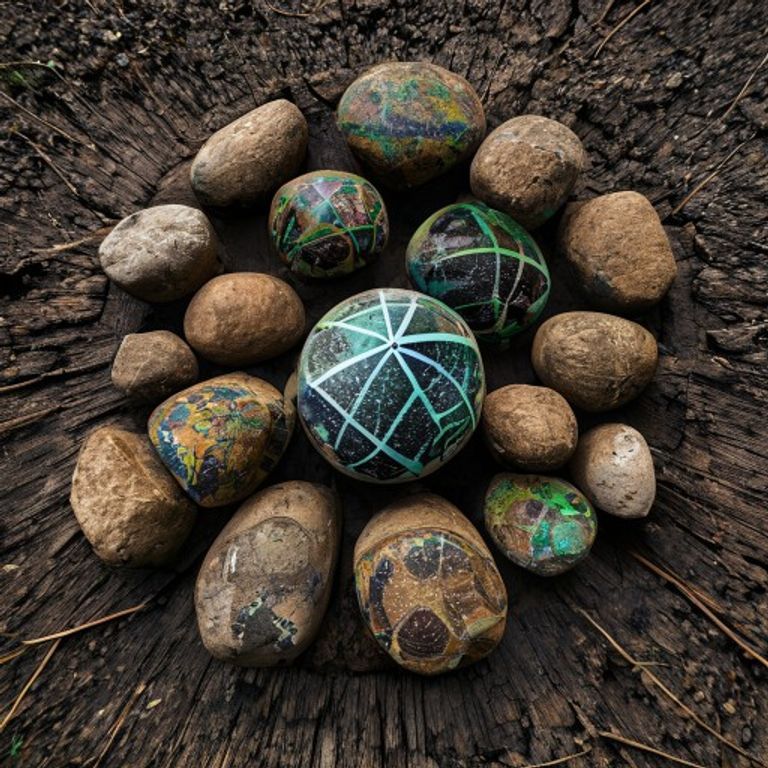
Hundreds of perfectly spherical carved stones have been found in the jungle, with their exact purpose and method of creation generating ongoing debates.
⚠️ Research elaborated with the aid of Deep Research is subject to referential ambiguity.
🖥️Clean HTML code using a proprietary tool.
👥 Research by Guilherme Felipe, Curation by Sílvio Lôbo
The Enigma of Costa Rica's Stone Spheres: An Investigative Dossier
By [Your Senior Journalist Name]
1. The Context and the Incident: Where, When, and How the Mystery Began
The mystery of the stone spheres of Costa Rica, also known as "Las Bolas", emerges from a geographical setting of singular beauty: the southern region of Costa Rica, particularly in the plains of Diquís, near the mouths of the Térraba and Sierpe rivers. These imposing geological formations, with diameters ranging from a few centimeters to over two meters, and weights that can exceed 20 tons, represent one of the most fascinating and challenging archaeological enigmas of Central America.
The "incident" does not refer to a single event, but rather to the gradual discovery and subsequent attempts to unravel the origin and purpose of these spheres, which began more systematically from the 1930s. Workers on a banana plantation owned by the United Fruit Company, while clearing dense vegetation, found the first traces of these perfectly spherical stones, some buried, others semi-exposed. News of the discovery generated curiosity, but the extraordinary nature and the difficulty in explaining their creation and transport by ancient pre-Columbian cultures laid the groundwork for a mystery that endures to this day.
2. Timeline of Events
- Late 19th / Early 20th Century: First sporadic discoveries by local populations and explorers, but without formal record.
- 1930s: The United Fruit Company undertakes extensive land clearing for banana plantation expansion in the Diquís region. During this process, hundreds of stone spheres are unearthed.
- 1939-1941: Archaeologist Samuel Lothrop, funded by Harvard University's Peabody Museum of Archaeology and Ethnology, leads the first scientific excavations and documentation of the spheres. He discovers over 180 spheres in various sizes and states of preservation.
- 1940s-1960s: The spheres gain international notoriety. Some are removed from their original locations, including the transfer of specimens to museums and private collections, often without proper scientific rigor.
- 1960s: The Costa Rican government takes measures to protect the Diquís archaeological site and most of the remaining spheres.
- 1980s onwards: New archaeological research and scientific analyses seek to shed light on the origin, manufacturing, and cultural significance of the spheres. The Guaica archaeological site and other sphere locations are declared National Heritage.
- 2014: The Stone Spheres of Diquís archaeological site is included in the UNESCO World Heritage Tentative List.
3. Main Theories
The absence of written records from the civilizations that created the spheres opens a vast field for speculation. Theories range from the scientific to the paranormal:
-
Scientific and Archaeological Theories (Most Probable Hypotheses)
- Manufacturing with Stone Tools and Polishing: The most accepted theory among archaeologists suggests that the spheres were shaped from large rocks of granodiorite or basalt. The process would involve using harder stone tools to rough out the raw rock, followed by a long and meticulous polishing process, possibly using sand and water. The spherical perfection would be achieved through continuous rotational polishing, possibly in rivers or areas with abrasive grains. It is believed that the technique involved using smaller stones to shape the rock and then polishing it with specific rocks, perhaps by rubbing the rock against other surfaces.
- Transport by Rivers and Land: The mobility of the spheres, some weighing tons, is one of the great enigmas. The most plausible hypothesis is that ancient inhabitants used the force of nearby rivers to transport the raw rocks to their work sites. Once shaped, they could have been dragged with the aid of ropes made from plant fibers, wooden logs as rollers, and a large number of people. Some researchers also speculate the use of leverage techniques and natural slopes.
- Cultural and Social Significance: It is believed that the spheres were not merely decorative objects but held deep social, political, and religious significance. Their distribution and alignment in certain sites suggest a role in rituals, territorial markers, or as status symbols for leaders or clan chiefs. The lack of weapons or war objects associated with them suggests a focus on peace and harmony, although this interpretation is speculative.
-
Alternative and Paranormal Theories (Speculations)
- Lost Technology / Advanced Civilizations: Some theories suggest that the perfection of the spheres points to a technological knowledge that transcends what is believed to be possible for pre-Columbian cultures. This leads to speculation about the existence of more advanced civilizations with unknown manufacturing and transportation methods, possibly involving sound, vibration, or other energies.
- Extraterrestrial Origin: More speculatively, the mystery leads some to theorize extraterrestrial intervention, with the spheres being artifacts left by visitors from other planets. This theory, while popular in ufology circles, lacks any scientific evidence.
- Exceptional Natural Phenomena: Although the sphericity and uniformity disfavor the idea of purely natural formation, some more exotic speculations address the possibility of extremely rare and unknown geological processes having shaped the rocks into spheres. However, human intervention is almost universally accepted by the scientific community.
4. Controversies and Blind Spots
The investigation and preservation of the stone spheres have not been without significant controversies and blind spots:
- Looting and Destruction of Evidence: During the period of mass discovery by the United Fruit Company, many spheres were removed from their original locations without any archaeological record. Some were broken in attempts to move them, or even destroyed under the belief that they contained gold, which was not proven. This action represented the irreparable loss of archaeological context and crucial data.
- Removal to Private Collections: Numerous spheres were sold or donated to museums and private collectors in different parts of the world. The difficulty in tracking and cataloging all these dispersed pieces hinders a complete understanding of the set and its original distribution.
- Lack of Detailed Records in Early Stages: The first "discoverers" and company workers did not possess the knowledge or intention to conduct precise archaeological surveys. Initial documentation, when it existed, was rudimentary, leaving significant gaps regarding the exact position and environment in which many spheres were found.
- Simplistic Interpretations: In some early stages, explanations were limited to attributing the spheres to generic natural phenomena or to populations without due recognition of their cultural and technological complexity.
- Absence of Organic Remains: The tropical climate of the region, with its high humidity and decomposition, rarely preserves organic remains such as wooden tools, fabrics, or bones in locations where the spheres were found. This lack of direct evidence about manufacturing and transportation methods forces researchers to infer from geological evidence and similar findings.
5. Curiosities and Legacy
The legacy of Costa Rica's stone spheres transcends the field of archaeology, impacting popular culture and national identity:
- National Symbol: The spheres have become one of Costa Rica's most recognized symbols, appearing on postage stamps, coins, and as part of the country's tourism identity.
- Inspiration for Legends: Their mysterious origin has fueled various local legends, some speaking of lost tools of the gods, others of ancient civilization war cannons.
- Ongoing Investigations: Although the discovery occurred decades ago, the study of the spheres continues. New analysis techniques, such as radiocarbon dating (when applicable to associated organic materials) and high-precision geological studies, seek to offer new clues.
- Preservation and Ecotourism: The inclusion of the Diquís site on the UNESCO tentative list reinforces the need for preservation and promotes ecotourism, allowing visitors to experience these monumental remains in their original context.
- The Continuing Puzzle: Despite scientific advances, the fundamental mystery remains: how exactly were these stones shaped with such perfection and transported by ancient civilizations, and what was their ultimate purpose? The stone spheres of Costa Rica continue to be a silent testament to ingenuity and the unknown, inviting reflection on the capabilities of past human societies.





