



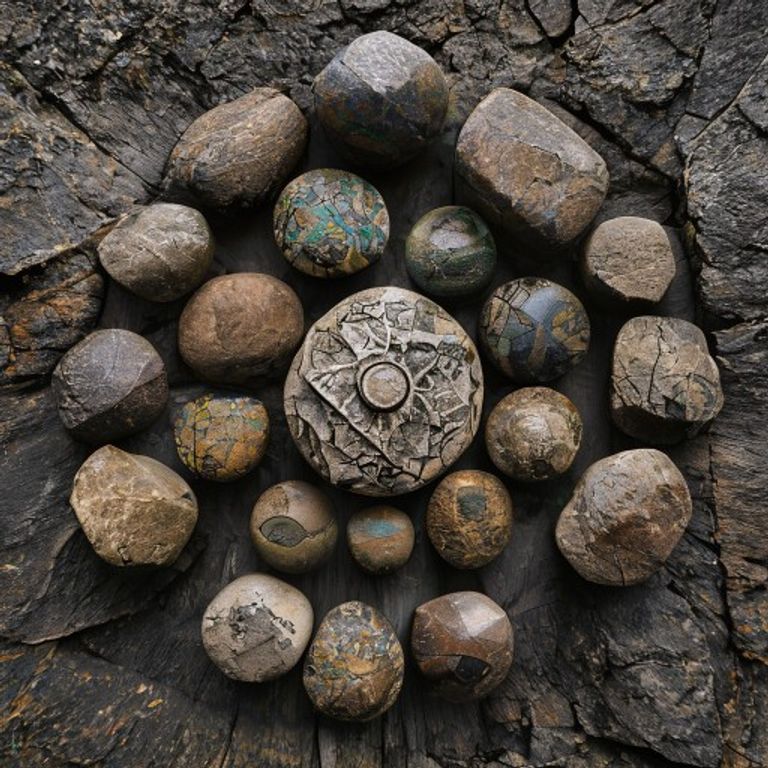
Hundreds of small stones carved with complex geometric symmetry were left by Neolithic European peoples with no record of their use or meaning.
⚠️ Research elaborated with the aid of Deep Research is subject to referential ambiguity.
🖥️Clean HTML code using a proprietary tool.
👥 Research by Guilherme Felipe, Curation by Sílvio Lôbo
The Silent Enigma of Scotland's Stone Balls: A Mystery That Haunts Time
In the ancient, legend-filled lands of Scotland, a peculiar and persistent mystery defies rational explanation. It is not a brutal passion crime or a lost treasure, but a silent enigma manifested in stone artifacts of unknown origin and purpose: the Scottish Stone Balls. These mysterious relics, found at various archaeological sites across the country, continue to intrigue archaeologists, historians, and enthusiasts of the inexplicable, casting a shadow of doubt over our knowledge of our ancestors.
The Context and the Incident: Where the Unknown Manifests
The Scottish Stone Balls are a group of lithic artifacts, generally spherical or sub-spherical, exhibiting remarkably precise finishing and, in many cases, intricate carvings. Their discovery is not associated with a single dramatic "incident" but rather with a gradual accumulation of findings in archaeological excavations spanning centuries. Most of these spheres are made of local rock, such as sandstone, granite, or serpentinite, and vary in size, from a few centimeters in diameter to over 20 centimeters.
The first formal record of a Scottish stone ball is often attributed to its discovery in Towie, Aberdeenshire, around 1860. Since then, hundreds of specimens have been unearthed at prehistoric sites, many associated with Neolithic and Bronze Age settlements. The most intriguing characteristic of these spheres is the presence of complex patterns carved into their surfaces. These patterns include concentric circles, spirals, dots, lines, and, in some cases, geometric figures that seem to encode an unknown meaning.
Timeline of Key Events
- Neolithic and Bronze Age (approximately 3000 BC - 500 BC): The period during which most stone balls are believed to have been created and used. Their exact purpose and the meaning of their carvings remain a mystery.
- 19th Century: Intensification of archaeological excavations in Scotland. Discoveries of numerous stone balls, including the notorious Towie ball, spurring scientific and public interest.
- Early 20th Century: Initial studies and attempts to classify the spheres. The first theories about their function emerge, ranging from ritual objects to tools.
- Mid-20th Century: Greater scientific rigor in excavations. Detailed analysis of the carved patterns, with experts attempting to decipher their symbolic language.
- 1970s and 1980s: Discovery of new spheres, some in burial contexts. Increased speculation about the spiritual or astronomical significance of the spheres.
- 21st Century: Ongoing research using new technologies, such as isotope analysis and 3D scanning, to try to unravel the origin of the materials and the precision of their manufacture. The mystery persists, fueling popular fascination.
Main Theories: Attempts to Decipher the Stone's Silence
The absence of written records from the time the spheres were created leaves a vast field for interpretation. Theories about their origin and function range from pragmatic explanations to more esoteric views.
Scientific and Archaeological Theories
- Weaving Tools or Spinning Wheels: Some archaeologists have suggested that the spheres could have been used as counterweights in primitive looms or as spinning wheels. The presence of holes in some spheres supports this hypothesis. However, the variety of sizes and the complexity of the carvings on many of them make this explanation insufficient.
- Game Objects or Status Symbols: The resemblance to balls could indicate their use in games. Alternatively, they could have been symbols of power or wealth, demonstrating the skill and status of their owners.
- Navigation or Measurement Instruments: The precision of the carvings, especially the circular and spiral patterns, has led some to speculate about their use in agricultural or time measurements, or even in some rudimentary form of navigation.
- Mythological or Religious Representations: The most widely accepted theory in traditional archaeology is that the spheres held ceremonial or religious significance. The patterns could represent constellations, cosmological myths, or abstract concepts of cosmology. The scarcity of spheres in habitation contexts and their greater prevalence in ritual or burial sites support this hypothesis.
Alternative and Paranormal Theories
- Astronomical or Solar Calendars: The precision of the carvings, which in some cases appear to correspond to lunar or solar cycles, leads to speculation that the spheres could have been used as sophisticated astronomical instruments, perhaps for predicting celestial events.
- Information Storage Devices or Symbolic Language: Some theorists believe that the carved patterns are not merely decorative but represent a writing system or a complex code containing information about the history, mythology, or knowledge of a lost civilization. Attempts to decipher these patterns have been unsuccessful to date.
- Lost or Alien Technology: In more speculative spheres, it is argued that the precision and complexity of their manufacture, especially when compared to other tools of the era, suggest an unknown advanced technology, possibly of extraterrestrial origin. The "perfect" nature of some spheres fuels this line of thought.
- Psychic or Spiritual Connection Artifacts: Some theories suggest that the spheres could have been used as focal points for shamanic rituals, deep meditation, or for connecting with spiritual energies. It is believed that the vibration or intrinsic energy of the stone, combined with the patterns, could have psychoactive or healing properties.
Controversies and Blind Spots: Where Truth Hides
The investigation into the Scottish Stone Balls is marked by gaps and inconsistencies that perpetuate the mystery.
- Lack of Clear Archaeological Context: In many cases, the spheres were found without a precise archaeological context, unearthed by farmers or laborers before the arrival of professional archaeologists. This makes exact dating and understanding their function within a specific site difficult.
- Loss of Evidence: Early reports of discoveries may be incomplete, or important data may have been lost over time. Some pieces from private collections, which could hold crucial clues, are not easily accessible for research.
- Subjective Interpretations of Patterns: The deciphering of the carvings is highly subjective. There is no clear consensus on the meaning of many symbols, and different scholars reach divergent conclusions. The lack of a "Rosetta Stone" for these patterns is a significant obstacle.
- Manufacturing Precision: The precision with which some spheres were shaped and carved, especially in hard rocks, raises questions about the tools and techniques available at the time. The lack of tools that explain this precision in many cases is a point of contention.
- Ignored Evidence: The history of archaeology is replete with examples where important clues were initially ignored or underestimated. It is possible that details observed in the field but considered irrelevant at the time could shed new light on the mystery today.
Curiosities and Legacy: The Whisper of Ages
The Scottish Stone Balls continue to exert a lasting fascination, transcending the academic realm and capturing the popular imagination.
- Cultural Icons: The spheres have become a symbol of prehistoric Scotland and its intrinsic mystery. They appear in books, documentaries, and even works of fiction, fueling curiosity about the past.
- Collector's Items: Authentic specimens are highly coveted by collectors and museums, with the best-preserved and most intricately carved ones fetching significant values.
- Ongoing Research: Although many spheres are in museum collections, active research continues. New finds, though rare, still occur, and new analysis technologies offer hope for uncovering new aspects of these relics.
- Status: The case of the Scottish Stone Balls has not been "solved" in the traditional sense. They remain an enigma to science, shelved in their silent magnificence. Research is ongoing, but a definitive consensus on their function and meaning is still distant.
The Scottish Stone Balls are a potent reminder that, even in an increasingly mapped and understood world, there are still profound mysteries that connect us to a distant past and to minds that operated under a different paradigm of knowledge than our own. They whisper stories of forgotten eras, inviting us to look beyond the obvious and contemplate the depths of the enigmatic human legacy.





