



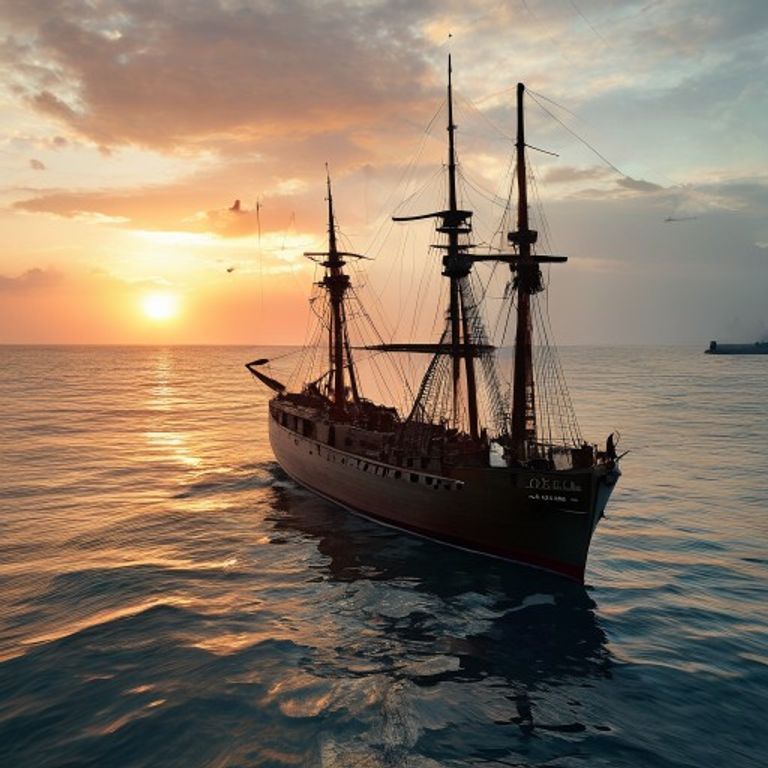
A massive cruise ship being towed for scrap broke its moorings in the Atlantic Ocean and reportedly drifted as a dangerous ghost ship.
⚠️ Research elaborated with the aid of Deep Research is subject to referential ambiguity.
🖥️Clean HTML code using a proprietary tool.
👥 Research by Guilherme Felipe, Curation by Sílvio Lôbo
The Ghost in the Icy Sea: Deciphering the Enigma of the Lyubov Orlova Ship
In an increasingly connected and transparent world, where every second is documented and every event, no matter how small, is reported, some enigmas persist, stubbornly defying logic and investigation. The case of the Lyubov Orlova ship is one of those icy mysteries that float in the murky waters of uncertainty, a testament to the persistence of untold stories and the fragility of our certainties. What happened to the luxurious Russian cruise ship, and more crucially, what caused its disappearance seemingly without leaving significant traces? This investigation delves into the depths of this enigma, separating proven facts from the mists of speculation.
1. Context and the Incident: The Beginning of an Icy Mystery
The Lyubov Orlova, a luxury passenger ship built in the former Yugoslavia in 1976, was a symbol of Soviet maritime glory and ambition. Designed for expedition cruises in polar regions, it served with distinction on various voyages, carrying tourists and scientists to the Arctic's farthest reaches. However, the change of regimes and the economic restructuring of Russia after the collapse of the Soviet Union marked the beginning of its decline.
After a period of financial difficulties and inactivity, the ship was seized in 2010 due to accumulated debts. Its seizure occurred in St. John's, Newfoundland, Canada, where it remained docked and in relative abandonment. What followed was a slow and bureaucratic process of recovery and eventual auction, culminating in its sale in 2012 to a dismantling company. The idea was for the ship to be towed to the Dominican Republic and scrapped. It was during this tow, in January 2013, that the Lyubov Orlova shockingly disappeared.
The central event that initiated the mystery was the breaking of the tow cable between the Lyubov Orlova and its tugboat, the MV Chignik, during a severe storm in the North Atlantic Ocean, about 1,300 nautical miles off the coast of Newfoundland. The ship was left adrift, a sleeping giant at the mercy of the waves.
2. Timeline of Events: The Clear Facts and the Shadows
A chronological reconstruction of events is crucial to unraveling what happened to the Lyubov Orlova:
- 1976: Construction of the Lyubov Orlova ship in Yugoslavia.
- 1980s-2000s: Period of active service on expedition cruises, mainly in the Arctic.
- 2010: The ship is seized in St. John's, Newfoundland, Canada, due to debts.
- 2010-2012: Period of inactivity and deterioration in St. John's.
- 2012: The ship is sold to a dismantling company with the aim of being towed to the Dominican Republic.
- January 29, 2013: The Lyubov Orlova is towed from St. John's, Canada, by the tugboat MV Chignik. The ship's crew was removed before the tow, leaving the vessel unmanned.
- January 30, 2013: The storm intensifies.
- January 31, 2013: A tow cable breaks, and the Lyubov Orlova is left adrift. The crew of the MV Chignik attempts, unsuccessfully, to re-establish the tow.
- Early February 2013: The MV Chignik, with limited resources and facing adverse weather conditions, abandons the recovery attempt and heads for safer ports. The last known contact with the ship is made.
- February-March 2013: Various unconfirmed reports and sightings emerge, but the ship is not located.
- March 2013: Canadian authorities declare the Lyubov Orlova missing and officially lost at sea.
3. Main Theories: Labyrinths of Possibilities
The disappearance of the Lyubov Orlova has generated a myriad of theories, some anchored in facts and others navigating the currents of imagination.
3.1. Theories Based on Facts and Logic (Scientific and Police)
- Sinking due to Structural Damage and Weather Conditions: This is the most probable hypothesis and widely accepted by authorities. The ship, neglected for years, already showed signs of deterioration. A violent storm in the North Atlantic, with giant waves and strong winds, could have caused catastrophic damage to the already compromised structure, leading to its rapid submersion. With no crew on board, there was no one to send a distress call. The absence of debris can be explained by the ocean's depth and maritime currents.
- Prolonged Drift and Natural Dismantling: It is possible that the ship remained adrift for weeks or months, being gradually destroyed by environmental conditions. Rusted metal, wave action, and the elements could have dismantled the ship into smaller pieces, impossible to track afterward.
3.2. Alternative and Speculative Theories
- Deliberate Abandonment for Insurance or Material Recovery: A less probable, but still considered, theory is that the tugboat's crew deliberately released the ship adrift. The motives could vary, from the hope of obtaining a larger insurance payout for the ship considered lost, to the intention of recovering it later for dismantling elsewhere, avoiding costs. However, there is no concrete evidence to support this hypothesis, and it would have been a high-risk operation with few guarantees.
- Furtiveness and Sale on the Black Market: Given the ship's age and commercial value, it is speculated that it could have been "hijacked" by a group interested in selling it in parts or as a ghost ship for illicit activities. This theory is highly speculative and lacks any proof.
- Paranormal and UFO Theories: Like many maritime enigmas, the case of the Lyubov Orlova has not escaped more fantastic theories. Some reports, often anecdotal and without scientific basis, suggest the presence of paranormal activities on board, which could have led to its disappearance. Other more audacious theories mention possible alien involvement or the creation of a ghost ship powered by inexplicable forces. These theories, while intriguing for fiction, have no factual or scientific basis.
4. Controversies and Blind Spots: Gaps in the Investigation
The official investigation into the disappearance of the Lyubov Orlova, while following protocols, presents points that raise questions and fuel the mystery:
- Lack of Debris: The absence of significant debris after such a long period adrift in a shipping lane is one of the most intriguing points. Although the ocean's depth and currents can partially explain it, the total scarcity of evidence is remarkable.
- Limited Communication from the Tugboat: Information regarding the recovery attempts and the exact reasons for the MV Chignik's abandonment of the mission is, in some aspects, limited. Extreme weather conditions may have hindered communication and decision-making, but the precise details of conversations and risk assessments have not been widely disclosed.
- Unconfirmed Sighting Reports: For weeks after the disappearance, rumors and alleged sightings of the ship circulated. However, none of these reports were conclusively confirmed, increasing the aura of mystery and speculation.
- Ignored Deterioration: The fact that a ship in such an advanced state of deterioration was put on a long-distance tow, under potentially severe weather conditions, raises questions about the risk assessments and due diligence of the companies involved.
5. Curiosities and Legacy: A Ghost Ship in Collective Memory
The case of the Lyubov Orlova has transcended maritime news to become a modern legend. The image of a luxurious ship, once full of life and now adrift in a relentless ocean, evokes a powerful melancholy and a fascination with the unknown.
- Cultural Impact: The disappearance of the Lyubov Orlova has inspired countless articles, documentaries, and online discussions. It has become a symbol of the dangers of the sea, the fragility of vessels, and the persistence of unresolved mysteries.
- Current Status: Officially, the Lyubov Orlova ship is considered lost at sea. Active searches ceased after a reasonable period without success. The case remains open in terms of a definitive outcome, with the theory of sinking due to structural damage and adverse weather being the most plausible explanation. However, the absence of concrete evidence and the vastness of the Atlantic Ocean ensure that the Lyubov Orlova will continue to sail in the waters of imagination and mystery for a long time to come.
The Lyubov Orlova is more than a missing ship; it is a somber reminder that, even in our age of ubiquitous information, the sea still holds its deepest secrets, challenging our ability to find definitive answers and leaving only the echo of an unfinished story in the icy vastness of the North Atlantic.





