



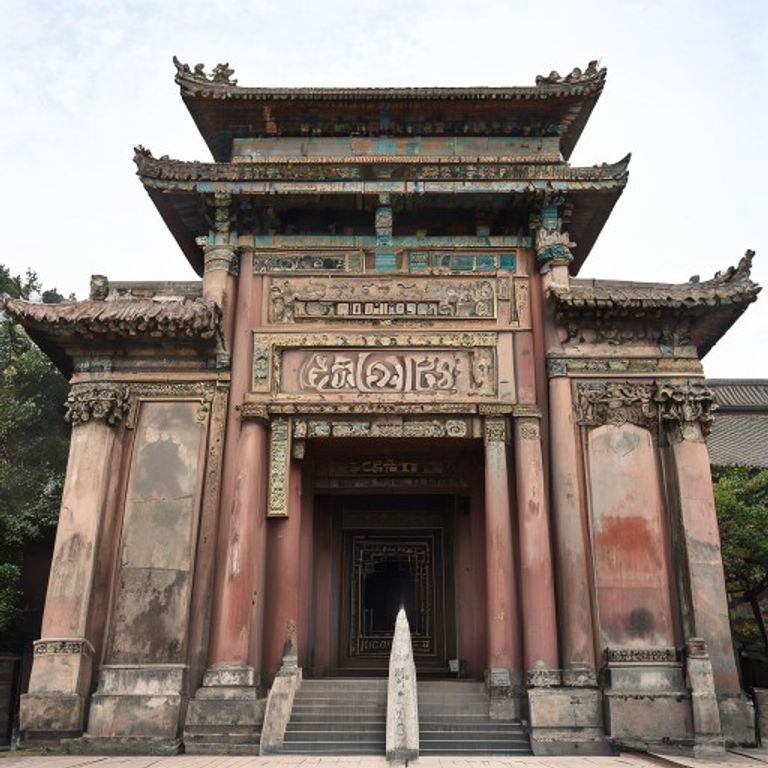
The immense funerary complex of the first Chinese emperor is guarded by a terracotta army, but the main chamber remains sealed and protected by supposed highly toxic mercury rivers.
⚠️ Research elaborated with the aid of Deep Research is subject to referential ambiguity.
🖥️Clean HTML code using a proprietary tool.
👥 Research by Guilherme Felipe, Curation by Sílvio Lôbo
The First Emperor's Enigma: Unraveling the Mystery of Qin Shi Huang's Mausoleum
In the depths of the province of Shaanxi, in China, lies one of history's greatest archaeological treasures and, at the same time, one of its most profound unsolved mysteries: the Mausoleum of Qin Shi Huang. Described by ancient historians as an underworld of wonders and terrors, this colossal funerary complex, home to the first emperor of unified China, hides secrets that defy modern understanding. This article delves into the known facts, the theories attempting to make sense of the inexplicable, and the gaps that fuel the suspense surrounding this singular monument.
1. The Context and the Incident: The Shadow of the Immortal Tyrant
The mystery does not lie in a single isolated "incident," but rather in the very nature of the Mausoleum of Qin Shi Huang, the construction of which began as soon as he ascended the throne in 246 BC and continued for nearly four decades until his death in 210 BC. The edifice, a pharaonic project that involved hundreds of thousands of workers, aimed to replicate the emperor's universe in the afterlife. Accounts from historians like Sima Qian, in his work "Records of the Grand Historian" (Shiji), paint a vivid picture of an intricate underground system, replete with mercury rivers, palaces, treasures, and even a terracotta army to guard it. The true "incident" is the inability of modern science and archaeology to fully access and comprehend what lies at the heart of the funerary mound, protected by a complex system of defenses, both natural and, it is speculated, artificial.
2. Timeline of Events (and Non-Events): A Chronology of Mysteries
- 259 BC: Birth of Ying Zheng, the future Qin Shi Huang.
- 246 BC: Construction of the Mausoleum begins.
- 221 BC: Ying Zheng unifies China, becoming the First Emperor.
- 210 BC: Death of Qin Shi Huang. Construction of the Mausoleum continues under the command of Zhao Gao and Li Si.
- 209-207 BC: Revolt of Chen Sheng and Wu Guang. There are reports of looters entering the Mausoleum, but with little apparent success.
- 1975: Discovery of the Terracotta Army by local peasants during agricultural excavations, attracting worldwide attention.
- 1980s onwards: Commencement of more in-depth excavations and studies around the funerary mound. The main interior of the Mausoleum remains sealed and untouched.
3. Main Theories: Seeking Answers in Hidden Lands
What lies hidden at the center of the Mausoleum is the core of the mystery. Theories range from scientifically grounded to purely speculative:
3.1. Scientific and Archaeological Hypotheses (Based on Evidence and Analogies)
- Mercury Rivers: Sima Qian described rivers of mercury circulating the tomb. Soil analyses around the mound have confirmed abnormally high concentrations of mercury, suggesting that the description was not merely a metaphor but a real system, possibly to preserve the body or create a toxic environment against looters. The scale and exact functioning of this system, however, are unknown.
- Treasures and Artifacts: It is believed that the Mausoleum houses a vast collection of artifacts from the Qin dynasty, including historical documents, artworks, and even imperial furnishings. The lack of significant looting in the outer levels of the terracotta army suggests that the main content may be intact, at a considerable depth.
- Advanced Technology: Some theories postulate the use of sophisticated hydraulic engineering to create the tomb's defenses, perhaps involving water trap systems or complex mechanisms to seal the entrances.
3.2. Alternative and Speculative Theories
- Traps and Mystical Defenses: Sima Qian also mentioned arrow traps and the possibility of "long-range traps" to deter intruders. The nature of these defenses is debated, potentially ranging from mechanical devices to supposed "mystical" or "energetic" protections.
- Qin Shi Huang's "End of the World": A bolder theory suggests that the Mausoleum was designed to simulate the Earth itself, with the emperor at its center, "ruling" the underworld. The complexity of the design suggests an obsession with control and immortality, which may have led to unprecedented architectural and technological innovations for the time.
3.3. Conspiracy and Paranormal Theories
- Alien/Ancient Protections: One of the most speculative theories links the Mausoleum to advanced ancient civilizations or even extraterrestrial interference. It is argued that the scale and sophistication of the construction would have been impossible with the technology of the era, suggesting "borrowed" or "inherited" knowledge.
- Psychic or Cosmic Energies: Some believe that the Mausoleum could be a center of cosmic or psychic energy, with the emperor seeking to prolong his consciousness through non-scientific means. The presence of mercury, a metal with conductive properties, is sometimes cited as evidence for this line of thought.
- Preservation of Body or Consciousness: There are speculations that the Mausoleum could house methods of bodily or even consciousness preservation that go beyond current scientific understanding, keeping the emperor "alive" in some state.
4. Controversies and Blind Spots: What Is Hidden?
The main blind spot is, evidently, access to the main tomb. Chinese authorities, under the guidance of archaeologists and historians, have been extremely cautious not to disturb what may be an extremely delicate and potentially dangerous structure. Controversies include:
- The Risk of Irreparable Damage: Opening the tomb could expose precious artifacts to unfavorable environmental conditions, leading to their deterioration. The presence of mercury also poses a risk to workers and the environment.
- Protection of Historical Legacy: There is ongoing debate about whether the risk of discovery outweighs the preservation of the mystery. Some argue that the Mausoleum, untouched, may offer more to the imagination and study than an intervention that could damage what it represents.
- Fragmented Official Reports: While there are many reports of excavations on the periphery, detailed information about the internal conditions of the main Mausoleum is scarce and often based on interpretations of ancient texts, given the impossibility of direct excavation.
- Missing or Ignored Evidence: Ancient history is full of narratives about looters. The lack of signs of massive looting in the deeper levels is, in itself, intriguing evidence, but it also raises the question of whether ancient accounts of invasions were fully understood or if important clues were overlooked in favor of more "comfortable" theories.
5. Curiosities and Legacy: An Icon of Chinese History
The Mausoleum of Qin Shi Huang is a testament to the power, ambition, and fear of death of an emperor. Its cultural legacy is immeasurable:
- Terracotta Army: The discovery of the Terracotta Army, with its thousands of life-size figures of warriors, horses, and chariots, is already one of the most important archaeological finds of the 20th century, providing an unprecedented glimpse into the army and art of the Qin dynasty.
- UNESCO World Heritage Site: The Mausoleum complex and the Terracotta Army were declared a UNESCO World Heritage Site in 1987.
- Current Status: The main Mausoleum remains closed to the public. The official policy is preservation and continuous research through non-invasive methods, such as ground-penetrating radar and other remote technologies. The case has not been "reopened" in the sense of a police investigation, as there was never a crime to solve. However, exploration and the attempt to unravel its secrets continue actively in the fields of archaeology and history.
- Cultural Inspiration: The mystery of the Mausoleum inspires countless documentaries, books, and works of fiction, perpetuating its fascination and aura of enigma.
Until science and archaeology find safe and ethical means to penetrate the heart of the Mausoleum of Qin Shi Huang, the first emperor of China will continue to reign over an empire of mysteries, a silent monument to grandeur and the secrets that time insists on keeping.





