



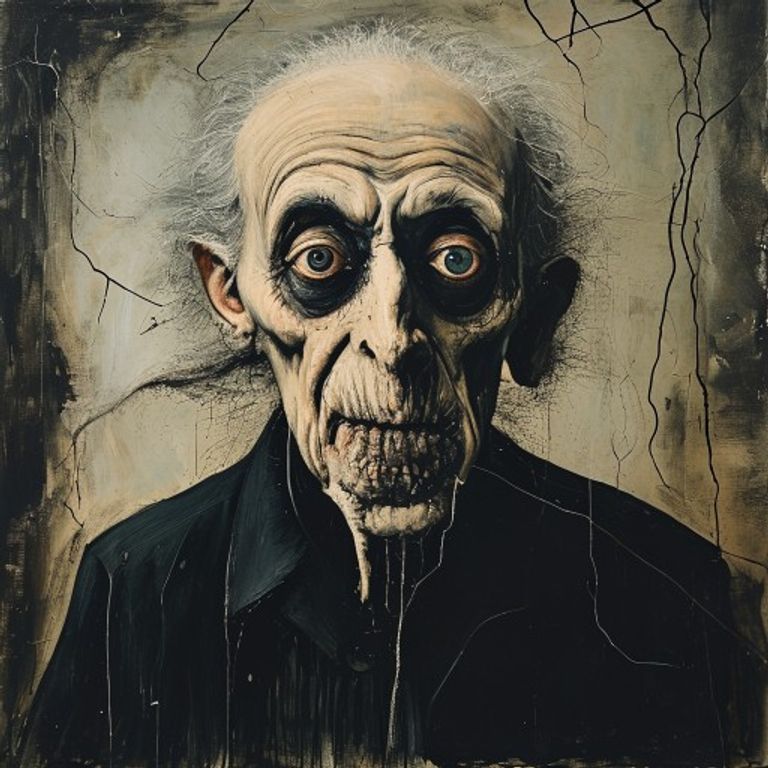
A young Canadian woman from the nineteenth century became the center of one of the most well-documented cases of violent paranormal activity involving fires and frightening messages on the walls.
⚠️ Research elaborated with the aid of Deep Research is subject to referential ambiguity.
🖥️Clean HTML code using a proprietary tool.
👥 Research by Guilherme Felipe, Curation by Sílvio Lôbo
The Amherst Poltergeist: A Ghost Town's Enduring Enigma
The small town of Amherst, Massachusetts, holds in its annals one of the most persistent and enigmatic cases in American paranormal folklore: the Amherst Poltergeist Case. What began as a series of strange events at the Sinclair family residence evolved into a phenomenon that defied rational explanations and has attracted the attention of investigators, scientists, and the curious for decades. This article delves into the depths of this mystery, separating the factual from the speculative, in the search for the truth behind the noises, moving objects, and the terrifying atmosphere that settled over Amherst.
The Context and the Incident: Where the Unexplained Began
The epicenter of the mystery was the house located at 39 Leavitt Street, in Amherst, Massachusetts. Starting in 1971, the phenomena began to manifest gradually but increasingly disturbingly. The Sinclair family, consisting of George Sinclair, his wife Esther, and their children Margaret and James, were the primary witnesses and victims of the events. Initially, it involved inexplicable sounds, knocks on the walls, and objects that seemed to move on their own.
What differentiated this case from other haunted house stories was its persistence, apparent randomness, and, crucially, the frequent presence of external witnesses, including authorities and investigators. The house, with its history of occupants and local rumors, became the stage for a drama that would transcend everyday reality.
Timeline of Key Events
The chronological reconstruction of events in the Amherst Poltergeist Case is fundamental to understanding the progression of the phenomenon:
- Early 1971: The first reports of strange noises and moving objects begin to be noticed at the Sinclair family residence.
- Mid-1971: The phenomena intensify. Objects begin to levitate and move visibly. The Sinclair family seeks external help.
- Fall 1971: Paranormal investigators and journalists begin to take an interest in the case. Reports of "voices" and "apparitions" become more frequent.
- December 1971: Local and national media begin to cover the case more broadly, generating a media frenzy.
- 1972: The case reaches its peak of notoriety. Several investigators, including teams from the University of Massachusetts, attempt to document the events.
- Subsequent Years: Although the intensity of the phenomena decreased with the Sinclairs' departure from the house, the case continued to be studied and debated, becoming a landmark in poltergeist studies.
Main Theories: Deciphering the Shadow
The Amherst Poltergeist Case has generated a myriad of theories, attempting to reconcile the inexplicable with the rational:
Scientific and Police Theories (High Probability):
- Stress-Induced Psychokinetic (PK) Phenomena: This is one of the most supported theories in the scientific community. The idea is that an individual in a state of deep emotional stress, possibly an adolescent or young adult, can unconsciously manifest energies capable of interacting with the physical environment. In the Amherst case, the focus often falls on the teenage daughter, Margaret Sinclair, who was experiencing emotional turmoil at the time. Reports from investigators like Hans Bender and the American Society for Psychical Research (ASPR) explored this possibility, documenting the young woman's presence and emotional state during the events.
- Deception and Fraud: As with many paranormal cases, the hypothesis of intentional staging by residents or third parties cannot be dismissed. However, the presence of independent witnesses and the number of phenomena observed by multiple individuals make this theory harder to sustain as the sole explanation. Expert analyses and police investigations, though often inconclusive, also sought evidence of fraud, but the results were ambiguous.
- Unexplained Environmental Factors: The possibility of unusual natural or geological phenomena has not been fully explored. Variations in atmospheric pressure, gases emanating from the ground, or even subtle electromagnetic interference could theoretically cause objects to move or produce strange sounds. However, the specific nature and intensity of the events in Amherst make this explanation less likely as the sole cause.
Alternative and Paranormal Theories (Speculation):
- Spirit or Entity Activity: The most traditional poltergeist theory posits the action of disembodied spirits, restless souls, or supernatural entities. These entities, according to belief, would be attracted to the residence or to some traumatic event that occurred there, manifesting through physical disturbances. The house's history and the atmosphere of fear reported by residents fuel this line of thought.
- Residual Energy from Past Events: A variation of the spiritualist theory suggests that traumatic events or intense emotions leave an energetic "mark" on a location, which can manifest over time as inexplicable phenomena.
- Psychic or Psychotronic Physicality: Some more esoteric theories suggest the use of mental or "psychotronic" energies by entities or even by the earth itself, with the capacity to interact with matter.
Controversies and Blind Spots: The Cracks in the Investigation
The investigation of the Amherst Poltergeist Case was not without its problems, leaving gaps and fueling speculation:
- Conflicting Testimonies: Although there were many consistent reports of phenomena occurring, specific details about the nature and origin of the events sometimes varied among testimonies, especially when it came to individual perceptions of "presences" or "voices."
- Missing or Inconclusive Evidence: Reports of concrete physical evidence, such as strange impressions or inexplicably damaged objects, were sometimes not properly documented or were lost over time. Photographs and recordings from the era, although they exist, often lack the clarity needed for definitive conclusions.
- Excessive Focus on One Individual: The strong inclination of many investigators to center the explanation on Margaret Sinclair, while understandable given the theory of stress-induced PK, may have led to a reduced focus on other possible environmental causes or external factors.
- Lack of Universal Scientific Rigor: In many of the initial investigations, the scientific rigor required for validating discoveries was not entirely maintained. The difficulty in replicating the phenomena under controlled conditions made scientific validation a constant challenge.
Curiosities and Legacy: The Shadow That Remains
The Amherst Poltergeist Case transcended the boundaries of the town and the field of paranormal research, shaping popular culture and the imagination about inexplicable phenomena:
- Cultural Inspiration: The case inspired books, documentaries, and films, including the famous 1982 movie "Poltergeist," which, although fictionalized, drew directly from the narratives and atmosphere of Amherst.
- Ongoing Challenge for Science: To this day, the case is cited in discussions about the nature of consciousness, the limits of human perception, and the possibility of psychokinetic phenomena.
- Current Status: Officially, the case remains an "unsolved mystery." Although the house has changed owners and the intensity of the phenomena has significantly decreased over time, the legend and fascination surrounding the Amherst Poltergeist persist. There has been no formal reopening of investigations by official security agencies, but the paranormal research community continues to analyze the available data and testimonies.
- The Silent Memorial: The residence at 39 Leavitt Street, though an ordinary house today, carries the aura of a place where the veil between the known and the unknown seemed to have become dangerously thin.
The Amherst Poltergeist Case serves as a reminder that, even in a world increasingly explained by science, there are dark corners of mystery that challenge our understanding and continue to intrigue us, keeping alive the flame of investigation and the pursuit of truth, however elusive it may be.





