



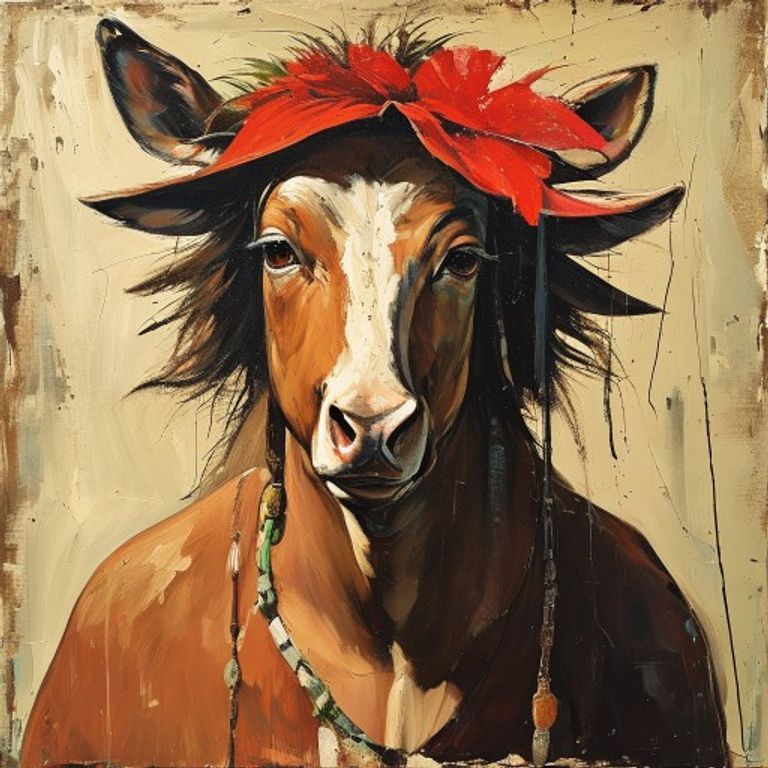
"A Carne" (The Flesh) is a novel by Brazilian writer Júlio Ribeiro, published in 1888. The work is considered one of the first naturalist novels in Brazilian literature and caused great controversy at the time due to its daring content, especially for dealing with themes such as sexual desire and female freedom in a very explicit manner for 19th-century standards.
The plot revolves around Lídia, a young woman who moves to her uncle's farm after her father's death. On the farm, she meets Manuel Barbosa, an older man and the farm owner, with whom she falls in love. The novel explores the development of this passion, focusing on Lídia's physical desire and the tensions between her feelings and the moral standards of the time.
"A Carne" provoked mixed reactions among critics and readers of the time. On one hand, it was praised for its daring and literary style; on the other, it was harshly criticized for its approach, considered immoral, to issues such as sexuality and female behavior. The book is a clear example of the influence of Naturalism, a literary movement that sought to portray human beings and society in a more objective and scientific manner, highlighting instincts and the influences of environment and heredity.
This work is important within the context of Brazilian literature for opening space for discussions about sexuality and the role of women in society.
⚠️ Research generated with the aid of Deep Research may be subject to referential ambiguity.
🖥️Clean HTML code with the use of a proprietary tool.
👥Research by Guilherme Felipe, Curation by Sílvio Lôbo
The Flesh, Júlio Ribeiro: An In-Depth Study
The novel "A Carne" (The Flesh), published in 1888 by Brazilian writer Júlio Ribeiro, is a unique and unsettling work that fits within the context of Naturalism but transcends its conventions with a visceral intensity and a dive into the human psyche that makes it unique for its time.
The Plot and Its Protagonists
The central narrative revolves around Leninha, a young woman who, after the death of her husband, the wealthy and infertile Dr. André, finds herself engulfed in a whirlwind of repressed desires and moral conflicts. Leninha's character is complex, oscillating between apparent virtue and a latent carnal drive, which manifests overwhelmingly.
The backdrop of the story is Rio de Janeiro society of the time, depicted with a critical and sometimes satirical eye. The hypocrisy of the elite, marriage for convenience, and the sexual repression of women are underlying themes that emerge forcefully through the characters' actions and thoughts.
Central Themes and In-Depth Analysis
The Awakening of Sexuality and "The Flesh"
The book's title already anticipates the driving force of the work: the flesh. Júlio Ribeiro does not limit himself to portraying romantic love or idealized passion. He explores sexuality in a raw and unidealized way, focusing on instinct, physical desire, and its capacity to dominate reason. "The flesh" in "A Carne" represents primary drives, the body that craves satisfaction, often at the expense of morality or social conventions.
Female Submission and Rebellion
Leninha is the embodiment of a woman who, suffocated by social constraints and her own nature, finds herself in an unbearable dilemma. Her journey is marked by the struggle between what is imposed on her and what her body and soul yearn for. This duality leads her to extreme acts that shocked the society of her time and still provoke reflection on the condition of women and the repression of sexual freedom.
Decay and Pathology
Following naturalist precepts, Ribeiro incorporates elements of pathology and decay into "A Carne." Leninha's drives, for example, can be interpreted as a deviation from the norm, a manifestation of a moral and physical "illness." The work delves into the darker aspects of human nature, exploring the vices, madness, and weaknesses that haunt individuals.
Curious and Striking Points
The Use of Language and Descriptive Rawness
One of the most striking aspects that causes bewilderment is the language used by Júlio Ribeiro. Far from the polished and rhetorical language of many of his contemporaries, he employs a vocabulary that is sometimes raw, descriptive, and even scatological to portray the physicality of the characters and their desires. This rawness contributes to the feeling of unease and the reader's immersion in the visceral universe of the work.
The Exposure of the Psyche and Unconfessable Desires
Ribeiro boldly ventures into the depths of his characters' minds, exposing desires that were considered taboo and unconfessable in the society of the time. The way he describes Leninha's fantasies and impulses, for example, is devoid of modesty and shocking in its brutal honesty. This unfiltered moral exploration is one of the pillars that make "A Carne" such an impactful work.
The Influence of Scientism and Biology
Although a literary work, "A Carne" reflects the strong influence of scientism and biological theories of the time. The idea that human behavior is determined by biological and physiological factors is present in the work, especially in how carnal instinct is portrayed as an almost inexorable force. Dr. André's impotence and Leninha's consequent frustration are explored from this perspective, bordering on biological determinism.
The Shock of Novelty and Reception
It is important to remember that "A Carne" was published at a time when Brazilian literature was still adapting to more conservative standards. The work's reception was, therefore, one of shock and repulsion by many critics and readers. Ribeiro's thematic and stylistic daring challenged the moral and aesthetic conventions of the time, generating controversy and, paradoxically, propelling the work to a prominent place in the national literary canon.
Conclusion
"A Carne" by Júlio Ribeiro is a work that resists simplistic classifications. It is a naturalist novel in its essence, but it rises through its psychological depth, thematic daring, and the power of its language. The exploration of female sexuality, social critique, and immersion in human nature, sometimes dark and instinctual, make "A Carne" a landmark in Brazilian literature, a work that, even today, continues to provoke, unsettle, and spark debate.





