



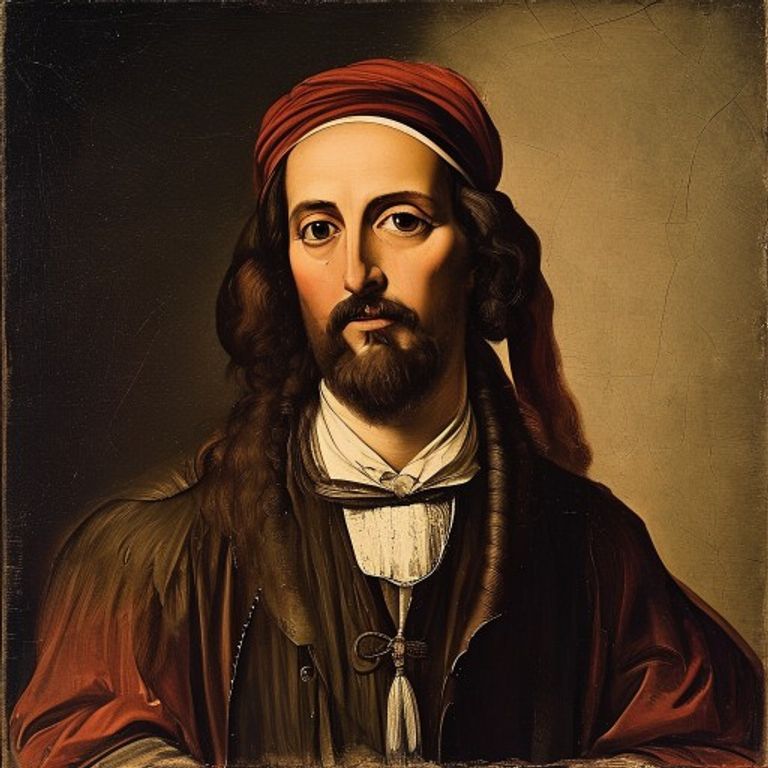
Text by: Mirna Queiroz Source: http://www.vidaslusofonas.pt
Poet, 1524(?) - 1580(?)
WHEN EVERYTHING HAPPENED...
1524 or 1525: Probable birth dates of Luís Vaz de Camões, perhaps in Lisbon. - 1548: Exile in Ribatejo; enlists in the Overseas Army. - 1549: Embarks for Ceuta; loses his right eye in a skirmish against the Moors. - 1551: Returns to Lisbon. - 1552: In a fight, wounds an official of the Royal Stables and is arrested. - 1553: Is released; embarks for the East. - 1554: Departs from Goa in pursuit of Moorish merchant ships, under the command of Fernando de Meneses. - 1556: Is appointed chief factor in Macau; shipwrecks on the coast of Cambodia. - 1562: Is arrested for unpaid debts; is released by Viceroy Count of Redondo and becomes his protégé. - 1567: Travels to Mozambique. - 1570: Returns to Lisbon on the ship Santa Clara. - 1572: The first edition of "Os Lusíadas" is published. - 1579 or 1580: Dies of plague in Lisbon.
VOYAGE TO INDIA
Camões is exiled to India. And meanwhile, what is happening in the rest of the world? Consult the Chronological Table.
1552. Corpus Christi. In Rossio Square, two masked men fight with Gaspar Borges, an official of the Royal Stables. Camões approaches, recognizes the masked men as his friends. He doesn't hesitate, reaches into his pocket, and joins the brawl. Knife in hand, a nervous movement, a stab to the opponent's neck. The night ends in blood. Camões is arrested and taken to the Tronco prison.
His mother, Dona Ana de Macedo, mourns her son's imprisonment. She pleads for Luís's pardon: she visits royal ministers and Borges himself. After nine months, the victim, having recovered from the wound, decides to grant the request.
It's a day of some freedom for Camões. The poet leaves the dungeons under two conditions: first, he must pay a fine of 4 thousand reis to the King's almoner; second, he must embark for India and serve for three years in the army of the East.
In March 1553, the poet departs for Goa on the São Bento, a ship incorporated into the fleet commanded by Captain Fernão Álvares Cabral. He is a common soldier. He arrives in the capital of Portuguese India six months later. With pen and paper always at hand, the poet writes about what he sees:
"(...) Here, where evil refines itself and good is ruined,
And tyranny prevails over honor;
Here, where mistaken and blind monarchy
Believes that an empty name deceives God;
(...) Here, in this dark chaos of confusion,
I am fulfilling the course of nature.
Will I forget you, Zion!" (1)
Camões participates in a punitive expedition against the King of Chemba, on the Malabar Coast, sent by Viceroy D. Afonso de Noronha. Victory. The poet returns to Goa. In February 1554, he departs again under the command of D. Fernando de Meneses. This time, in pursuit of Moorish ships trading between India and Egypt, harming the Portuguese trade monopoly. The fleet only returns to India in November of the same year.
Military leave arrives, end of salary. To earn some money, Camões writes verses and plays on commission for a powerful lord who presents them as his own to a lady he desires. In return, he receives scraps of food. The poet also becomes a public scribe. Many soldiers are illiterate. Camões writes letters to their families back home. He lives this way in Goa until 1556: "Near a dry, hard, barren mountain"(2). "With a pen in one hand and a sword in the other."(3)
THE SHIPWRECK
End of mandatory service in the army of the East. Camões is appointed chief factor in Macau, a Portuguese trading post in China. He is tasked with inventorying and provisionally administering the assets of deceased or missing persons. There, he discovers a narrow cave, a refuge. He spends hours writing "Os Lusíadas": Vasco da Gama's epic voyage and, at the southern tip of Africa, the giant Adamastor trying to prevent the advance of the Portuguese navigators:
«I am that hidden and great Cape
Whom you call the Stormy One.»
Tragic maritime heroes; mythological gods, passions, intrigues, battles, adventures, and greed. Stories of a tiny Portugal in expansion, "more than human strength promised"...
Soon he is accused by his compatriots of misappropriating money. Camões must go to Goa to answer a judicial inquiry.
On the return journey, a shock, the shipwreck. He is on the coast of Cambodia, near the Mekong River. Camões jumps from the boat. "Os Lusíadas" clutched to his body. Strokes. More strokes. A whirlwind of water, scarcity of air. Camões swims tirelessly. Dry land. He hasn't lost consciousness yet. He knows he is alive. A sideways glance, the manuscript is safe. Now he can faint. His body sweating, burning, feverish. Childhood, passions, and conflicts, flashes. Ailments.
A SAD LIFE IS ORDAINED FOR ME...
Camões falls in love with the king's sister. And meanwhile, what is happening in the rest of the world? Consult the Chronological Table.
Camões loses an eye in a skirmish in Ceuta. And meanwhile, what is happening in the rest of the world? Consult the Chronological Table.
A poor nobleman, from a ruined family, he has a childhood full of deprivation. His father, Simão Vaz de Camões, leaves his son and wife to seek riches in the Indies. He dies in Goa. The family is left destitute. Young Luís Vaz witnesses his mother's remarriage. A stranger occupies the place of the deceased.
He is educated in Lisbon by Dominicans and Jesuits. He spends time in Coimbra, where he studies Arts at the Convent of Santa Cruz. His uncle, D. Bento de Camões, is the prior of the Monastery and chancellor of the University. Camões frequents aristocratic circles, where he has access to the works of Petrarch - whom he takes as a model - Bembo, Garcilaso, Ariosto, Tasso, Bernardim Ribeiro, among others. He masters Classical literature from Greece and Rome; he reads Latin, knows Italian, and writes Spanish.
It is said that the poet is brought to court by D. António de Noronha, whose death is mentioned in a sonnet. There he meets Dona Caterina de Ataíde, a Lady of the Queen, for whom he falls madly in love. The object of his passion is immortalized in his lyric poetry under the anagram Natércia. Some also say that the author of "Os Lusíadas" falls in love with the Infanta D. Maria herself, sister of D. João III, King of Portugal.
Perhaps rumors, like so many others about his life. What is known for sure is that his friends are vagrants who riot in the streets of the city; his women, prostitutes. "O Malcozinhado," a disreputable Lisbon brothel, is his favorite place to indulge. He likes to look at the opposite sex. He woos, talks, sings. He is jovial. He invites them to dance, the scent of cloves. Skirts twirling, contentment. Inspiration:
"Love is a fire that burns without being seen;
It is a wound that hurts and is not felt;
It is a discontented contentment
It is a pain that maddens without hurting..."(4))
But the poet's life is not made solely of chance encounters. He alternates brief moments of joy with deep introspection. In his thoughts, carnal appetites collide with the platonic vision he has of women and amorous feelings. He transfers this contradiction to his lyric poetry. He composes love in its highest spiritual and affective yearning. Transcendent, immaculate love:
"The lover transforms into the beloved thing,
By virtue of much imagination,
I have nothing more to desire,
Since in myself I have the desired part.
If my soul is transformed in her,
What more does the body wish to achieve?
In itself alone it can rest,
For with itself such a soul is bound." (3)
But he also evokes eroticism, desires, and the art of seduction so well. He would later say in "Os Lusíadas":
"Oh! What famished kisses in the forest,
And what gentle crying that was heard!
What tender caresses, what honest anger,
That turned into happy giggles!
What more do they do in the morning and in the afternoon,
That Venus inflamed with pleasures,
It is better to experience than to judge;
But let those who cannot experience it judge it." (5)
On a more earthly level, Camões has other concerns. He is known as a carefree and quarrelsome subject. He earns the nickname Trinca-Fortes. His disputes lead to his exile in 1548. He goes to Ribatejo. Not a penny in his pocket. Fortunate friends provide him with bed and food.
He lives for six months in the province, on favors. He decides to enlist in the Overseas Army. He embarks for Ceuta in the autumn of 1549. He loses his right eye in a skirmish against Moors who are enemies of Christ. In 1551, he returns to Lisbon. Bitterness, disillusionment:
"(...) What a punishment, and what justice.
(...) What deaths, what dangers, what storms,
What cruelties he experiences in them."(6)
The poet is very quiet. Reflections. He confesses to his friends that he feels all the values he believes in are shattered, he, a man of Christian principles. Distressed by the differences between utopia and reality, aspiration and reward. He had already written about the contradiction between what he considers moral and rational, and what he actually witnesses and lives. It is the "disorder of the World, where the good always see grave torments passing through the world, the wicked always see themselves swimming in a sea of contentment" (1). Such injustices become a constant theme in his lyric poetry. He describes his misfortunes, points with contempt at the greedy thirst, the desire to tyrannize (1). The transformations to which men are subject also do not escape him:
"Times change, wills change,
Being changes, confidence changes;
All the world is composed of change,
Always taking on new qualities." (3)
THAT CAPTIVE...
Camões falls in love with the Chinese captive. And meanwhile, what is happening in the rest of the world? Consult the Chronological Table.
Camões wakes up on the beach. Everything is blurry, meaningless images. Dream and reality merge. He gives up. He mourns the loss of the woman he loved: Dinamene, the Chinese woman, "that captive who holds me captive"... She, who traveled with him, did not survive the shipwreck.
Luís Vaz gets up, staggering, disconsolate:
"My gentle soul, that departed
So early from this life, discontent,
Rest there in heaven eternally
And let me live here on earth forever sad." (3)
He remains in the region in the company of Buddhist monks, until one day he is taken back to Goa on a Portuguese ship.
THE WORK IS BORN
Camões lives in poverty in Mozambique. And meanwhile, what is happening in the rest of the world? Consult the Chronological Table.
In Goa, the usual troubles: a loan here, another there. He dodges. A creditor gets angry. Prison. From prison, Camões invokes the good offices of the Count of Redondo, Viceroy of Portuguese India, in some humorous verses written around 1562. The viceroy grants him freedom. The poet is also distinguished by his protection.
During this period, he maintains contact with other important figures. He represents the play "Filodemo" for Governor Francisco Barreto. He composes an ode in favor of Viceroy D. Constantino de Bragança, defending him against criticism. He is also friends with Viceroy Francisco de Sousa Coutinho. He receives an appointment to the factory in Chaul from one of them, but never takes up the post. He interacts with Diogo do Couto, the successor of the "Décadas," and with Garcia de Orta. The doctor, naturalist, and former professor from Lisbon asks him for an ode to accompany the first edition of "Colóquios dos Simples e Drogas."
Despite good relations, Camões complains about his difficult life. He then decides to celebrate his own misfortunes, as he tells his companions. A banquet. But at the table, there are no delicacies or good wine.
"Heliogabalus mocked the invited guests,
And deceived them in such a way,
That the delicacies he offered
Came painted on the plates.
Do not fear such a prank,
For it can no longer be new;
For the supper is safe
From not coming to you in a painting,
But it will come entirely in verse." (3)
In 1567, Camões meets Pêro Barreto. Appointed captain for Mozambique, Barreto promises him a job and advances his passage fare. Prolonged debt. The two quarrel. The Captain has him arrested, routine.
Hunger. Friends help him once again. Winter. Camões retreats into poetry. He revises "Os Lusíadas". He greatly desires to print it. In these cold days, the poet never leaves his pen: he composes "Parnaso Lusitano," a collection of lyric poems. A work of great erudition, his friends consider it. A rogue takes it, its fate unknown.
Late 1569. In the last months, the poet talks a lot about his homeland, which he praises so much in his verses. Nostalgia. Diogo do Couto gathers some friends, they buy clothes for Camões, pay his debts, and help him leave Mozambique.
Camões arrives in Lisbon on the Santa Clara in 1570. He brings with him Jau, a Javanese slave bought in Mozambique, and the ten cantos of "Os Lusíadas." In the Portuguese capital, he lives with his mother in Mouraria. His poverty is even greater. The dejected poet rests his head on his desk and complains in a low voice: "Ah! Cruel Fortune! Ah! Harsh Fates! (7)
PUBLICATION OF "OS LUSÍADAS"
His only ambition: to publish "Os Lusíadas". Gloomy, with tight and ragged clothes, a remnant of pride, the poet asks for help from the Count of Vimioso, D. Manuel de Portugal. Royal permission to proceed with his project. Jubilation. The censor, Frei Bartolomeu Ferreira, grants him the imprimatur. But first, he reads the poem and makes some modifications: cleansing of certain indications of impiety.
In the workshop of Master António Gonçalves, on Costa do Castelo, Camões's work takes shape. Carelessness: two hundred copies full of typographical errors. This happens in the early months of 1572.
After publication, D. Sebastião, the young monarch, grants the poet a triennial pension of 15 thousand reis, meaning 40 reis per day, "in respect for the services rendered in India and for the knowledge he demonstrated in the book about the affairs of that place." It is worth remembering that, at this time, a carpenter earned an average of 160 reis per day. The pension is renewed in 1575 and again in 1578. It is said that the poet survives by combining these provisions with the alms collected by the Javanese slave.
His name begins to gain recognition. Lyric compositions and even letters written by him - one in Ceuta, another in India, and two more written in Lisbon - begin to be collected in private handwritten songbooks.
THE AUTHOR DIES
Plague in Lisbon. And meanwhile, what is happening in the rest of the world? Consult the Chronological Table.
In 1579, the plague ravages Lisbon. In a dark room, Camões lies in bed. He has a high fever, and no one doubts he is another victim of the disease. In his mouth, a taste, a mixture of ginger, cinnamon, cumin, and saffron: a remedy against the pestilence. Dona Ana de Macedo follows all known recipes: bloodletting and even thyme juice mixed with women's milk. In the house, the fire is always lit to burn the air that smells foul.
The author of "Os Lusíadas" is very weak, but insists on writing. He sends a letter to D. Francisco de Almeida, referring to the disaster of Alcácer-Quibir, the Crown of Portugal's financial ruin, and the threatened national independence. "In the end, I will end my life, and everyone will see that I was so devoted to my homeland that I was content not only to die in it, but with it."
His mother leaves the room, an untouched plate of food in her hands. The poet no longer reacts. He fades away.
"My short life flees from me,
If by chance it is true that I am still alive;
(...) I weep for the past; and, as I speak,
The days pass by me, step by step.
In the end, my age is leaving me, and the pain remains." (3)
ERRORS AND FORTUNE
His body is buried in some corner outside the cemetery of the Convent of Santana. And even then, thanks to the Companhia dos Cortesãos, who pays the funeral expenses. According to his closest friends, Camões's last years were lived in absolute poverty. He leaves his mother only the pension assigned to him and transferred to her.
After his death, interest grows in his poems - only three of them published in his lifetime - and in his plays and comedies: Auto dos Anfitriões, Auto d’El Rei-Seleuco, and Auto de Filodemo.
In 1548, the second edition of "Os Lusíadas," called "Dos Piscos," is published. It is expurgated by censorship, which mutilates it, mainly for religious reasons, until the fourth edition in 1609. By 1670, there are 18 editions of the cantos. Time passes, scholars from various parts of the world delve into his life and work. He is elevated to national hero. The poet is still alive, despite his fate. Alive through his love for his homeland, through the epic, through "Os Lusíadas." Alive through his existential anguish, through his lyric poetry: woman as an angel, yet the flesh; reason, yet desire; ideas, yet daily life; the spirit, yet the body. Luís Vaz torn, violence, violence:
"My errors, bad fortune, ardent love
Conspired in my perdition;
Errors and fortune abounded,
As love alone was enough for me.
I went through everything; but I keep so present
The great pain of the things that happened,
That the wounded angers taught me
Never to want to be content again.
I made all the discourse of my years wrong;
I gave cause for fortune to punish
My deepest hopes.
From love, I only saw brief deceptions.
Oh! If only someone could do enough to satisfy
This hard spirit of vengeance in me!"(1)
_____________________________________________________________
(1) "Rimas,1616 - (2) "Os Lusíadas", canto VII - (3) "Rhitmas, 1595 - (4) "Rimas", 1598 - (5) "Os Lusíadas", Canto IX - (6) "Os Lusíadas", canto IV - (7) "Rimas", 1668
Text by: Mirna Queiroz Source: http://www.vidaslusofonas.pt
Poet, 1524(?) - 1580(?)
WHEN EVERYTHING HAPPENED...
1524 or 1525: Probable birth dates of Luís Vaz de Camões, perhaps in Lisbon. - 1548: Exile in Ribatejo; enlists in the Overseas Army. - 1549: Embarks for Ceuta; loses his right eye in a skirmish against the Moors. - 1551: Returns to Lisbon. - 1552: In a fight, wounds an official of the Royal Stables and is arrested. - 1553: Is released; embarks for the East. - 1554: Departs from Goa in pursuit of Moorish merchant ships, under the command of Fernando de Meneses. - 1556: Is appointed chief factor in Macau; shipwrecks on the coast of Cambodia. - 1562: Is arrested for unpaid debts; is released by Viceroy Count of Redondo and becomes his protégé. - 1567: Travels to Mozambique. - 1570: Returns to Lisbon on the ship Santa Clara. - 1572: The first edition of "Os Lusíadas" is published. - 1579 or 1580: Dies of plague in Lisbon.
VOYAGE TO INDIA
Camões is exiled to India. And meanwhile, what is happening in the rest of the world? Consult the Chronological Table.
1552. Corpus Christi. In Rossio Square, two masked men fight with Gaspar Borges, an official of the Royal Stables. Camões approaches, recognizes the masked men as his friends. He doesn't hesitate, reaches into his pocket, and joins the brawl. Knife in hand, a nervous movement, a stab to the opponent's neck. The night ends in blood. Camões is arrested and taken to the Tronco prison.
His mother, Dona Ana de Macedo, mourns her son's imprisonment. She pleads for Luís's pardon: she visits royal ministers and Borges himself. After nine months, the victim, having recovered from the wound, decides to grant the request.
It's a day of some freedom for Camões. The poet leaves the dungeons under two conditions: first, he must pay a fine of 4 thousand reis to the King's almoner; second, he must embark for India and serve for three years in the army of the East.
In March 1553, the poet departs for Goa on the São Bento, a ship incorporated into the fleet commanded by Captain Fernão Álvares Cabral. He is a common soldier. He arrives in the capital of Portuguese India six months later. With pen and paper always at hand, the poet writes about what he sees:
"(...) Here, where evil refines itself and good is ruined,
And tyranny prevails over honor;
Here, where mistaken and blind monarchy
Believes that an empty name deceives God;
(...) Here, in this dark chaos of confusion,
I am fulfilling the course of nature.
Will I forget you, Zion!" (1)
Camões participates in a punitive expedition against the King of Chemba, on the Malabar Coast, sent by Viceroy D. Afonso de Noronha. Victory. The poet returns to Goa. In February 1554, he departs again under the command of D. Fernando de Meneses. This time, in pursuit of Moorish ships trading between India and Egypt, harming the Portuguese trade monopoly. The fleet only returns to India in November of the same year.
Military leave arrives, end of salary. To earn some money, Camões writes verses and plays on commission for a powerful lord who presents them as his own to a lady he desires. In return, he receives scraps of food. The poet also becomes a public scribe. Many soldiers are illiterate. Camões writes letters to their families back home. He lives this way in Goa until 1556: "Near a dry, hard, barren mountain"(2). "With a pen in one hand and a sword in the other."(3)
THE SHIPWRECK
End of mandatory service in the army of the East. Camões is appointed chief factor in Macau, a Portuguese trading post in China. He is tasked with inventorying and provisionally administering the assets of deceased or missing persons. There, he discovers a narrow cave, a refuge. He spends hours writing "Os Lusíadas": Vasco da Gama's epic voyage and, at the southern tip of Africa, the giant Adamastor trying to prevent the advance of the Portuguese navigators:
«I am that hidden and great Cape
Whom you call the Stormy One.»
Tragic maritime heroes; mythological gods, passions, intrigues, battles, adventures, and greed. Stories of a tiny Portugal in expansion, "more than human strength promised"...
Soon he is accused by his compatriots of misappropriating money. Camões must go to Goa to answer a judicial inquiry.
On the return journey, a shock, the shipwreck. He is on the coast of Cambodia, near the Mekong River. Camões jumps from the boat. "Os Lusíadas" clutched to his body. Strokes. More strokes. A whirlwind of water, scarcity of air. Camões swims tirelessly. Dry land. He hasn't lost consciousness yet. He knows he is alive. A sideways glance, the manuscript is safe. Now he can faint. His body sweating, burning, feverish. Childhood, passions, and conflicts, flashes. Ailments.
A SAD LIFE IS ORDAINED FOR ME...
Camões falls in love with the king's sister. And meanwhile, what is happening in the rest of the world? Consult the Chronological Table.
Camões loses an eye in a skirmish in Ceuta. And meanwhile, what is happening in the rest of the world? Consult the Chronological Table.
A poor nobleman, from a ruined family, he has a childhood full of deprivation. His father, Simão Vaz de Camões, leaves his son and wife to seek riches in the Indies. He dies in Goa. The family is left destitute. Young Luís Vaz witnesses his mother's remarriage. A stranger occupies the place of the deceased.
He is educated in Lisbon by Dominicans and Jesuits. He spends time in Coimbra, where he studies Arts at the Convent of Santa Cruz. His uncle, D. Bento de Camões, is the prior of the Monastery and chancellor of the University. Camões frequents aristocratic circles, where he has access to the works of Petrarch - whom he takes as a model - Bembo, Garcilaso, Ariosto, Tasso, Bernardim Ribeiro, among others. He masters Classical literature from Greece and Rome; he reads Latin, knows Italian, and writes Spanish.
It is said that the poet is brought to court by D. António de Noronha, whose death is mentioned in a sonnet. There he meets Dona Caterina de Ataíde, a Lady of the Queen, for whom he falls madly in love. The object of his passion is immortalized in his lyric poetry under the anagram Natércia. Some also say that the author of "Os Lusíadas" falls in love with the Infanta D. Maria herself, sister of D. João III, King of Portugal.
Perhaps rumors, like so many others about his life. What is known for sure is that his friends are vagrants who riot in the streets of the city; his women, prostitutes. "O Malcozinhado," a disreputable Lisbon brothel, is his favorite place to indulge. He likes to look at the opposite sex. He woos, talks, sings. He is jovial. He invites them to dance, the scent of cloves. Skirts twirling, contentment. Inspiration:
"Love is a fire that burns without being seen;
It is a wound that hurts and is not felt;
It is a discontented contentment
It is a pain that maddens without hurting..."(4))
But the poet's life is not made solely of chance encounters. He alternates brief moments of joy with deep introspection. In his thoughts, carnal appetites collide with the platonic vision he has of women and amorous feelings. He transfers this contradiction to his lyric poetry. He composes love in its highest spiritual and affective yearning. Transcendent, immaculate love:
"The lover transforms into the beloved thing,
By virtue of much imagination,
I have nothing more to desire,
Since in myself I have the desired part.
If my soul is transformed in her,
What more does the body wish to achieve?
In itself alone it can rest,
For with itself such a soul is bound." (3)
But he also evokes eroticism, desires, and the art of seduction so well. He would later say in "Os Lusíadas":
"Oh! What famished kisses in the forest,
And what gentle crying that was heard!
What tender caresses, what honest anger,
That turned into happy giggles!
What more do they do in the morning and in the afternoon,
That Venus inflamed with pleasures,
It is better to experience than to judge;
But let those who cannot experience it judge it." (5)
On a more earthly level, Camões has other concerns. He is known as a carefree and quarrelsome subject. He earns the nickname Trinca-Fortes. His disputes lead to his exile in 1548. He goes to Ribatejo. Not a penny in his pocket. Fortunate friends provide him with bed and food.
He lives for six months in the province, on favors. He decides to enlist in the Overseas Army. He embarks for Ceuta in the autumn of 1549. He loses his right eye in a skirmish against Moors who are enemies of Christ. In 1551, he returns to Lisbon. Bitterness, disillusionment:
"(...) What a punishment, and what justice.
(...) What deaths, what dangers, what storms,
What cruelties he experiences in them."(6)
The poet is very quiet. Reflections. He confesses to his friends that he feels all the values he believes in are shattered, he, a man of Christian principles. Distressed by the differences between utopia and reality, aspiration and reward. He had already written about the contradiction between what he considers moral and rational, and what he actually witnesses and lives. It is the "disorder of the World, where the good always see grave torments passing through the world, the wicked always see themselves swimming in a sea of contentment" (1). Such injustices become a constant theme in his lyric poetry. He describes his misfortunes, points with contempt at the greedy thirst, the desire to tyrannize (1). The transformations to which men are subject also do not escape him:
"Times change, wills change,
Being changes, confidence changes;
All the world is composed of change,
Always taking on new qualities." (3)
THAT CAPTIVE...
Camões falls in love with the Chinese captive. And meanwhile, what is happening in the rest of the world? Consult the Chronological Table.
Camões wakes up on the beach. Everything is blurry, meaningless images. Dream and reality merge. He gives up. He mourns the loss of the woman he loved: Dinamene, the Chinese woman, "that captive who holds me captive"... She, who traveled with him, did not survive the shipwreck.
Luís Vaz gets up, staggering, disconsolate:
"My gentle soul, that departed
So early from this life, discontent,
Rest there in heaven eternally
And let me live here on earth forever sad." (3)
He remains in the region in the company of Buddhist monks, until one day he is taken back to Goa on a Portuguese ship.
THE WORK IS BORN
Camões lives in poverty in Mozambique. And meanwhile, what is happening in the rest of the world? Consult the Chronological Table.
In Goa, the usual troubles: a loan here, another there. He dodges. A creditor gets angry. Prison. From prison, Camões invokes the good offices of the Count of Redondo, Viceroy of Portuguese India, in some humorous verses written around 1562. The viceroy grants him freedom. The poet is also distinguished by his protection.
During this period, he maintains contact with other important figures. He represents the play "Filodemo" for Governor Francisco Barreto. He composes an ode in favor of Viceroy D. Constantino de Bragança, defending him against criticism. He is also friends with Viceroy Francisco de Sousa Coutinho. He receives an appointment to the factory in Chaul from one of them, but never takes up the post. He interacts with Diogo do Couto, the successor of the "Décadas," and with Garcia de Orta. The doctor, naturalist, and former professor from Lisbon asks him for an ode to accompany the first edition of "Colóquios dos Simples e Drogas."
Despite good relations, Camões complains about his difficult life. He then decides to celebrate his own misfortunes, as he tells his companions. A banquet. But at the table, there are no delicacies or good wine.
"Heliogabalus mocked the invited guests,
And deceived them in such a way,
That the delicacies he offered
Came painted on the plates.
Do not fear such a prank,
For it can no longer be new;
For the supper is safe
From not coming to you in a painting,
But it will come entirely in verse." (3)
In 1567, Camões meets Pêro Barreto. Appointed captain for Mozambique, Barreto promises him a job and advances his passage fare. Prolonged debt. The two quarrel. The Captain has him arrested, routine.
Hunger. Friends help him once again. Winter. Camões retreats into poetry. He revises "Os Lusíadas". He greatly desires to print it. In these cold days, the poet never leaves his pen: he composes "Parnaso Lusitano," a collection of lyric poems. A work of great erudition, his friends consider it. A rogue takes it, its fate unknown.
Late 1569. In the last months, the poet talks a lot about his homeland, which he praises so much in his verses. Nostalgia. Diogo do Couto gathers some friends, they buy clothes for Camões, pay his debts, and help him leave Mozambique.
Camões arrives in Lisbon on the Santa Clara in 1570. He brings with him Jau, a Javanese slave bought in Mozambique, and the ten cantos of "Os Lusíadas." In the Portuguese capital, he lives with his mother in Mouraria. His poverty is even greater. The dejected poet rests his head on his desk and complains in a low voice: "Ah! Cruel Fortune! Ah! Harsh Fates! (7)
PUBLICATION OF "OS LUSÍADAS"
His only ambition: to publish "Os Lusíadas". Gloomy, with tight and ragged clothes, a remnant of pride, the poet asks for help from the Count of Vimioso, D. Manuel de Portugal. Royal permission to proceed with his project. Jubilation. The censor, Frei Bartolomeu Ferreira, grants him the imprimatur. But first, he reads the poem and makes some modifications: cleansing of certain indications of impiety.
In the workshop of Master António Gonçalves, on Costa do Castelo, Camões's work takes shape. Carelessness: two hundred copies full of typographical errors. This happens in the early months of 1572.
After publication, D. Sebastião, the young monarch, grants the poet a triennial pension of 15 thousand reis, meaning 40 reis per day, "in respect for the services rendered in India and for the knowledge he demonstrated in the book about the affairs of that place." It is worth remembering that, at this time, a carpenter earned an average of 160 reis per day. The pension is renewed in 1575 and again in 1578. It is said that the poet survives by combining these provisions with the alms collected by the Javanese slave.
His name begins to gain recognition. Lyric compositions and even letters written by him - one in Ceuta, another in India, and two more written in Lisbon - begin to be collected in private handwritten songbooks.
THE AUTHOR DIES
Plague in Lisbon. And meanwhile, what is happening in the rest of the world? Consult the Chronological Table.
In 1579, the plague ravages Lisbon. In a dark room, Camões lies in bed. He has a high fever, and no one doubts he is another victim of the disease. In his mouth, a taste, a mixture of ginger, cinnamon, cumin, and saffron: a remedy against the pestilence. Dona Ana de Macedo follows all known recipes: bloodletting and even thyme juice mixed with women's milk. In the house, the fire is always lit to burn the air that smells foul.
The author of "Os Lusíadas" is very weak, but insists on writing. He sends a letter to D. Francisco de Almeida, referring to the disaster of Alcácer-Quibir, the Crown of Portugal's financial ruin, and the threatened national independence. "In the end, I will end my life, and everyone will see that I was so devoted to my homeland that I was content not only to die in it, but with it."
His mother leaves the room, an untouched plate of food in her hands. The poet no longer reacts. He fades away.
"My short life flees from me,
If by chance it is true that I am still alive;
(...) I weep for the past; and, as I speak,
The days pass by me, step by step.
In the end, my age is leaving me, and the pain remains." (3)
ERRORS AND FORTUNE
His body is buried in some corner outside the cemetery of the Convent of Santana. And even then, thanks to the Companhia dos Cortesãos, who pays the funeral expenses. According to his closest friends, Camões's last years were lived in absolute poverty. He leaves his mother only the pension assigned to him and transferred to her.
After his death, interest grows in his poems - only three of them published in his lifetime - and in his plays and comedies: Auto dos Anfitriões, Auto d’El Rei-Seleuco, and Auto de Filodemo.
In 1548, the second edition of "Os Lusíadas," called "Dos Piscos," is published. It is expurgated by censorship, which mutilates it, mainly for religious reasons, until the fourth edition in 1609. By 1670, there are 18 editions of the cantos. Time passes, scholars from various parts of the world delve into his life and work. He is elevated to national hero. The poet is still alive, despite his fate. Alive through his love for his homeland, through the epic, through "Os Lusíadas." Alive through his existential anguish, through his lyric poetry: woman as an angel, yet the flesh; reason, yet desire; ideas, yet daily life; the spirit, yet the body. Luís Vaz torn, violence, violence:
"My errors, bad fortune, ardent love
Conspired in my perdition;
Errors and fortune abounded,
As love alone was enough for me.
I went through everything; but I keep so present
The great pain of the things that happened,
That the wounded angers taught me
Never to want to be content again.
I made all the discourse of my years wrong;
I gave cause for fortune to punish
My deepest hopes.
From love, I only saw brief deceptions.
Oh! If only someone could do enough to satisfy
This hard spirit of vengeance in me!"(1)
_____________________________________________________________
(1) "Rimas,1616 - (2) "Os Lusíadas", canto VII - (3) "Rhitmas, 1595 - (4) "Rimas", 1598 - (5) "Os Lusíadas", Canto IX - (6) "Os Lusíadas", canto IV - (7) "Rimas", 1668





