



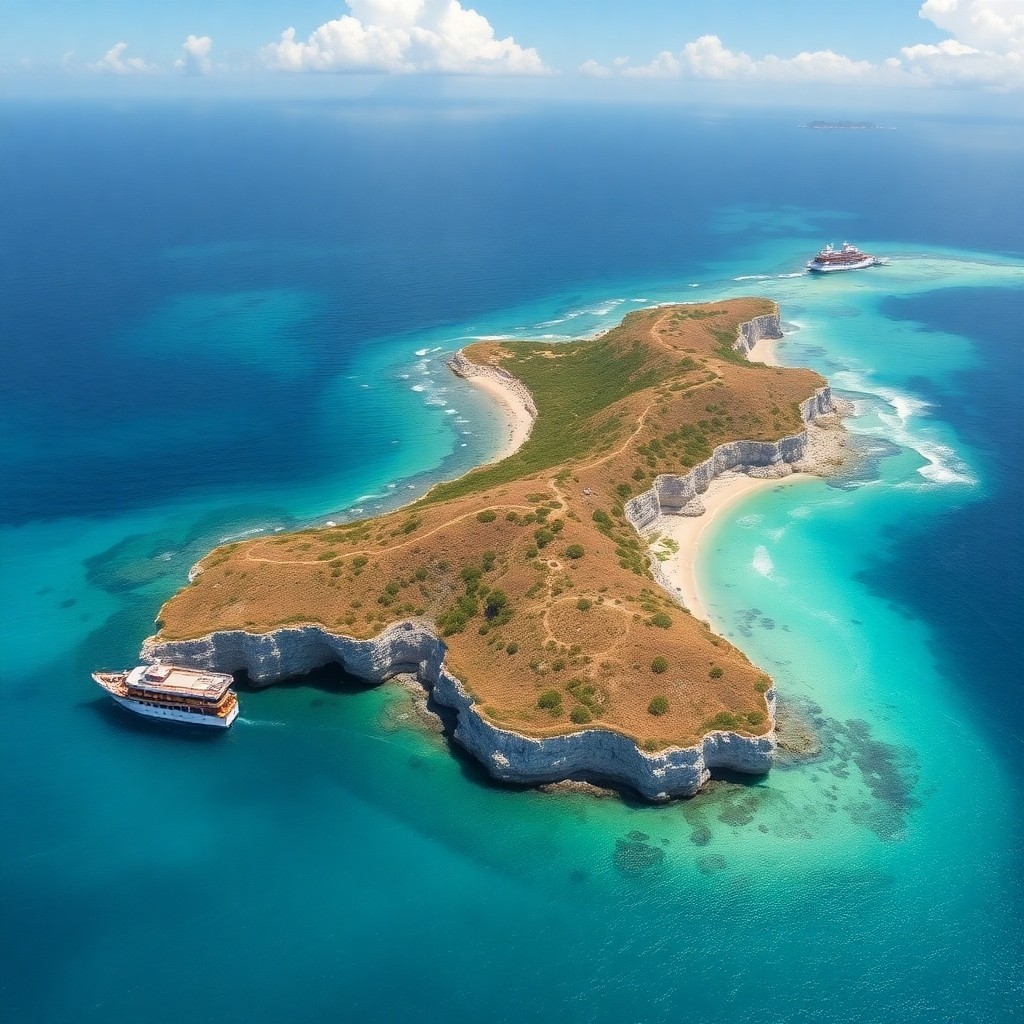
On the white sands and in the almost unbelievable turquoise waters of Providenciales, ultra-luxury tourism paints a reality of exclusivity and leisure. However, far from the five-star resorts of Grace Bay, the football of the Turks and Caicos Islands breathes an air of resistance, operating within the geographical, demographic, and financial limits of the global sport. A historical bottom-dweller in the FIFA rankings, this small British Overseas Territory of just over 45,000 inhabitants fights a daily battle to transform football from a recreational activity into a symbol of national identity. This dossier analyzes the inner workings of one of the most unique federations on the planet, revealing how Caribbean geopolitics, citizenship tensions, external financial dependence, and the isolated talent of icons like Billy Forbes shape the destiny of a national team that plays not for the glory of trophies, but for the simple and dignified affirmation of its own existence on the football map.
1. Origins and Formation of National Identity
To understand the development of football in the Turks and Caicos Islands (TCI), one must first decipher the complex social and geographical tapestry of this archipelago located north of Hispaniola. Historically dependent on salt extraction and, later, tourism and financial services, the territory never possessed a consolidated football tradition until the final decades of the 20th century. While cricket and athletics dominated the local sporting scene due to the British colonial heritage, football was a marginal activity, practiced in a disorganized manner on dirt fields and beaches.
The transition of football from an expatriate pastime to a structured sport only began to take official shape in the 1990s. The Turks and Caicos Islands Football Association (TCIFA) was founded in 1996, a late period compared to its Caribbean neighbors like Jamaica and Haiti, which already had established federations since the first half of the century. Affiliation with CONCACAF and FIFA occurred in 1998, opening the doors to development funds, which were essential for a nation without basic sports infrastructure.
The great catalyst for local football identity was migration. The construction and tourism boom in Providenciales (the most populous island and economic hub, although the administrative capital is Cockburn Town, in Grand Turk) attracted thousands of workers from neighboring countries, mainly Haiti, the Dominican Republic, and Jamaica. This migratory flow brought with it a fervent passion for football. However, this demographic fusion created a complex duality in the formation of the national team.
On one hand, football became one of the few tools for social integration for the children of Haitian immigrants born or raised on the islands. On the other, the territory's rigid citizenship laws—based on the concept of "Belonger status"—created significant barriers. Many of the best young technical talents raised on the streets of Providenciales could not represent the national team because they did not hold a British Overseas passport, strictly reserved for those with direct local ancestry. Thus, the Turks and Caicos team was born under the tension of representing a territory that, legally, excluded many of its most talented practitioners, forcing the federation to rely on a limited group of native citizens and naturalized British expatriates to compose its first official squads.
The national team's first official match took place on February 24, 1999, a 3-0 defeat to the Bahamas in the Caribbean Nations Cup qualifying round. At that time, the team was composed almost entirely of amateurs: teachers, divers, accountants, and police officers who divided their time between their formal jobs and grueling physical training under the scorching Caribbean sun. The lack of tactics and physical preparation was evident, but the first step toward the islands' insertion into the international scene had been taken.
2. Golden Era, Great Campaigns, and Eternal Idols
Speaking of a "Golden Era" for a team that frequently occupies the bottom positions of the FIFA rankings requires a shift in perspective. For the Turks and Caicos Islands, glory is not measured in titles, but in isolated victories that defied the logic of scarcity. The high point of the country's football history occurred between 2006 and 2008, a period of rare conjunction of talent and organization under the command of English coach Matthew Green.
In September 2006, during the preliminary round of the Caribbean Cup, the national team achieved its first consecutive official victories. The stage was Cuba, and the Turks and Caicos Islands defeated the Cayman Islands 2-0, with goals from Gavin Glinton and Maxime Fleuriot. Days later, the team surprised by beating Anguilla 3-2. Although they did not advance to the final stage of the tournament, these victories injected an unprecedented dose of self-confidence into local football and proved that the archipelago could compete at a regional level.
The competitive peak occurred on February 6, 2008, in the first leg of the first round of the 2010 World Cup Qualifiers. Playing at the modest TCIFA National Academy in Providenciales, in front of just over a thousand spectators, the Turks and Caicos team defeated the favored Saint Lucia side 2-1. The goals were scored by David Shearer and the legendary Gavin Glinton. The victory generated unprecedented national commotion. For the first time, the national anthem echoed in a context of global sporting triumph. Although the team was eliminated in the second leg by losing 2-0 in Saint Lucia, that afternoon in Providenciales remains the most glorious moment in the country's football history.
No dossier on Turks and Caicos would be complete without detailing the figure of Gavin Glinton. Born in Grand Turk, Glinton moved to the United States at a young age, where he excelled in college football for the prestigious Dartmouth College. He became the first—and for a long time the only—player from the country to turn professional and play in Major League Soccer (MLS), defending clubs like the Los Angeles Galaxy (where he played alongside international stars), San Jose Earthquakes, and Chicago Fire. Glinton was an intelligent striker with excellent positioning and refined technique, whose presence on the national team instantly raised the level of his amateur teammates. He represented the hope that an athlete from the islands could triumph at the highest level.
After the Glinton era, the baton of national hero was passed to Billy Forbes. Born in Providenciales, Forbes followed a similar path, migrating to American college football before building a solid professional career in the North American Soccer League (NASL) and the USL Championship, shining especially at San Antonio FC and Miami FC. Forbes is a winger with explosive speed, tight dribbling, and finishing ability who, for over a decade, carried the national team's attack practically alone. He is the top scorer in the team's history and a figure revered by all young players in the archipelago.
Another name worthy of historical record is Marco Fenelus. Although he had less exposure in North America, Fenelus followed an exotic and extremely successful path in Taiwanese football, where he became the top scorer of the local league for Tainan City and won multiple national titles. Fenelus's trajectory exemplifies the extreme globalization of modern football: a striker born in a small British Overseas Territory in the Caribbean finding his professional consecration in East Asia.
3. Rivalries, Crises, and Behind-the-Scenes Power
Football in the Caribbean is deeply influenced by the political dynamics of CONCACAF and power struggles within FIFA itself. For the Turks and Caicos Islands, sporting survival has always depended on the ability of its leaders to navigate these turbulent waters. The great political figure of the country's football is Sonia Bien-Aime. A former athlete and a firm administrator, Bien-Aime rose to the position of president of the TCIFA and later became one of the most influential women in world football, gaining a seat on the FIFA Executive Committee and the vice-presidency of CONCACAF.
Bien-Aime's rise placed the Turks and Caicos Islands at the center of the region's political decisions. Under her leadership, the local federation managed to secure significant resources through FIFA's development programs (such as the former Goal Project and the current FIFA Forward). However, this political influence contrasts sharply with internal structural difficulties and criticisms regarding the distribution of these resources. While the federation's headquarters boasts modern synthetic grass fields and well-equipped offices in Providenciales, local clubs in the Provo Premier League continue to operate almost entirely as amateurs, without sponsorship revenue or broadcasting rights.
The national team's biggest rivalry is against the Bahamas, a clash dubbed by locals as "The Lucayan Classic," in reference to the geographical archipelago shared by both nations. The clashes against the Bahamas are loaded with historical and migratory tension, as many Turks and Caicos citizens migrated to the Bahamas throughout the 20th century in search of work. Another intense rivalry is against the British Virgin Islands and Anguilla, teams that share the same status as overseas territories and fight tooth and nail to avoid the uncomfortable last position in the FIFA rankings.
Behind the scenes, the biggest crisis faced by the TCIFA refers to the player eligibility policy. For years, there was a heated debate between the nationalist wing of the federation—which advocated for the exclusive call-up of players with "Belonger status" to preserve the team's strictly local identity—and the coaching staff, which pushed for the facilitation of naturalization for long-term residents, mainly of Haitian and Jamaican origin. This internal division hindered the continuity of several work cycles. At various times, talented players who played in the local league were prevented from traveling for international matches due to bureaucratic passport hurdles, weakening the team at decisive moments in CONCACAF qualifiers.
Furthermore, the federation had to deal with internal geographical isolation. The centralization of all elite activities in Providenciales generated resentment on neighboring islands, such as Grand Turk and North Caicos. Talented athletes from these peripheral regions often abandoned the sport due to the financial impossibility of traveling for national team training at the national academy, highlighting that internal economic inequality also affected the development of football.
4. The Current Moment: Tactics, Generation, and Challenges
Currently, the Turks and Caicos Islands national team is undergoing a deep and painful transition process. The generation that sustained the team's relative competitiveness over the last decade, led by Billy Forbes, is in the phase of physical farewell, and the renewal of the squad has proven to be a Herculean challenge due to the lack of volume of young players with international competitive experience.
The creation of the CONCACAF Nations League in 2018 was a watershed moment for the national team. While the tournament guaranteed a regular calendar of official matches—something unprecedented for a team that previously went years without playing a competitive match—it also cruelly exposed the country's technical and tactical limitations. Allocated in League C (the continental tournament's entry division), the team has faced extreme difficulties competing against teams like Bonaire, Sint Maarten, and the US Virgin Islands.
Tactically, the national team has historically been characterized by an extremely defensive stance, operating almost always in low blocks, using formations like 5-4-1 or 4-5-1. Under the command of recent coaching staffs, which included foreign coaches with experience in the Caribbean, attempts were made to implement a faster and more vertical transition, taking advantage of the wingers' speed. However, the team's great Achilles' heel remains the build-up phase and ball retention in midfield. The lack of midfielders capable of dictating the pace of the game causes the team to rely heavily on long balls toward Billy Forbes or the target strikers, making the game predictable for minimally organized opposing defenses.
Defensive fragility is also chronic. Without center-backs playing in professional leagues, the team constantly suffers from tactical positioning errors, coverage failures, and vulnerability on set pieces. In matches against physically imposing or tactically organized opponents, these errors accumulate quickly, resulting in lopsided scores that undermine the young squad's morale.
Currently, the team's backbone includes some young players looking to follow the path of professionalism outside the islands. Players like Junior Paul and Jeff Beljour represent the new hope for speed and dribbling. However, the technical gap between these youngsters and the level required to compete on equal terms in CONCACAF is still considerable. The challenge for the current coaching staff is to balance the remaining experience of the veterans with the energy and tactical naivety of those recently promoted from the youth ranks.
5. Talent Development, Structure, and Future
The future of football in the Turks and Caicos Islands is intrinsically linked to its ability to develop infrastructure and create viable paths for talent export. The Provo Premier League, the local first division, is a strictly amateur league composed of a handful of clubs (such as AFC Academy, Beaches FC, and Sapadilla FC) that play their matches almost exclusively at the TCIFA complex in Providenciales. Without their own stadiums, ticket revenue, or robust sponsorships, the clubs function more as community projects than as structured sports entities.
Faced with this scenario, the TCIFA has taken on the role of the main—if not only—developer of athletes in the country. The model adopted is based on the centralization of talent at the National Academy itself. Promising youngsters are inserted into elite training programs funded by the federation from childhood. The main goal of the local training system is not to supply the domestic league, but to prepare these youngsters to obtain sports scholarships at universities in the United States or Canada, or for trials in lower divisions of English football (taking advantage of colonial ties and the ease of a British passport for some).
This "academic export model" is the only realistic path for the emergence of new professional athletes. However, it faces severe bottlenecks. The main one is the transition from youth to adult football. Many young players who stand out in local youth categories, upon turning 18, prioritize their academic and professional careers outside of sports, abandoning competitive football due to the lack of financial prospects in the local league. Football ceases to be a viable career and returns to being a hobby.
To mitigate this problem, the TCIFA has invested heavily in women's grassroots football and school programs. In fact, women's football in Turks and Caicos has shown proportionally faster growth than the men's, achieving interesting competitive results in the region due to the early focus on the athletic development of girls.
In terms of physical infrastructure, the great challenge is the maintenance of natural grass in an archipelago with a chronic shortage of fresh water and high energy costs. For this reason, the federation opted for the installation of state-of-the-art synthetic turf at its sports complex. Although ideal for durability under continuous use, synthetic fields alter the dynamics of the game and the physical wear and tear of the athletes, creating an adaptation barrier when the national team needs to play on heavy, muddy natural grass in the rest of the Caribbean.
The horizon for the Turks and Caicos Islands in the coming decades does not point to qualification for the World Cup or the final stages of the Gold Cup. The future success of football in the country will be measured by the sustainability of its social and sporting project: the ability to keep its youth away from urban crime in Providenciales, to integrate immigrant communities through sport, to form citizens with access to higher education abroad, and, occasionally, to produce a new Billy Forbes capable of making the world remember that, behind that paradise of perfect beaches, there is a people who also know how to and love to play football.
- Turks and Caicos Islands Football Association (TCIFA): Founded in 1996, affiliated with FIFA in 1998.
- Main Stadium: TCIFA National Academy, Providenciales (capacity for approximately 3,000 spectators).
- Main Idols: Gavin Glinton (ex-MLS), Billy Forbes (ex-USL/NASL), and Marco Fenelus.
- Biggest Victory in History: Turks and Caicos Islands 5-1 Sint Maarten (May 14, 2022, CONCACAF Nations League).
- Biggest Rivalry: Bahamas (The Lucayan Classic) and the British Virgin Islands.





