



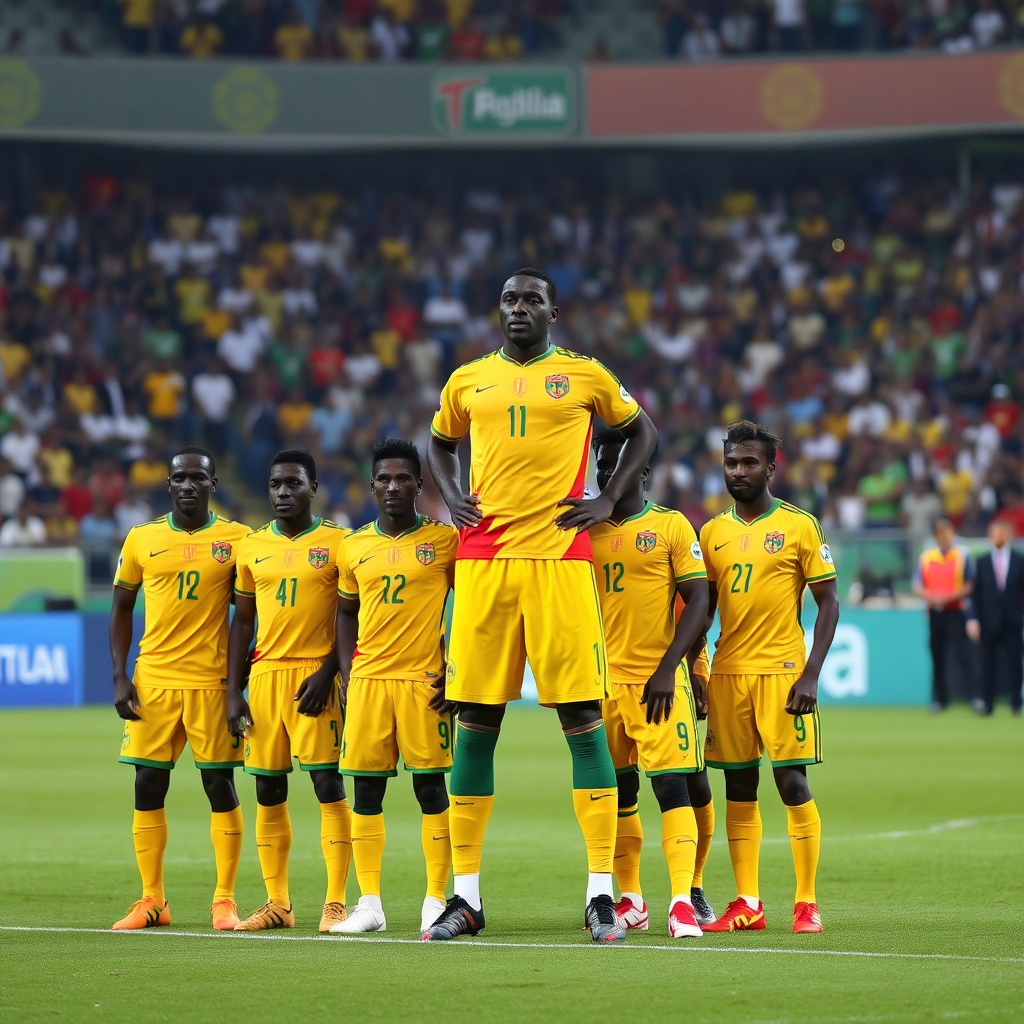
On the banks of the imposing Niger River, football is not just a sport, but a chronicle of resistance, raw talent, and an incessant quest for emancipation. The Mali national football team, affectionately known as Les Aigles (The Eagles), represents one of the most intriguing phenomena in global football. It is a nation that, despite never having qualified for a FIFA World Cup in its senior category, is internationally recognized as one of the planet's greatest talent factories. Malian football constantly balances on a fine line between the technical genius of its athletes and the structural fragility of its institutions. This dossier dives deep into the bowels of a football that pulses to the rhythm of the Bamako drums, analyzing its colonial origins, its golden eras neglected by official history, the complex political and geopolitical webs that shape the sport in the Sahel, the silent tactical revolution promoted by its academies, and the prospects for a future that insists on defying global skepticism.
1. Origins and Formation of National Identity
To understand the genesis of football in Mali, one must go back to the period when the territory was known as French Sudan, a vast colonial possession administered by Paris. Football was introduced to the region in the early decades of the 20th century, brought by French military personnel, missionaries, and colonial officials. Initially, the sport functioned as a tool for social control and the imposition of a supposed "civilizing mission." However, the local population quickly appropriated the game, transforming it into a space of resistance and affirmation of collective identity in the face of colonial oppression.
With the achievement of independence in 1960, under the leadership of the socialist and pan-Africanist president Modibo Keïta, the sport was elevated to a national priority. Keïta saw football as the perfect vehicle for building the nation-state and consolidating a unified Malian identity, overcoming ethnic divisions between Bambara, Tuareg, Fula, and Songhai peoples. The government invested in creating clubs that could rival regional powers and used the national team as a traveling embassy for the new, proud, independent Mali.
The Founding of the Giants of Bamako
In this scenario of political and social effervescence, the great domestic football rivalry between Djoliba AC and Stade Malien was consolidated. Founded during the transition to independence, these clubs were not just sports associations; they represented different worldviews and strata of Bamako society. Djoliba, born from the merger of local teams and historically linked to nationalist and popular sectors, adopted red as its identity color. On the other hand, Stade Malien, wearing white, emerged with strong ties to the capital's intellectual and administrative elite.
The clashes between Djoliba and Stade Malien divided the country and packed the old Stade Omnisports (now Stade Modibo Keïta). This internal rivalry served as the main engine for the technical development of Malian football in the 1960s and 1970s. The players who stood out in these classics formed the backbone of the national team, which began to take its first firm steps on the African continental stage.
Salif Keïta: The Pioneer and the Legend
One cannot discuss the identity of Malian football without evoking the name of Salif Keïta. Nicknamed the "Black Pearl of Bamako," Keïta was the country's first great football icon and one of the greatest African players of all time. Discovered by Real Bamako, his talent was so overwhelming that he caught the attention of Saint-Étienne in France. His transfer to Europe in 1967, surrounded by dramatic circumstances that included a clandestine escape from Mali due to political restrictions at the time, opened the doors of European football to generations of African athletes.
At Saint-Étienne, Salif Keïta became a living legend, winning multiple French league titles and defining an era with his speed, bewildering dribbling, and sharp goal-scoring instinct. In 1970, he was awarded the first edition of the African Footballer of the Year award (African Golden Ball). Keïta was not just an elite athlete; he was the symbol of the dignity and potential of a newly independent nation, proving that Malian talent could shine on the most demanding stages in the world.
2. Golden Era, Great Campaigns, and Eternal Idols
The first great moment of international glory for the Mali national team occurred at the 1972 Africa Cup of Nations (AFCON), held in Cameroon. Under the technical command of German coach Karl-Heinz Weigang, the Eagles presented a flashy, offensive, and highly technical style of football that enchanted the continent. Led on the field by legendary figures such as Fantamady Keïta (the tournament's top scorer) and Kidian Diallo, the Malian team overcame continental giants to reach the grand final against Congo-Brazzaville.
The Yaoundé final, played on March 5, 1972, remains etched in the country's collective memory. In a dramatic and extremely physical match, Mali was defeated 3-2. Despite the runner-up finish, the reception for the players in Bamako was worthy of national heroes. That campaign established Mali as a respected force in African football, although it also inaugurated an uncomfortable "almost-there" fate that would haunt the team for decades.
The Renaissance of the 2000s and the Golden Generation
After a long period of ostracism in the 1980s and 1990s, marked by financial crises and administrative disorganization, Mali re-emerged on the international stage at the turn of the millennium. The turning point was hosting the 2002 Africa Cup of Nations. Playing at home, in front of their passionate fans, and driven by a new generation of athletes trained on national soil and polished in Europe, the team reached the semifinals, finishing in fourth place.
This campaign was the prelude to the emergence of what is considered the true "Golden Generation" of Malian football. During the 2000s, Mali boasted one of the most formidable midfields in world football, composed of athletes who were absolute starters at the biggest clubs in European football:
- Mahamadou Diarra: The dynamic engine who shone at Lyon and became a fundamental piece in the Real Madrid of the "Galácticos."
- Seydou Keita: The elegant midfielder, tactically perfect and gifted with a formidable long-range shot, who won every possible title under Pep Guardiola at Barcelona.
- Mohamed "Momo" Sissoko: A defensive midfielder of impressive physical strength and great marking ability, with notable stints at Valencia, Liverpool, Juventus, and Paris Saint-Germain.
- Frédéric Kanouté: Born in France, but who chose to defend the homeland of his ancestors, Kanouté was a center-forward of refined technique and unique tactical intelligence, becoming a historic idol at Sevilla and being elected African Footballer of the Year in 2007.
The Bronzes of 2012 and 2013: Football as Social Balm
Although this constellation of stars could not qualify the country for a World Cup or win the long-awaited AFCON title, their legacy of competitiveness bore fruit in the following years. In the 2012 (in Gabon and Equatorial Guinea) and 2013 (in South Africa) editions of the Africa Cup of Nations, Mali consecutively won the bronze medal, finishing in third place.
These achievements had a significance that went beyond the limits of the pitch. During that period, Mali was going through one of its most serious political and security crises since independence, with the north of the country occupied by Tuareg rebel groups and Islamic extremists, in addition to a coup d'état that destabilized the capital, Bamako. Led by veteran Seydou Keita, the players took on the role of peace ambassadors. Each victory was celebrated as a call for national unity and a rare moment of joy for a people battered by civil war. Keita's tears upon receiving the bronze medal in 2012 symbolized the deep connection between the national team and the suffering of its people.
3. Rivalries, Crises, and Behind-the-Scenes Power
The trajectory of the Mali national team is inseparable from the complex geopolitical dynamics of the Sahel and West Africa region. On the sporting level, the Eagles' greatest rivalries are against their geographical neighbors: Senegal, Guinea, and, above all, Ivory Coast. The clashes against the Ivorians, known as the "Elephants," often carry dramatic tension, with Mali frequently suffering painful eliminations at decisive moments in continental tournaments.
These regional rivalries are fueled by historical migration flows, economic rivalries, and political leadership disputes in the sub-region. However, the greatest adversary of Malian football throughout history has not been on the other side of the border, but within its own power structures.
Political Instability and the Impact on Sport
Mali has suffered multiple coups d'état throughout its recent history (in 1968, 1991, 2012, 2020, and 2021). Each rupture in the constitutional order had direct repercussions on the management of the sport. The Malian Football Federation (FEMAFOOT) has historically functioned as a microcosm of national politics, characterized by factional disputes, lack of transparency, and direct government interference.
In March 2017, this interference reached its peak when the then-Minister of Sports of Mali dissolved the FEMAFOOT executive committee due to a prolonged internal dispute. FIFA's reaction was immediate and ruthless: the Malian federation was suspended from all international activities. Although the suspension was lifted weeks later after the government backed down, the episode exposed the institutional fragility that sabotages the long-term planning of the national team.
The Infrastructure Crisis and the Conflict in the North
The armed conflict that has plagued northern and central Mali since 2012 has also imposed severe limitations on the development of football. Historic regions like Timbuktu, Gao, and Kidal have been turned into active conflict zones, making organized sports and talent recruitment in these areas impossible. Professional football has concentrated almost exclusively in the south of the country, in the Bamako metropolitan area, depriving the country of true territorial representation.
Furthermore, the country suffers from a chronic lack of modern infrastructure. The Stade du 26 Mars in Bamako, the main stage for national football, frequently faces maintenance problems and has even been vetoed by the Confederation of African Football (CAF) for international matches due to failure to meet minimum safety and comfort standards. The need to host matches outside the country or play on poor pitches undermines the Eagles' competitive advantage in crucial qualifiers.
4. The Current Moment: Tactics, Generation, and Challenges
The contemporary Mali national team is experiencing an extremely interesting moment of tactical and generational transition. From a tactical point of view, Mali has abandoned the predominantly physical and vertical style of play that characterized African football at the end of the 20th century, adopting an identity based on ball possession, rapid circulation through short passes, and strong pressure after losing the ball. This paradigm shift is a direct reflection of the profile of the players who make up the current squad, most of whom were trained in academies that prioritize cognitive intelligence and technical excellence.
The backbone of the current team is young, dynamic, and plays in the main European football leagues. However, the great tactical challenge for recent coaches who have led the team, such as Mohamed Magassouba and Eric Chelle, has been to find the balance between the technical exuberance of the midfield and effectiveness in both boxes (defensive and offensive).
The Midfield: The World-Class Sector
Mali's greatest asset remains its midfield sector. The team has an abundance of options that arouses envy in many European powers. Names like Yves Bissouma (Tottenham Hotspur), Amadou Haidara (RB Leipzig), Mohamed Camara (Monaco), and Diadie Samassékou offer a rare combination of combativeness, physical endurance, passing precision, and the ability to progress with the ball at their feet.
Tactically, Mali usually lines up in a 4-3-3 or 4-2-3-1 system, where the midfield trio dictates the pace of the game. The team seeks to draw opponent pressure into its own half to exploit the empty spaces behind the opposing defensive line, using the speed of its wingers and the overlapping runs of full-backs, such as the experienced captain Hamari Traoré.
The "Number 9 Curse" and Defensive Vulnerability
Despite dominating possession in most of its matches, Mali often runs into a chronic lack of offensive clinicality. Since the retirement of Frédéric Kanouté, the team has been desperately searching for a reference center-forward who can translate the volume of play created by the midfield into goals. Prospects like Sekou Koita and El Bilal Touré have shown flashes of genius but have suffered from recurring injuries that have delayed their establishment as reliable goalscorers.
Another Achilles' heel has been defensive lapses during moments of high pressure. In the 2023 Africa Cup of Nations (played in 2024 in Ivory Coast), Mali presented some of the most attractive football in the tournament. However, the quarter-final elimination against the host nation — in a match where Mali played with an extra man for most of the time and conceded a comeback in the final minutes of extra time — highlighted a psychological fragility and an inability to manage critical moments of the game that still prevent the team's definitive leap toward the global top tier.
5. Talent Development, Structure, and Future
If the senior Mali national team is still looking to consolidate itself with titles, the country's youth categories tell a story of absolute success and vanguardism. Mali is, without a doubt, one of the world's greatest superpowers in youth football. The country boasts impressive results in FIFA and CAF youth tournaments:
- FIFA U-17 World Cup: Runner-up in 2015 (losing the final to Nigeria) and third place in 2023.
- FIFA U-20 World Cup: Third place in 1999 (Seydou Keita's generation) and third place again in 2015 (revealing Adama "Noss" Traoré, elected the tournament's best player).
- U-20 Africa Cup of Nations: Champion in 2019.
These consistent results are not the result of chance or mere spontaneous generation of talent; they are the direct result of a highly sophisticated and structured training model that has become a global benchmark.
The JMG Academy Bamako Revolution
The great engine of this silent revolution goes by the name of Jean-Marc Guillou (JMG) Academy. Founded in Bamako by the former French player and coach Jean-Marc Guillou (famous for his previous work at the legendary ASEC Mimosas academy in Ivory Coast), the Malian branch of JMG has become a true assembly line for elite athletes.
The JMG philosophy is based on a revolutionary training method. During the first years of training, young athletes train exclusively barefoot on small-sided pitches. This approach aims to develop extraordinary tactile sensitivity with the ball, in addition to improving body balance, decision-making under spatial pressure, and motor coordination. The focus is not on immediate physical results, but on technical excellence and tactical intelligence. Athletes like Yves Bissouma, Amadou Haidara, Diadie Samassékou, and Hamari Traoré are direct products of this training ecosystem.
The Connection with European Football and the Export Model
The success of the Malian training model has attracted the attention of major European talent scouting networks. The most successful and prolific partnership was established with the Red Bull group, specifically through Red Bull Salzburg in Austria and its satellite club, FC Liefering. Local Malian clubs, such as Real Bamako and Yeelen Olympique, act as strategic partners that facilitate the transition of young talents to European football as soon as they turn 18.
Salzburg has refined the raw technical talent of young Malians, adding physical intensity, European tactical rigor, and aggressive pressing ability. This business model has proven extremely profitable for European clubs and vital for the competitiveness of the national team, ensuring that young Malian athletes have access to cutting-edge training methodologies from an early age.
The Road to 2026: Breaking the Historical Taboo
With the expansion of the FIFA World Cup to 48 teams starting in 2026, with Africa securing nine direct spots, Mali finds itself facing a historic and unprecedented opportunity. Qualification for the World Cup is no longer seen in Bamako as a distant dream, but rather as a sporting obligation for a generation that is at the peak of its physical and technical maturity.
To consolidate this goal, Malian football needs to overcome its own contradictions. It is imperative that FEMAFOOT establishes stable governance, offering qualified technical commissions, professional-level logistics for athletes playing in Europe, and serious investments in local sports infrastructure. If it can align the genius of its talent development with minimally organized institutional management, the Mali national team will cease to be the continent's eternal promise and assume its rightful place as one of the most vibrant and competitive forces in world football. The Eagles of Bamako are finally ready to take their highest flight.





