



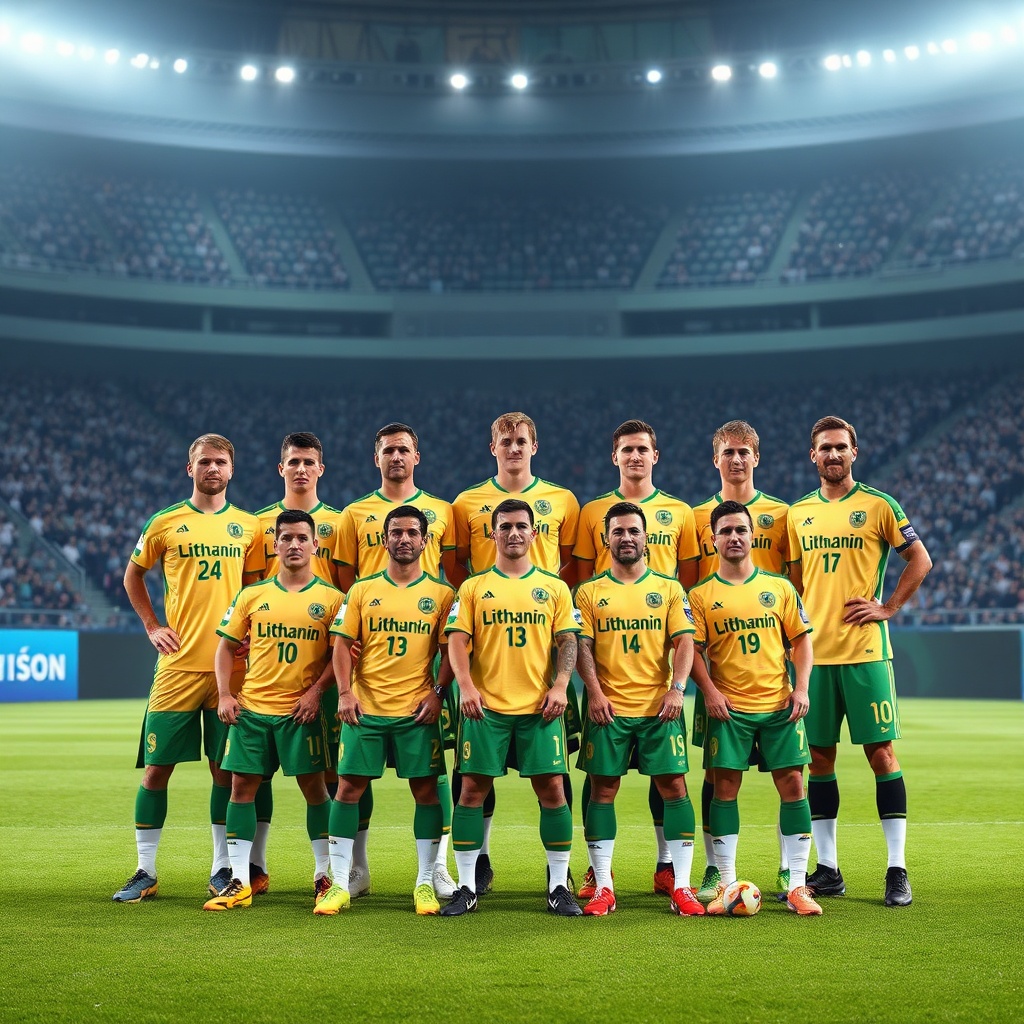
In a country where the orange ball is treated as a religion and sports temples are dedicated to basketball giants, football in Lithuania survives in a state of perpetual melancholy and resistance. While the heirs of Arvydas Sabonis and Šarūnas Jasikevičius collect Olympic glories and global reverence, the national football team, affectionately known as the Trispalvės (Tricolors), drags itself along the fringes of the European scene, fumbling between structural amateurism and a latent desire for geopolitical affirmation. However, reducing Lithuanian football to a mere shadow of basketball is to ignore one of the richest, most complex, and most politicized narratives in Eastern Europe. It is a sport forged in resistance to Soviet occupation, which experienced moments of technical dignity in the 1980s and 1990s, collapsed under the weight of institutionalized corruption at the turn of the millennium, and today seeks a painful tactical and identity-based reconstruction under the command of its heroes from the past.
1. Origins and Formation of National Identity
To understand the genesis of football in Lithuania, one must look back to the interwar period, a window of sovereign independence squeezed between the imperial ambitions of Germany and the Soviet Union. Football was introduced to the country in the early 1920s, with the founding of the Lithuanian Football Federation (LFLS) in 1922 and affiliation with FIFA in 1923. The international debut took place on June 24, 1923, in Kaunas, with a 5-0 defeat to neighboring Estonia. Less than a year later, the young nation sent its delegation to the 1924 Paris Olympic Games. The experience was traumatic in sporting terms—a 9-0 defeat to Switzerland—but it founded the bases of an identity that saw sport as a tool for diplomatic validation before the international community.
During the 1920s and 1930s, football was the most popular sport in the country, driven by the fierce competition of the Baltic Cup against Latvia and Estonia. However, Lithuania's geopolitical fate was sealed with the Molotov-Ribbentrop Pact and the subsequent Soviet annexation in 1940. From that moment on, Lithuanian football was dismantled and reorganized to serve Moscow's propaganda machine. Traditional clubs were dissolved or renamed under the aegis of state security forces or industrial unions. It was in this scenario of oppression that FK Žalgiris Vilnius emerged, founded in 1947 under the name Dinamo, and renamed in 1962 in honor of the historic Battle of Grunwald (Žalgiris in Lithuanian), where Lithuanian and Polish forces defeated the Teutonic Knights in 1410.
Žalgiris Vilnius became much more than a football club; it transformed into the ultimate symbol of Lithuanian national identity within the Soviet empire. Every match against Russian teams, especially the Muscovite giants like Spartak, CSKA, and Dynamo, was viewed by the population of Vilnius as a symbolic battle for sovereignty. The culmination of this era occurred in the 1980s. Under the technical command of the visionary Benjaminas Zelkevičius, Žalgiris assembled a squad that played technical, fast-paced football with dynamic transitions, standing out from the physical pragmatism that dominated the Soviet league. In 1987, the club reached a historic third place in the Soviet Championship, surpassing powers from Moscow and Kiev, and securing an unprecedented qualification for the UEFA Cup.
That Žalgiris team was the backbone of a golden generation that included names like Arminas Narbekovas, Valdas Ivanauskas, Viačeslavas Sukristovas, and Arvydas Janonis. The political importance of this group became evident in 1988, when Sukristovas and Narbekovas were part of the Soviet team that won the gold medal at the Seoul Olympics and the runner-up spot at the European Championship in Germany. However, the desire for freedom spoke louder than the glories offered by the Kremlin. In March 1990, Lithuania became the first Soviet republic to unilaterally declare its independence. Days later, in an act of extreme political and sporting courage, Žalgiris Vilnius and other Lithuanian clubs withdrew from the ongoing Soviet championship, abdicating revenue and prestige for the sake of the new Republic of Lithuania. The national team's first match after the restoration of independence took place on May 27, 1990, against Georgia in Tbilisi, a 2-2 draw that symbolized the birth of a new era.
2. Golden Era, Great Campaigns, and Eternal Idols
The first years after independence were marked by romantic optimism and results that suggested Lithuania could establish itself as a respectable mid-tier force in European football. In the qualifiers for the 1994 World Cup, the Lithuanian team, under the leadership of coach Algimantas Liubinskas, surprised the continent by securing goalless draws against Denmark (then European champions) and Ireland, in addition to beating Ukraine. The team finished in an honorable third place in its group, ahead of nations with greater footballing tradition. The style of play was characterized by an implacable defense, a spirit of collective sacrifice, and surgical counterattacks led by the genius of Arminas Narbekovas.
Narbekovas, elected in 2003 by the Lithuanian Federation as the country's "Golden Player" for UEFA's 50th anniversary, was an attacking midfielder of rare elegance, peripheral vision, and finishing precision. Due to the political restrictions of his youth, he could only move abroad late in his career, shining at Austria Wien. Alongside him, Valdas Ivanauskas, nicknamed "Ivan the Terrible" by Hamburg fans due to his physical strength and goal-scoring instinct in the Bundesliga, formed one of the most feared offensive duos in Eastern Europe. These players served as inspiration for the next generation, which would reach the peak of international competitiveness in the 2000s.
In the qualifiers for Euro 2004, Lithuania shocked the world by drawing 1-1 with Germany in Nuremberg on March 29, 2003. Tomas Ražanauskas's goal after an anthological individual play remains alive in the fans' memory. A few years later, in the qualifiers for Euro 2008, the Lithuanians repeated the feat by holding Italy to a 1-1 draw in Naples, just two months after the Italians had won their fourth world title in Germany. In that same campaign, the team defeated Scotland and Ukraine, finishing with 16 points in one of the toughest groups in the history of European qualifiers.
This era of competitiveness was sustained by athletes who managed to establish themselves in the continent's top leagues. The greatest exponent of this period was Edgaras Jankauskas. A classic center-forward, powerful in the air and intelligent with his back to the goal, Jankauskas was the first—and only—Lithuanian to win the UEFA Champions League, lifting the trophy in 2004 under José Mourinho at Porto, in addition to winning the UEFA Cup in 2003 and having notable spells at Real Sociedad, Club Brugge, and Hearts. Another fundamental pillar was Deividas Šemberas, a defender and midfielder of extreme combativeness who played over 350 matches in Russian football, winning the 2005 UEFA Cup with CSKA Moscow. In the national team's historical scoring charts, Tomas Danilevičius stands out; the striker played in Italian football (notably for Livorno) and scored 19 goals in the national shirt, becoming the top scorer in the history of the Trispalvės and, subsequently, president of the national federation.
3. Rivalries, Crises, and Behind-the-Scenes Power
If on the pitch Lithuania achieved moments of sporting dignity, off it, the country's football plunged into an abyss of financial scandals, institutional corruption, and organized crime influence that undermined any possibility of sustainable development. While basketball organized itself in an exemplary manner through private academies and professionalized management, the Lithuanian Football Federation (LFF) transformed, during the 1990s and 2000s, into a closed fiefdom, impervious to transparency and frequently associated with figures from the country's economic underworld.
The central figure of this dark period was Julius Kvedaras, who held the positions of secretary-general and president of the LFF for nearly two decades. Under his management, the federation was the target of investigations by Lithuania's Financial Crime Investigation Service (FNTT) for the embezzlement of development funds sent by UEFA and FIFA. Kvedaras, who had connections documented by investigative journalism to figures linked to organized crime in Kaunas—specifically the infamous "Daktarai" gang—was even temporarily detained in 2012. The lack of transparency and poor financial management drove away legitimate corporate sponsors, leaving local clubs at the mercy of investors of dubious integrity.
The most emblematic case of this structural fragility was the collapse of FBK Kaunas and Ekranas Panevėžys. FBK Kaunas, which dominated Lithuanian football in the 2000s by winning eight national titles, was financed by the controversial businessman Vladimir Romanov, owner of the Ukio Bankas bank. Romanov used Kaunas as a satellite for his other football investments, including Hearts in Scotland and Partizan Minsk. When Romanov's financial empire went bankrupt in 2013 amid accusations of fraud and the embezzlement of billions of euros, FBK Kaunas simply disappeared from the football map, leaving a legion of creditors and destroying the youth development base of the country's second-largest city. A similar fate befell Ekranas, a seven-time national champion, which declared bankruptcy in 2015 due to debts accumulated by irresponsible management.
This institutional instability was directly reflected in regional rivalries. The Baltic Cup, played since 1928, is the oldest national team competition in Europe still in operation, but it lost prestige as the technical level of the teams declined. The rivalry with Latvia is historically the most intense, marked by physical disputes and an uncomfortable statistical balance. However, in recent decades, seeing Latvia compete in Euro 2004 and Estonia reach the playoffs for Euro 2012 generated a deep feeling of humiliation and stagnation for the Lithuanian fan, who saw their neighbors modernize their federations and infrastructures while Lithuania remained mired in behind-the-scenes power struggles.
Another symbol of this structural decay is the saga of the Vilnius National Stadium. For over three decades, the project to build a modern stadium in the capital has been a national tragicomedy, marked by legal disputes, contractor bankruptcies, suspicions of corruption, and abandoned construction sites. While neighboring capitals like Tallinn and Riga erected modern arenas, the Lithuanian national team was forced for years to play at the cramped LFF Stadium in Vilnius, a federation-owned stadium with a capacity of only 5,000 spectators and an artificial pitch of questionable quality, considered obsolete by elite international football standards.
4. The Current Moment: Tactics, Generation, and Challenges
The contemporary scenario for the Lithuanian national team is one of slow but necessary reconstruction. Currently positioned in the lower tiers of the FIFA rankings and competing in League C of the UEFA Nations League, the national team is trying to shed the label of Europe's "whipping boy." The return of Edgaras Jankauskas to the position of head coach in 2023 brought a breath of professionalism, tactical rigor, and unity to a squad that had been suffering humiliating defeats to lower-ranked teams like Luxembourg and Andorra.
Tactically, Jankauskas abandoned the sterile pragmatism of his predecessors, who limited themselves to positioning an ultra-deep defensive line in the hope of conceding as few goals as possible. The coach implemented a hybrid system, varying between 4-2-3-1 and 5-4-1 in the defensive phase, but with a clear intention to propose the game when circumstances allow. Jankauskas's Lithuania seeks a sustained build-up from the defense, using midfielders with good passing ability and aggressive wingers to exploit the width of the pitch. The main focus is on collective organization, compact lines, and rapid offensive transition, trying to compensate for the lack of elite individual talent with ironclad tactical discipline.
The great hope of this new era goes by the name of Gvidas Gineitis. The young midfielder from Torino, in the Italian Serie A, is the most talented player produced by the country in the last decade. Endowed with an excellent left foot, refined vision, physical strength to contest duels in midfield, and a notable ability to finish from distance, Gineitis represents the prototype of the modern player that Lithuania so desperately needs. He is the team's metronome, responsible for dictating the pace of the game and connecting the defensive sector to the attack.
Around Gineitis, Jankauskas blends the experience of resilient veterans with the energy of young prospects. In defense, goalkeeper Edvinas Gertmonas offers security between the posts, while the experienced defender and captain Edvinas Girdvainis leads the rearguard with his physical style and vocal leadership. On the wings, Justas Lasickas, who plays for Olimpija Ljubljana, offers defensive consistency and offensive support down the right flank. In the creative sector, Paulius Golubickas and left-winger Arvydas Novikovas—the latter one of the remnants of the previous generation, known for his one-on-one ability and decisive goals—try to supply the attack.
The current generation's great Achilles' heel, however, lies in the absence of a center-forward of international standing. Since the retirement of Tomas Danilevičius and the physical decline of Fiodor Černych, Lithuania lacks a "number 9" capable of holding the ball in the attacking third, playing as an effective pivot, and ensuring an acceptable volume of goals. Players like Armandas Kučys have been tested in the role, demonstrating physical commitment and combativeness, but they still lack the technical refinement and goal-scoring instinct necessary to decide matches against high-level defenses on the European stage.
5. Talent Development, Structure, and Future
For Lithuania to aspire to a brighter future in football, it is imperative to structurally reform the athlete development process in the country. The current diagnosis reveals a methodological and financial abyss compared to the great European schools. The main historical obstacle is cultural and economic: basketball monopolizes children's interest, support from large companies, and government subsidies. The best sports facilities in public schools are destined for basketball courts, and the young people with the greatest physical aptitude and motor coordination are systematically directed to the courts, attracted by the prestige of clubs like Žalgiris Kaunas and Rytas Vilnius.
Despite this unfair competition, there are signs of change. The Lithuanian Football Federation, under new executive leadership that seeks to break with the murky practices of the past, has focused on the decentralization of athlete development. The creation of the National Football Academy (NFA) in Kaunas was an important step, although still insufficient. The current focus has been to establish partnerships with foreign clubs and implement integrated training methodologies, inspired by the Belgian and German models, which prioritize individual technical development and decision-making in tight spaces from the youngest youth categories.
Another factor of transformation has been the recent performance of local clubs in European competitions. FK Žalgiris Vilnius made history in the 2022/2023 season by becoming the first Lithuanian club to qualify for the group stage of a UEFA competition, the UEFA Europa Conference League. This campaign not only injected millions of euros in prize money into the club's coffers but also raised the country's coefficient in the UEFA rankings and proved that it is possible to compete at a continental level with serious and professional sports management. Žalgiris's success serves as a mirror for other teams in the A Lyga (the national first division), such as FK Panevėžys and Kauno Žalgiris, which are beginning to invest more in infrastructure and talent scouting.
The structure of the A Lyga, however, still faces the challenge of an excess of foreign players of dubious quality, hired in search of immediate short-term results, which often blocks the transition space for locally trained youngsters into professional football. To mitigate this problem, the federation has been studying the implementation of stricter quota rules for locally trained players (homegrown players) in national championship matches.
The future of football in Lithuania depends on the consolidation of three fundamental pillars:
- Modernization of Infrastructure: The completion of the new Dariaus ir Girėno Stadium in Kaunas, with a capacity for 15,000 spectators and UEFA Category 4 standard, finally gave the national team a worthy and modern home. Now, the focus must turn to the construction of indoor training pitches across the country, essential to allow football to be played during the harsh Baltic winter months.
- Professionalization of Management: Keeping the federation shielded from external political influences and corruption scandals, ensuring that revenues generated by UEFA are fully reinvested in grassroots football and the training of local coaches.
- Early Export of Talent: Encouraging the departure of promising youngsters to elite academies abroad (as happened with Gvidas Gineitis in Italy) before their technical development is stagnated by the low average competitiveness of the local championship.
The path for Lithuania to leave the periphery of European football is long and tortuous. There are no magic formulas for a country of 2.8 million inhabitants where football is not the hegemonic national passion. However, if it can combine the historical passion of its most loyal fans with modern and transparent technical management, Lithuania may, gradually, transform the melancholy of its football into renewed pride, showing that, under the Baltic cold, the leather ball also knows how to warm hearts.





