



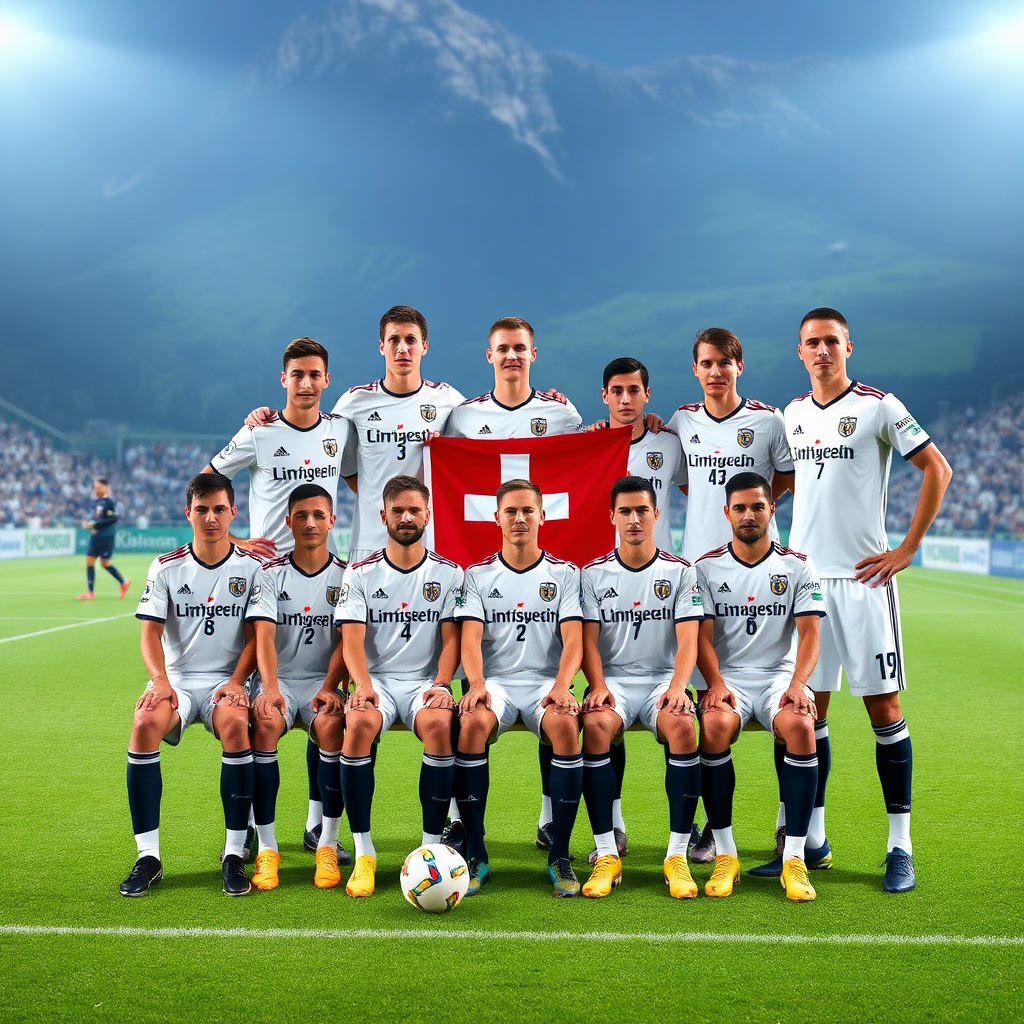
In the heart of the Alps, wedged between Swiss neutrality and the rugged mountains of Austria, lies one of the most fascinating paradoxes of contemporary football. The Principality of Liechtenstein, with its little more than 39,000 inhabitants spread across eleven fairytale communes, boasts one of the highest Human Development Indices and GDPs per capita on the planet. However, when the ball rolls under the UEFA banner, this financial opulence dissolves into a narrative of resistance, stoicism, and often, painful sporting melancholy. The Liechtenstein national football team, affectionately known as Blau-Rot (Blue and Red), embodies the archetype of "David" in a sport increasingly dominated by corporate Goliaths. Without a national league of its own and dependent on a symbiotic structure with the Swiss league system, the country has forged a unique footballing identity: a blend of romantic amateurism, obsessive tactical organization, and the constant search for occasional miracles that justify its existence on Europe's political-sporting map. This dossier delves into the depths of a federation that, far from surrendering to the insignificance of results, turns every draw against a powerhouse and every young player exported to professional leagues into a trophy of national sovereignty, facing today the challenge of reinventing itself in an era where even neighboring microstates seem to be marching at a faster pace.
1. Origins and Formation of National Identity
The history of football in Liechtenstein is inseparable from its own geopolitical and socioeconomic evolution throughout the 20th century. After World War I, the Principality made a decision that would change its destiny forever: it moved away from the struggling Austria and sealed a customs and monetary union with Switzerland in 1923, adopting the Swiss franc as its official currency. This deep rapprochement with the Swiss paved the way for the introduction and consolidation of football in the country. The sport arrived relatively late in the shadows of Vaduz Castle. While neighboring nations were already structuring their professional leagues in the first decades of the century, football in Liechtenstein was still a purely recreational activity, practiced by young people who crossed borders to study or work.
The founding of the Liechtenstein Football Association (Liechtensteiner Fussballverband - LFV) in 1934 marked the first institutional effort to organize sporting practice in the microstate. However, the LFV founders immediately faced an insurmountable geographical and demographic obstacle: the scarcity of clubs and players. With a territory of only 160 square kilometers, the creation of a viable national league was a logistical and financial anachronism. The solution found was a reflection of the country's own diplomacy: the total integration of its clubs into the Swiss Football Association (SFV) league system. Since then, the country's seven clubs — FC Vaduz, FC Balzers, USV Eschen/Mauren, FC Triesen, FC Schaan, FC Ruggell, and FC Triesenberg — have competed in the different divisions of Swiss football, from the professional elite to regional amateur leagues.
The Anachronism of the National Cup
This symbiosis with Switzerland created one of the greatest peculiarities in world football. Because Liechtenstein clubs play in the Swiss pyramid, they are considered "guest clubs." This means that even if FC Vaduz were to win the Swiss Super League (the top Swiss division), they could not be crowned official champions of Switzerland, nor could they inherit the spot reserved for the country in the UEFA Champions League. To circumvent this limitation and ensure a presence in continental competitions, the LFV organizes the Liechtensteiner Cup annually. The tournament, played since 1946, is the only official club competition organized in the country. The winner of this cup secures Liechtenstein's only spot in European competitions — historically in the defunct European Cup Winners' Cup, later in the UEFA Cup/Europa League, and currently in the UEFA Conference League. FC Vaduz, with its professional structure, has become the absolute sovereign of this competition, accumulating dozens of titles and using the tournament as its only window to showcase itself to the continent.
The Late Debut on the International Stage
Although the federation was founded in 1934 and joined FIFA and UEFA in 1974, the Liechtenstein national team took a long time to take its first official steps. For decades, the LFV focused its efforts on developing youth categories and strengthening local clubs within the Swiss structure. The first game considered international, although not recognized by FIFA, took place on March 9, 1982, in Balzers, where Liechtenstein put up a fight in a 1-0 loss to neighboring Switzerland. The official debut in major competitions would only happen more than a decade later, in the qualifiers for Euro 1996.
On April 20, 1994, in Belfast, Liechtenstein officially entered the map of national team football by facing Northern Ireland. The 4-1 defeat was the baptism of fire for a team composed mostly of bankers, carpenters, students, and only a handful of professional athletes playing in Switzerland. The consolation goal scored by Daniel Hasler that day was not just a statistical record, but the birth certificate of a team that understood, from the very first minute, that its journey would be paved by resilience. The identity of the national team was born there: a team that did not play for the glory of titles, but for the dignity of representing a sovereign state before global audiences of millions of spectators.
2. Golden Era, Great Campaigns, and Eternal Idols
For any elite national team, success is measured in trophies and qualifications for final tournaments. For Liechtenstein, however, the historical yardstick is different. The "Golden Era" of the Principality's football is not defined by trophies, but by a brief and glorious window in the mid-2000s, when the team stopped being a mere punching bag to become an indigestible opponent, capable of taking points from giants and producing nights of absolute collective delirium in Vaduz.
The architect of this transformation was Swiss coach Hans-Peter "Bidu" Zaugg, who took charge of the national team in 2003. Zaugg, a pragmatic strategist with vast experience in Swiss football, understood that to compete internationally, Liechtenstein needed to abandon the passive stance of just avoiding historic thrashings. He implemented a rigorous tactical system based on an extremely compact defensive line, quick transitions, and, above all, a fierce competitive mentality. Under his baton, the national team experienced its most memorable campaign in the 2006 World Cup Qualifiers.
The Miracle of Vaduz and the 2004 Epic
October 9, 2004, is etched in golden letters in the history of Liechtenstein sport. At the modest Rheinpark Stadion in Vaduz, under the watchful eye of the Prince's Castle, the local team hosted the powerful Portugal national team, then European runners-up, led by Luiz Felipe Scolari and filled with stars like Cristiano Ronaldo, Deco, Ricardo Carvalho, and Pauleta. The script seemed drawn for another routine massacre when the Portuguese took a 2-0 lead in the first half, with goals from Pauleta and an own goal by Daniel Hasler.
However, the halftime break brought a tactical and psychological miracle. Liechtenstein returned for the second half with unprecedented courage. In the 48th minute, Franz Burgmeier narrowed the score, igniting the stands that held just over 3,900 spectators. Portugal, stunned by the insolence of the hosts, retreated. In the 76th minute, striker Thomas Beck unleashed a precise shot to tie the match at 2-2. The final minutes were a test of cardiac survival, with goalkeeper Peter Jehle making miraculous saves. The final whistle sealed the greatest result in the country's history. A draw that tasted like a world title and shocked the international sports press.
Just four days later, on October 13, 2004, the team proved that the draw against Portugal was no fluke. Playing in Luxembourg, Liechtenstein achieved its biggest win in official matches: a crushing 4-0 victory over the hosts, with goals from Martin Stocklasa, Franz Burgmeier (twice), and Mario Frick. That qualifying campaign ended with an unprecedented 8 points earned, including another 3-0 victory over Luxembourg in Vaduz and a draw against Slovakia.
The Pillars of the Golden Era
This period of competitiveness was sustained by a generation of extraordinary athletes who transcended the borders of the Principality and established themselves as legends of Alpine football:
- Mario Frick: The greatest player in Liechtenstein's history. A technical, intelligent striker with an imposing physique, Frick is the top scorer (16 goals) and one of the most capped players for the national team. He was the pioneer in breaking into high-level football in Italy, shining in Serie A for clubs like Hellas Verona and Siena, in addition to notable spells at Ternana in Serie B. Frick was the technical reference capable of holding the ball in attack and giving oxygen to the defense under pressure. In his final years, he moved to the center-back position, demonstrating unique leadership and game reading.
- Peter Jehle: The guardian of national sovereignty. With 132 international caps, Jehle was the personification of safety between the posts for two decades. His monumental performances against European powerhouses earned him transfers to foreign professional football, defending the colors of Boavista in Portugal, Metz in France, and Tours, before returning to become the pillar of FC Vaduz.
- Franz Burgmeier: A midfielder of extreme dynamism and a nose for goal in decisive moments. Burgmeier was the author of some of the most important goals in the national team's history, and his tactical consistency caught the attention of English football, where he had a stint at Derby County, in addition to playing for FC Basel in Switzerland.
- Martin Stocklasa: An elegant and relentless defender who led Liechtenstein's rearguard for over a decade. With spells in Swiss (FC Zürich) and Austrian (LASK Linz) football, Stocklasa brought the professionalism and physical imposition necessary to face the best strikers on the continent.
This golden generation would still produce other notable results in the Euro 2008 qualifiers, such as the historic 1-0 victory over Latvia in March 2007, with a goal by Mario Frick, and the 3-0 thrashing of Iceland in October of the same year at the Rheinpark Stadion. These were moments when Liechtenstein proved that, with organization, passion, and a pinch of individual genius, the financial and demographic abyss of European football could be temporarily ignored.
3. Rivalries, Crises, and Behind-the-Scenes Power
Unlike global powerhouses, whose rivalries are fueled by historical geopolitical disputes or continental hegemonies, Liechtenstein's rivalry dynamic operates on a microcosmic scale. The great silent "derby" of the Principality is played against the other micro-nations of Europe: San Marino, Andorra, Gibraltar, and the Faroe Islands. In these clashes, the usual atmosphere of "party for participation" dissipates, giving way to suffocating psychological pressure. Against Spain or Germany, defeat is the natural and accepted result; against San Marino or Andorra, victory is a moral obligation to avoid public mockery.
This pressure behind the scenes often generates moments of extreme internal tension. The most dramatic and recent episode of this dynamic occurred on September 5, 2024, at the opening of the UEFA Nations League. Playing in Serravalle, Liechtenstein was defeated 1-0 by San Marino. The result went down in football history infamously: it was the first competitive victory in San Marino's entire history, ending a 20-year winless streak for the Sammarinese. The defeat was received in Vaduz with a mixture of disbelief and fury by public opinion and the local media. The setback exposed the fractures of a sporting plan that seemed stagnant in time, while other microstates evolved through processes of naturalization and modernization of their leagues.
The Citizenship Labyrinth and Tensions with FC Vaduz
One of the great behind-the-scenes debates limiting the growth of the Liechtenstein national team lies in its rigid citizenship laws. Unlike Andorra or Gibraltar, which manage to accelerate naturalization processes for foreign athletes who play in their local leagues for a few years, the Principality of Liechtenstein has one of the most restrictive nationality legislations in the world. To obtain citizenship through common naturalization, a foreigner must reside continuously in the country for no less than 30 years (or 10 years in the case of marriage to a local citizen, or through a complex and rare direct voting process in the commune of residence).
This bureaucratic barrier prevents the LFV from adopting the strategy of "importing" talents from Swiss or Austrian football who play for FC Vaduz but have no blood ties to the Principality. The federation is forced to work exclusively with an extremely small pool of native talent. It is estimated that there are fewer than 2,000 registered football players in the entire country, adding up all categories, from youth to veteran. Any injury to a key athlete takes on proportions of a national tragedy for the coaching staff.
Furthermore, the relationship between the Federation (LFV) and FC Vaduz — the only professional club in the country — is marked by a subtle but constant tension of interests. FC Vaduz, to remain competitive in the Challenge League (second Swiss division) or eventually seek promotion to the Super League, needs to sign foreign players of a higher technical level. This reduces the space for young local Liechtenstein players to develop in a professional environment. The national team's coaching staff often calls for more playing time for national athletes at Vaduz, while the club's board needs to balance this patriotic demand with the harsh financial and sporting requirements of professional Swiss football.
Identity Crisis and Changes in Direction
The lack of technical renewal after the retirement of the Mario Frick and Peter Jehle generation plunged the national team into a deep identity crisis over the last decade. The coaching staff found themselves trapped in a cycle of consecutive defeats that undermined the athletes' confidence and drove the public away from the Rheinpark Stadion. Coaches like Austrian René Pauritsch and Icelander Helgi Kolviðsson tried to stop the tactical bleeding but ran into the technical scarcity of a squad that hovered dangerously between amateurism and semi-professionalism.
The appointment of German Konrad Fünfstück in 2023 was an attempt by the LFV to refresh the behind-the-scenes and bring the modern methodology of Germanic football to the Alps. However, the transition has been painful. Fünfstück inherited a young squad, tactically raw and psychologically fragile from years of humiliating defeats. The German coach's challenge goes far beyond the four lines: he needs to rebuild the mentality of athletes who have become accustomed to taking the field just to mitigate the size of the loss.
4. The Current Moment: Tactics, Generation, and Challenges
The current tactical scenario of Liechtenstein under the command of Konrad Fünfstück reflects an attempt at modernization that collides daily with the individual technical limitations of its squad. Historically attached to the ultra-defensive 5-4-1 that characterized the Zaugg era, the national team is now trying to transition to a hybrid system, alternating between 5-3-2 and 3-5-2 in the possession phase, seeking a slightly more proactive and vertical stance in transitions.
In theory, Fünfstück's proposal aims to press the ball carrier in mid-field zones, preventing the team from spending 90 minutes trapped inside its own penalty area — a scenario that physically wears out amateur players in the final thirty minutes of matches. In practice, however, the execution runs into individual passing errors and slowness in defensive recovery. When facing top-tier national teams, Liechtenstein is still forced to resort to the classic "low block," positioning two compact lines in front of its area and hoping for an inspired night from its goalkeeper.
Fünfstück's Tactical Structure
The standard tactical design of the current national team is structured as follows:
- Defensive Phase (5-4-1 / 5-3-2): A line of five defenders very close together, where the wing-backs have little freedom to support and focus on closing the side channels. The three central midfielders act as a containment barrier, running kilometers to cover the spaces left by the opponents' fluctuations.
- Transition Phase (Direct Play): Without the technical capacity to build play from the defense with short passes under pressure, the team abuses direct play. The goal is to quickly trigger the target strikers or exploit the speed of the wingers in rare and surgical counter-attacks.
- Set Pieces: This remains the team's main offensive resource. Corners and side free kicks are rehearsed to exhaustion in training in Vaduz, as they represent the only real opportunity to put Liechtenstein players on equal footing inside the opponent's area.
The Protagonists of the Current Generation
The current service record of the national team relies on a small group of experienced players and some prospects who try to carry the piano amidst the reconstruction:
Nicolas Hasler: The captain, spiritual leader, and the most technically qualified player in the current squad. Son of the legendary Rainer Hasler (elected by UEFA as the greatest player in Liechtenstein's history in the entity's Jubilee in 2004), Nicolas carries the nobility of local football in his blood. With notable spells in the United States' Major League Soccer (MLS), where he played for Toronto FC (being an MLS Cup champion), Chicago Fire, and Sporting Kansas City, Hasler returned to FC Vaduz to lead the club and the national team. His versatility allows him to play as a right wing-back, central midfielder, or even as a second striker. He is the team's brain, the only one capable of dictating the pace of the game and retaining possession under pressure.
Benjamin Büchel: The starting goalkeeper and heir to Peter Jehle's goal. Playing professionally at FC Vaduz, Büchel is constantly voted the best Liechtenstein player in international matches. Endowed with quick reflexes and excellent positioning, he usually records impressive averages of saves per game, being the main person responsible for avoiding even more lopsided scores against European powerhouses.
Sandro Wieser: A midfielder of physical strength and excellent vision. Wieser had an elite formation at FC Basel and even played in the German Bundesliga for Hoffenheim, in addition to spells in Belgian and Greek football. His serious injuries throughout his career limited his sporting ceiling, but he remains a fundamental piece in the national team's midfield, offering the experience and physical imposition necessary for international clashes.
The New Crop: Players like young striker Fabio Luque Notaro and defender Severin Schlegel represent the hope for renewal. They are raised in the LFV's integrated youth categories and are starting to gain precious minutes in the FC Vaduz first team and in clubs in the Swiss lower divisions. However, the maturation process of these young people is slow and occurs under the immense pressure of consecutive bad results.
5. Talent Formation, Structure, and Future
Given Liechtenstein's extreme demographic limitation, the country cannot afford to lose a single potential talent. To optimize the recruitment and development of young athletes, the LFV has created a training structure that is widely praised by UEFA and works in close collaboration with the Swiss Football Association (SFV). The heart of this system is the elite program known as Spitzenfussball (Elite Football).
Since there is no national youth league in Liechtenstein, the country's youth national teams (from U-15 to U-18) are integrated directly into the Swiss youth league system. They compete weekly against the youth categories of traditional clubs like FC Basel, Grasshopper, FC Zürich, and St. Gallen. This integration allows young Liechtenstein talents to play at a high level of competitive intensity from their early training years. If a youngster from Vaduz or Balzers stands out in these leagues, he is immediately monitored by local scouts and integrated into the transition structure for professional football.
The Vital Role of FC Vaduz and Infrastructure
FC Vaduz functions as the "national club team" of Liechtenstein. The club, which plays its matches at the modern Rheinpark Stadion (with a capacity for 5,873 seated spectators, practically the population of its capital), offers the only 100% professional training structure in the country. The LFV uses Vaduz's facilities and its center of excellence in Schaan to concentrate the best athletes in the country. The partnership is vital: Vaduz acts as the final stage of preparation for young people who aspire to a professional career in Switzerland or larger leagues.
The country's sports infrastructure, proportionally, is one of the best in the world. Thanks to the continuous financial support of FIFA (Forward) and UEFA (HatTrick) development programs, in addition to the generous support of the Principality's government and private sponsors from the prosperous local financial sector, Liechtenstein has state-of-the-art synthetic grass pitches, physiotherapy centers, and performance analysis technology that are the envy of first-division clubs in populous countries. Liechtenstein's problem has never been a lack of material resources, but rather a scarcity of human raw material.
The Dilemma of Abundance: The Socioeconomic Obstacle
Here lies one of the most unique and complex aspects of football in Liechtenstein: the socioeconomic factor as a barrier to professionalism. Liechtenstein has a highly industrialized economy and an extremely strong financial sector, with average annual salaries that are among the highest in the world. The unemployment rate is practically non-existent.
For a talented 18-year-old in Liechtenstein, the decision to pursue a professional football career involves a huge opportunity cost. Choosing football means embracing an uncertain, physically demanding career that, for the most part by local standards, will be played in the lower divisions of Switzerland (where salaries are not astronomical). On the other hand, the young person can choose to attend a prestigious university in Switzerland or Austria and, immediately after graduation, join a highly paid executive position in a Vaduz bank, a technology company, or the Principality's civil service.
Many opt for the second path. Football, for several promising young people, ends up becoming a secondary activity, practiced at a semi-professional or amateur level in local clubs that play in the fourth or fifth Swiss division. This "dilemma of abundance" deprives the national team of athletes who could reach the professional level if they had the economic need to win through sport, a stark contrast to the reality of young people in developing countries or even in other regions of Europe.
The Future: Survival in a Polarized Scenario
The future of Liechtenstein football presents itself at a dramatic crossroads. The polarization of European football, intensified by the creation of new competition formats and the growing financial abyss between elite nations and peripheral countries, threatens to push Liechtenstein into even greater irrelevance. The recent defeat to San Marino highlighted that even the "lower floor" of European football is becoming too competitive for a national team that cannot renew its squads at the same speed.
To survive and return to being competitive within its reality, the LFV needs to focus on three strategic pillars:
- Exploration of the Diaspora: Intensify the mapping and recruitment of players with dual nationality (Swiss or Austrian) who have family ancestry in Liechtenstein. Small countries like Albania and Croatia, and more recently Armenia, have shown that the search for talent in the diaspora can transform the level of a national team in a short period of time.
- Deepening the Partnership with the SFV: Seek even greater integration with Swiss football, allowing young Liechtenstein players to be inserted into elite Swiss academies (such as those of FC Basel or FC Zürich) from even earlier ages, ensuring a technical formation superior to that which can be offered locally.
- Realism of Expectations and Focus on the Nations League: Accept that traditional World Cup and Euro qualifiers serve primarily as exhibitions of prestige and tactical learning. Liechtenstein's true "championship" is League D of the UEFA Nations League. It is in this division, facing opponents of similar size, that the national team needs to focus its tactical and psychological resources to win again, recover the self-esteem of its fans, and prove that Liechtenstein's Alpine football still has a story of dignity and overcoming to tell the world.





