



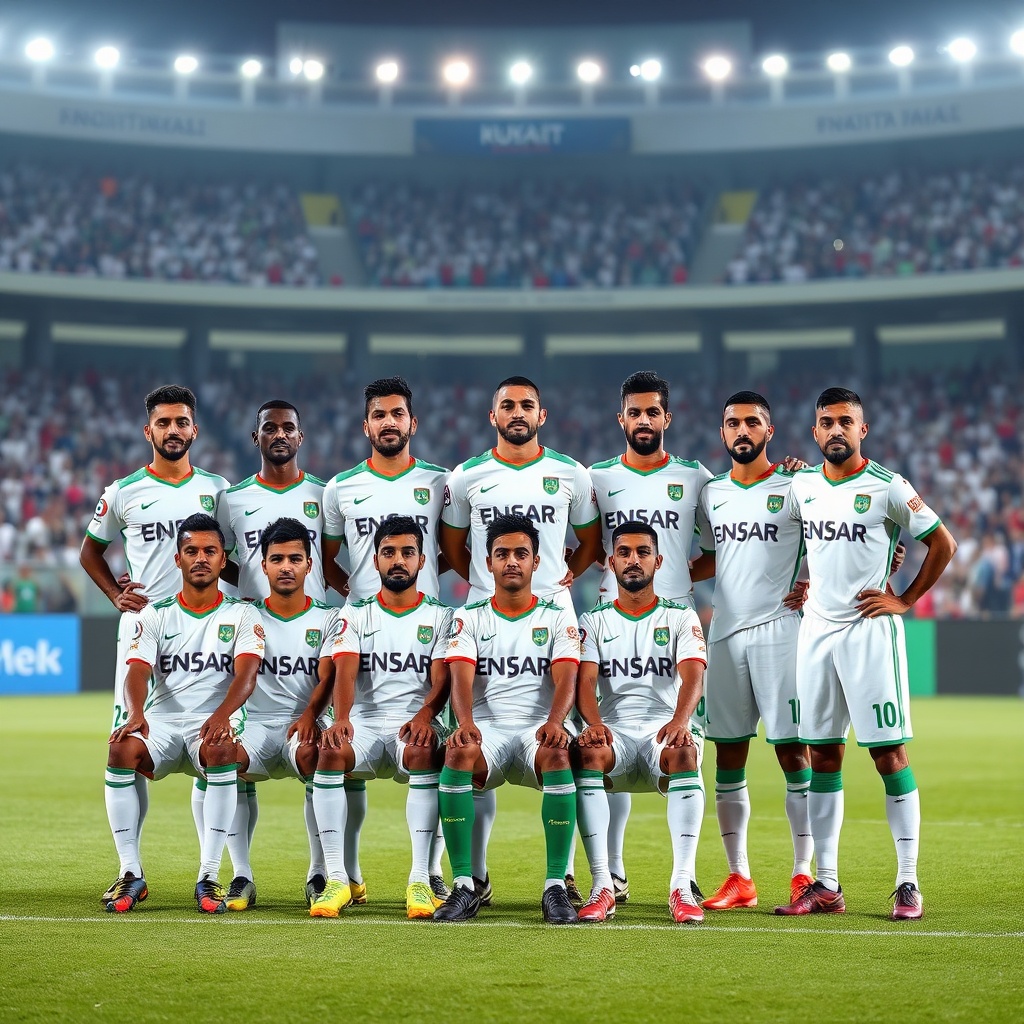
There was a time when the Persian Gulf did not bow to the money of Riyadh or the architectural opulence of Doha. In the late 1970s and early 1980s, the vanguard of football on the Arabian Peninsula wore blue and went by the name of Kuwait. As the first national team in the region to win the AFC Asian Cup and stamp their passport to a FIFA World Cup, the Kuwaiti team represented a trial of tactical and technical modernity in a territory that was still crawling toward professionalism. Under the baton of legendary Brazilian coaches like Mário Zagallo and Carlos Alberto Parreira, the "Blues" (Al-Azraq) challenged the established order of Asian football and inscribed their names in the history of the global sport with a flashy, creative, and deeply original style of play.
However, the history of football in Kuwait is not a narrative of continuous ascent, but rather a chronicle of splendor, geopolitical tragedy, administrative self-destruction, and painful ostracism. The same country that enchanted the world in 1982 saw its structures crumble under the impact of the Iraqi invasion in 1990, a trauma that claimed the life of the national sport's main patron and left indelible scars on the nation's soul. In the following decades, Kuwaiti football was held hostage by dynastic power struggles, chronic government interventions, and severe FIFA sanctions that isolated the country from the international scene for crucial years. Today, while its neighbors host World Cups and sign the biggest stars on the planet, Kuwait struggles to rediscover its tactical and administrative identity, feeling its way back to the elite of a continent it once dominated with authority.
1. Origins and Formation of National Identity
To understand the genesis of football in Kuwait, one must look back to the period before the discovery of oil, when the territory was a commercial outpost for pearls and maritime trade under the British protectorate. The introduction of the British sport to the sands of Kuwait occurred informally in the early decades of the 20th century, brought by employees of British oil companies and sailors docking in Kuwait City. Football quickly captured the imagination of local youth, who improvised pitches on arid land, playing barefoot with balls made of tied-up fabric. This playful and spontaneous character shaped the country's first generation of footballers, characterized by refined ball control and agility developed on the uneven surfaces of the desert.
The transition from romantic amateurism to institutional structuring accelerated in the 1950s. With the explosion of oil wealth, the Kuwaiti state began an ambitious process of urban and social modernization. The founding of the Kuwait Football Association (KFA) in 1952 marked the beginning of formal club organization, many of which were born from student associations and cultural centers. Clubs like Al-Arabi, founded in 1960, Al-Qadsia in 1953, and Al-Kuwait in 1960, became the backbones of national sports development. These institutions were not mere sports entities; they were centers of socialization for the elite and the emerging middle class, reflecting the political, sectarian, and social divisions of a nation in rapid transformation. The KFA's affiliation with FIFA in 1964 and the Asian Football Confederation (AFC) in 1962 formally placed the country on the international football map.
After the declaration of independence from the United Kingdom in 1961, football was instrumentalized by the state as a powerful tool for building national identity and geopolitical projection. In a region marked by territorial tensions and the search for sovereign legitimacy, victories on the pitch served as a testament to the modernity and vitality of the young nation. The Kuwaiti government began to generously fund sports infrastructure, building modern stadiums and sponsoring technical exchange programs. Football became the national sport par excellence, surpassing traditional practices and uniting a diverse population under the colors of the national team. The sky-blue jersey came to symbolize not just a team, but the pride of a country that saw itself as the "Venice of the Gulf," a beacon of cultural and economic progress in the region.
The identity of Kuwaiti football consolidated around a philosophy of play that favored ball possession, short dribbling, and individual creativity, characteristics that contrasted with the more physical and direct style of other Arab nations. This aesthetic inclination found its ideal catalyst in the hiring of foreign coaching staffs, with special emphasis on the Brazilian school. The arrival of South American coaches in the 1970s and 1980s refined the natural technique of Kuwaiti athletes, introducing modern concepts of tactical positioning, physical preparation, and collective discipline. The marriage between the cunning of Kuwaiti street football and the tactical rigor imported from Brazil generated a unique hybrid identity, which allowed the country to compete on equal terms with the traditional powers of the Asian continent, such as Iran, South Korea, and Japan.
The Role of Clubs in Structuring National Football
- Al-Arabi SC: The green giant, historically associated with the working classes and the Shia community, was the first great dominator of local football, establishing a standard of technical excellence and popular passion.
- Al-Qadsia SC: Representing the commercial elite and the ruling dynasty, the yellow and black club developed one of the most prolific academies in the country, serving as the foundation for the national team in its most glorious eras.
- Al-Kuwait SC: Funded by influential business magnates, it consolidated itself as a financial and structural powerhouse, attracting the best national and foreign talents and dominating continental competitions in recent decades.
2. Golden Era, Great Campaigns, and Eternal Idols
The "Golden Era" of Kuwaiti football extended from the mid-1970s to the late 1980s, a period of nearly fifteen years in which the country established an unquestionable hegemony in the Persian Gulf region and projected its strength at the continental and world levels. The turning point of this glorious trajectory was the hiring of Brazilian coach Mário Zagallo in 1976. The legendary two-time world champion as a player and champion as a coach in 1970 brought to Kuwait a level of professionalism and tactical demand unprecedented in the Middle East. Zagallo not only organized the senior national team but restructured the youth categories, implementing a talent scouting system that would feed the national football scene for over a decade. Under his command, Kuwait won the 1976 Gulf Cup with a devastating campaign, signaling that a new power was emerging.
The technical and tactical peak of this generation was reached under the direction of another Brazilian, Carlos Alberto Parreira, who took over as head coach after Zagallo's departure. Parreira, a deep connoisseur of physical preparation and modern tactical organization, maximized the talent of an extraordinary generation of players. In 1980, playing in front of their home crowd in Kuwait City, the Kuwaiti national team won the 1980 AFC Asian Cup. In the final, a categorical 3-0 victory over South Korea crowned a brilliant campaign and placed Kuwait at the top of the continent. The goals by Faisal Al-Dakhil and Jasem Yaqoub that October afternoon not only secured the trophy but consolidated an engaging style of play that mixed Brazilian rhythm with the speed of offensive transitions.
The definitive consecration occurred in the qualifiers for the 1982 World Cup. In a memorable campaign in the final Asian phase, Kuwait overcame powers like New Zealand, Saudi Arabia, and China, securing a historic qualification for the World Cup in Spain. Kuwait thus became the first nation in the Persian Gulf region to reach the final stage of a FIFA World Cup. The preparation for the tournament in Spain was treated as a matter of state, with friendlies against major European clubs and a period of intensive training that raised the physical level of the athletes to heights never before seen in the country.
In Spain, Kuwait was in Group 4, alongside England, France, and Czechoslovakia. The debut against the Czechoslovaks, in Valladolid, ended in a heroic 1-1 draw, with Faisal Al-Dakhil scoring the historic Kuwaiti goal with a beautiful shot from outside the box. However, Kuwait's participation would be eternally remembered for one of the most bizarre and folkloric episodes in the history of the World Cup, which occurred in the match against France. With the score at 3-1 for the French, Alain Giresse scored the fourth goal after the Kuwaiti defenders stopped on the pitch, claiming to have heard a whistle from the stands. Faced with the confusion, Sheikh Fahad Al-Ahmed Al-Jaber Al-Sabah, president of the Kuwait Football Association and brother of the Emir, came down from the VIP stands of the José Zorrilla stadium and invaded the pitch. In a surreal scene, the Sheikh gestured vehemently, ordered his players to leave the field if the goal was not disallowed, and pressured the Soviet referee Miroslav Stupar. After several minutes of interruption and intense discussion, the referee gave in to the pressure and disallowed the French goal, sparking indignant protests from the French coaching staff, led by Michel Hidalgo. Although France ended up winning 4-1 and the Sheikh was fined 14,000 dollars by FIFA, the incident illustrated the immense political power and audacity that characterized Kuwaiti football leaders at the time.
The Pillars of the Golden Generation
- Jasem Yaqoub: Considered by many the greatest player in Kuwait's history, he was a complete center-forward, endowed with excellent heading, impeccable positioning sense, and a lethal finish that made him the national team's top scorer.
- Faisal Al-Dakhil: Yaqoub's ideal partner in attack. An extremely technical, fast, and intelligent forward, author of Kuwait's historic first goal in World Cups against Czechoslovakia.
- Saad Al-Houti: The captain and the brain of the midfield. Al-Houti was the team's thermometer, responsible for dictating the pace of the game, initiating attacking plays, and ensuring defensive balance with his unquestionable leadership.
- Abdulaziz Al-Anberi: A left-winger with refined skill and precise crossing, Al-Anberi was the team's main weapon for speed and dribbling, dismantling opposing defenses with ease.
3. Rivalries, Crises, and Behind-the-Scenes Power
The trajectory of football in Kuwait is inseparable from the complex geopolitical dynamics of the Middle East and the internal power struggles of the Al-Sabah royal family. Kuwait's greatest football rivalry is with Iraq, a confrontation that transcends the four lines and carries deep historical and political weight. During the 1970s and 1980s, Kuwait and Iraq fought for the supremacy of football in the Persian Gulf in matches of extreme tension and aggression. However, the sporting dimension of this rivalry was tragically surpassed on August 2, 1990, when Iraqi troops, under the orders of Saddam Hussein, invaded Kuwait, starting the Gulf War. The invasion had devastating consequences for Kuwaiti sport. Sheikh Fahad Al-Ahmed Al-Jaber Al-Sabah, the charismatic and influential president of the KFA who had invaded the pitch in Spain in 1982, was assassinated by Iraqi forces while defending Dasman Palace, the royal residence. The death of Sheikh Fahad deprived Kuwaiti football of its most powerful leader and represented a traumatic blow from which the national sport never fully recovered.
The Iraqi occupation resulted in the systematic destruction of the country's sports infrastructure. Stadiums were turned into military bases and detention centers, historical archives of the federation were burned, and many athletes and officials were forced into exile or suffered persecution. The national championship was interrupted, and the national team spent months unable to train or play on its territory. After the country's liberation by the international coalition in 1991, Kuwaiti football began a painful reconstruction process. Although the national team won Gulf Cup titles in the 1990s (1996 and 1998), the technical and organizational foundation of the country had been severely compromised, allowing neighbors like Saudi Arabia and, later, Qatar and the United Arab Emirates to take the lead in the region.
In the following decades, the greatest adversary of Kuwaiti football did not come from outside, but from within its own borders. The sport became a hostage to an intense political dispute between different factions of the Al-Sabah royal family and the Kuwaiti Parliament, one of the most active and politicized in the Arab world. Chronic government interference in the affairs of the football federation led to a destructive cycle of suspensions imposed by FIFA. The world's highest football body adopts a zero-tolerance policy against state interference in the administration of national federations. Kuwait was suspended for the first time in 2007, followed by a new suspension in 2008. However, the most devastating blow occurred in October 2015, when FIFA, together with the International Olympic Committee (IOC), banned Kuwait from all international competitions due to a new national sports law that compromised the independence of local federations.
This suspension, which lasted more than two years (being revoked only in December 2017), was catastrophic for the country's football. During this period of isolation, the national team was disqualified from the 2018 World Cup Qualifiers and the 2019 AFC Asian Cup, despite being in favorable qualifying positions before the ban. Kuwaiti clubs were prevented from playing in continental competitions, sponsorships were canceled, and the development of youth categories was completely paralyzed. An entire generation of Kuwaiti talents was deprived of competing at an international level in their peak physical and technical years, deepening the abyss that separates Kuwait from the main powers of contemporary Asian football.
Chronology of FIFA Suspensions of Kuwait
- November 2007: Suspension due to government interference in the election of KFA board members. The suspension was temporarily lifted after reform commitments.
- October 2008: New suspension after the federation failed to hold elections independently and in accordance with FIFA statutes.
- October 2015 to December 2017: The longest and most damaging ban in the country's history. Motivated by parliamentary amendments that allowed the government to dissolve local sports federations and take control of their funds. The suspension isolated Kuwaiti football for 26 months, destroying the short and medium-term planning of all national teams.
4. The Current Moment: Tactics, Generation, and Challenges
Contemporary Kuwaiti football is experiencing a moment of deep transition and a search for relevance. After the end of the FIFA suspension in 2017, the national team found a dramatically transformed continental landscape. Countries that were once easily surpassed by Kuwait had professionalized their leagues, invested in cutting-edge sports technology, and naturalized international-level players. Kuwait, in turn, found itself forced to start almost from scratch, tactically outdated and with a chronic shortage of new talents capable of replicating the brilliance of past generations. The national team has struggled to be competitive even at a regional level, suffering early eliminations in the Gulf Cups and facing enormous difficulties in the preliminary phases of AFC competitions.
From a tactical point of view, Kuwait has abandoned the proactive stance and possession-based football that characterized its golden era. Under the command of successive foreign coaches—which included stints by Croatian, Portuguese, and Spanish managers—the team has adopted a markedly defensive, reactive, and physical style of play. The lack of intensity in transitions and the slowness in ball circulation have become chronic problems. In many matches against top-tier Asian opponents, Kuwait positions itself in a low block, using tactical systems like 5-4-1 or 4-5-1, trying to close central spaces and betting almost exclusively on long balls and sporadic counterattacks. This pragmatic approach reflects the squad's lack of technical confidence and the need to stop heavy defeats, but it also limits the team's collective growth potential.
The transition of generations has been slow and painful. For nearly two decades, the central figure of Kuwaiti football was striker Bader Al-Mutawa. One of the players with the most official international caps in the history of world football, Al-Mutawa was the symbol of the country's technical resistance during the years of isolation. Endowed with extraordinary vision, precision in set pieces, and silent leadership, he carried the weight of a declining national team. However, the excessive dependence on Al-Mutawa highlighted the inability of the country's training system to produce new protagonists. With the inevitable physical decline and the gradual retirement of the veteran from the main call-ups, Kuwait faces a vacuum of technical leadership and creativity in the offensive sector.
Currently, hopes for renewal rest on names like Shabaib Al-Khaldi, a center-forward with good physical presence and a nose for goal, who has stood out on the domestic scene and in some international appearances. However, the tactical and physical gap between players who play in the local league and those who play in Asia's elite leagues (such as the K-League, J-League, or the revamped Saudi Arabian league) is evident. The lack of competitive intensity in the Kuwaiti championship is directly reflected in the performance of the national team, which frequently succumbs when pressured by opponents who impose a more dynamic and physical pace of play.
Tactical Analysis of the Current Game Model
- Defensive Phase: Low block compaction, with defensive lines very close together to deny space behind the defense. There is a clear preference for center-backs with greater physical vigor, sacrificing quality in ball distribution for greater ability to clear and win aerial duels.
- Transition Phase: Direct and vertical offensive transition. The team seeks to quickly trigger the wings or the target center-forward through direct balls, avoiding sustained build-up from the defensive third to minimize the risk of losing the ball in dangerous zones.
- Chronic Problems: Low physical intensity without the ball, difficulty maintaining possession under high pressure from the opponent, and excessive dependence on set pieces (corners and wide free kicks) to create real goal-scoring chances.
5. Talent Development, Structure, and Future
The future of football in Kuwait depends on a deep structural reform that must necessarily include the modernization of its domestic league and the complete restructuring of the youth categories. The Kuwait Premier League (VIVA Premier League, for sponsorship reasons) remains an essentially amateur or semi-professional league in its administrative essence, despite the high salaries paid to local players. Unlike what happens in Saudi Arabia or the United Arab Emirates, where clubs have been privatized or receive direct investments from trillion-dollar sovereign wealth funds, Kuwaiti clubs still rely heavily on government subsidies and sponsorship from influential families. This financial model limits the ability to invest in cutting-edge infrastructure, sports science, and the recruitment of high-level international talent.
The structure for training athletes in Kuwait is obsolete compared to modern standards established by neighbors like Qatar, with its world-famous Aspire Academy. In Kuwait, the discovery of players still occurs almost spontaneously in traditional clubs, without a unified methodology or the support of multidisciplinary teams that include nutritionists, sports psychologists, and performance analysts from the youth categories. Young Kuwaiti athletes face a deficit of high-intensity competitive minutes during their training, which delays their tactical and physical maturation. Furthermore, the lack of incentives for the export of players is a significant obstacle. Due to the comfortable salaries offered by local clubs and the bureaucratic and cultural difficulties of adapting abroad, very few Kuwaiti players venture into European leagues or even more competitive championships in the Middle East. The geographical and technical isolation of the athletes perpetuates the cycle of stagnation in national football.
To break this cycle, the Kuwait Football Association has sought to draw up new strategic plans. There are ongoing discussions for the definitive professionalization of the national league, the creation of a development league for young athletes, and the establishment of technical partnerships with top European federations. Hiring foreign professionals to manage the youth national teams is an initial step, but one that requires long-term political and financial support to generate concrete results. The great challenge is to isolate football administration from the constant political turmoil that characterizes the parliament and power struggles in the country, ensuring stability so that technical projects can be executed to the end.
The expansion of the FIFA World Cup to 48 teams, starting from the 2026 edition, appears as a light at the end of the tunnel and a powerful motivating element for Kuwaiti football. With the increase in the number of spots allocated to the Asian Football Confederation (AFC), the dream of returning to the biggest stage of world football ceases to be a distant utopia and becomes a tangible medium-term goal. However, for Kuwait to realistically compete for one of these spots, it will take more than just individual talent or jingoistic speeches. It will require a cultural revolution in the country's sport: a transition from political and administrative amateurism to scientific, tactical, and ethical professionalism. Only then will the "Blues" be able to rescue the pride of their fans, honor the memory of pioneers like Sheikh Fahad, Jasem Yaqoub, and Faisal Al-Dakhil, and rewrite their history as a true Asian football powerhouse.
Structural Challenges for the Modernization of Kuwaiti Football
- Privatization and Professionalization: Transform clubs from semi-public sports associations into football corporations, attracting private investment and professional corporate management.
- Infrastructure and Technology: Invest in the modernization of training centers, the implementation of data analysis and scouting departments, and the improvement of pitches and club medical facilities.
- Stimulating Athlete Export: Create mechanisms that facilitate and encourage the transfer of young talents to European football or stronger Asian leagues, raising the average competitive level of national team players.
- Political Stability in the KFA: Shield the Kuwait Football Association against internal political disputes and government interference, ensuring the continuity of technical projects and avoiding the risk of new FIFA sanctions.





