



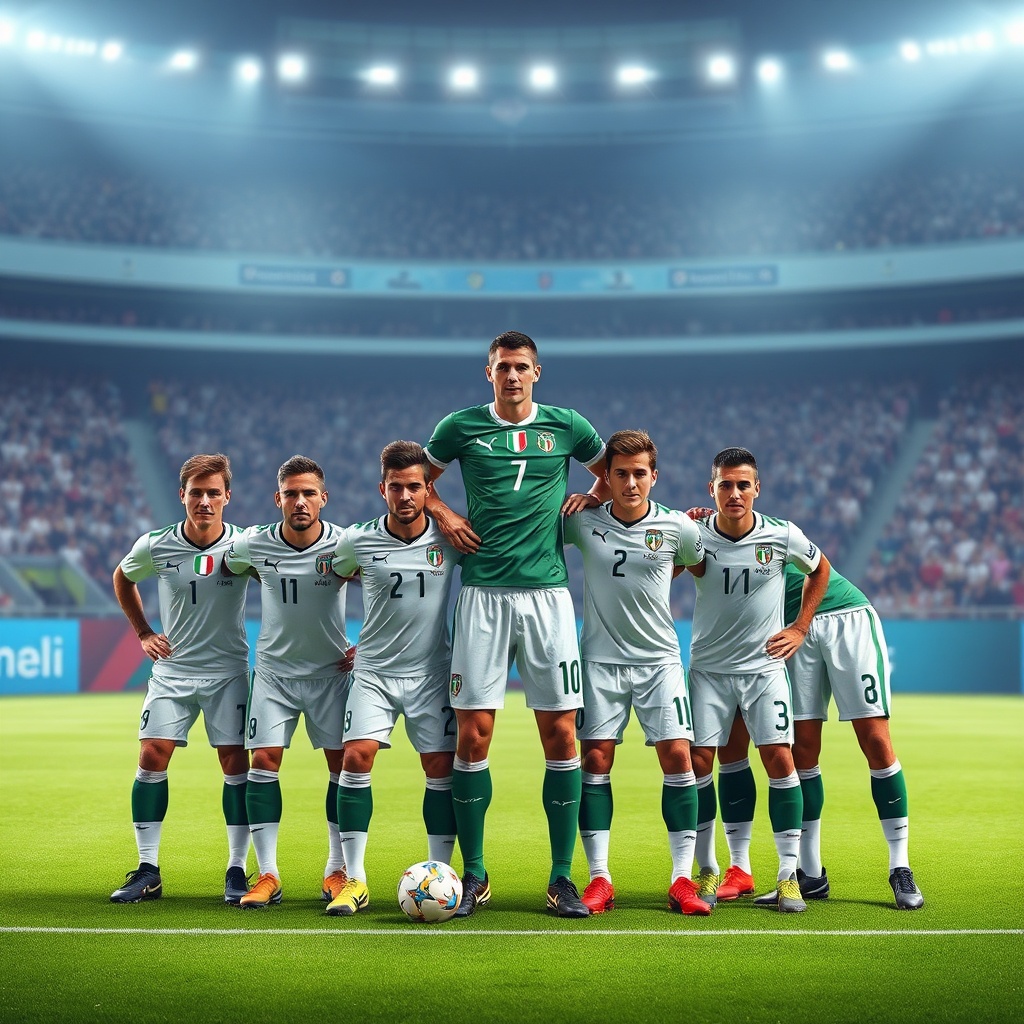
In the vast pantheon of world football, few jerseys carry as much dramatic, glorious, and contradictory weight as Italy's Maglia Azzurra. A four-time world champion, the Italian national team is an entity that refuses to be simply deciphered. It transitions, with almost theatrical ease, between the pinnacle of tactical refinement and the abyss of institutional disorganization; between the almost mystical solidity of its historic defenses and the schizophrenia of its recurring collapses in qualifiers. To understand Italian football, one must abandon superficial analyses and dive into a culture where the sport is not just a game, but a mirror of the peninsula's own soul: a blend of art, politics, visceral passion, and a pragmatism that borders on survival. This dossier examines the inner workings of the Squadra Azzurra, tracing its origins under the shadow of fascism, its golden eras marked by unlikely heroes, its geopolitical rivalries, and, fundamentally, the contemporary identity crisis that seeks to redefine what it means to play football in the homeland of catenaccio.
1. Origins and the Formation of National Identity
Football was not born in Italy, but it was there that it was codified as an extension of the national character. Although the British exported the modern game through the ports of Genoa and Turin in the late 19th century, the Italians quickly sought a family tree of their own to legitimize their passion. They found it in the Calcio Storico Fiorentino, a violent and aristocratic Renaissance game that mixed wrestling, athletics, and civic pride. When the Federazione Italiana Giuoco Calcio (FIGC) was founded in 1898, the country was still stitching the wounds of its late political unification (the Risorgimento). The national team, which debuted on May 15, 1910, wearing white against France at Milan's Arena Civica, would soon adopt the Savoy blue (Azzurro) in honor of the Royal House of Savoy. Football, therefore, was born with the mission of unifying a country fragmented by dialects, regional rivalries, and abysmal economic disparities between the industrialized North and the agrarian South.
The true transformation of Italian football into a mass tool and a vehicle for geopolitical projection occurred under the fascist dictatorship of Benito Mussolini. In the 1930s, the fascist regime understood the propaganda potential of the sport. The man tasked with translating this vision into victories on the pitch was Vittorio Pozzo, a journalist, military man, and strategist with a brilliant mind and autocratic methods. Pozzo, who led the national team in the victorious 1934 and 1938 World Cup campaigns, as well as the 1936 Olympic gold, is the true father of Italian football. He developed the Metodo, a tactical variation of the classic system that dropped attacking midfielders back to create a solid defensive block and quick counter-attacking outlets—the conceptual embryo of what would later become Italian reactive football.
Under Pozzo's baton, Italy played with physical intensity and almost military discipline. Mussolini's regime financed the construction of monumental stadiums and used the 1934 World Cup, hosted in Italy, as a showcase for fascism. Pozzo was also a pioneer in the use of oriundi—South American players of Italian descent, such as the Argentines Luis Monti, Raimundo Orsi, and Attilio Demaría. This strategy, although criticized by purists at the time, was justified by the regime's nationalist rhetoric, which considered the children of Italians abroad as legitimate citizens of the homeland. The victory in the 1934 final against Czechoslovakia and the subsequent title defense in 1938 in France, amidst jeers from the anti-fascist public, consolidated Italy as the first superpower of world football. However, this golden era was intrinsically linked to political darkness, leaving a legacy of suspicion and tension that would shape the external perception of Italian football for decades.
The post-war period brought the need for moral and material reconstruction. Italian football found its new axis of pride in the Grande Torino, the Torino FC team that dominated the domestic scene in the 1940s. Led by the brilliant Valentino Mazzola, this team formed the backbone of the national team, often providing up to ten starters for the Azzurra's eleven. However, fate had one of the greatest tragedies in sports history in store: on May 4, 1949, the plane carrying the Torino team crashed into the Superga Basilica, killing everyone on board. The Superga disaster not only decimated a legendary club but decapitated the Italian national team on the eve of the 1950 World Cup. Traumatized, the delegation traveled to Brazil by ship, and the national team spent the 1950s in a state of technical and tactical mourning, unable to replicate the greatness of the Pozzo era, culminating in the humiliation of failing to qualify for the 1958 World Cup in Sweden.
2. Golden Era, Great Campaigns, and Eternal Idols
The resurrection of Italian football occurred through a tactical revolution that would define its identity forever: the advent of Catenaccio. Popularized by Nereo Rocco at AC Milan and perfected by Helenio Herrera at Internazionale, the system was based on an ultra-reinforced defensive line with the figure of the libero (the defender free from individual marking who covered the space) and surgical counter-attacks. Although criticized by the international press as a destructive and unsportsmanlike style, catenaccio was, in reality, a scientific response to momentary physical or technical inferiority, transforming the art of defending into an exact science. It was with this rigorous defensive mentality that Italy won the 1968 European Championship on home soil, after a coin toss in the semifinal against the Soviet Union and a replayed final against Yugoslavia.
Two years later, at the 1970 World Cup in Mexico, the world would witness the duality of Italian football in the famous Staffetta (relay) between midfielders Gianni Rivera and Sandro Mazzola, orchestrated by coach Ferruccio Valcareggi. Rivera, the elegant "Golden Boy" of Milan, and Mazzola, the dynamic engine of Inter, were seen as incompatible in the same starting lineup. This debate divided the country and symbolized the eternal Italian search for the balance between artistic fantasy and tactical rigor. It was in this World Cup that Italy played the semifinal against West Germany at the Azteca Stadium, an epic clash won by the Italians 4-3 in extra time, immortalized as the "Game of the Century." Although they were defeated in the final by the brilliance of Pelé's Brazil, the Azzurra had regained its place in the global elite.
The emotional and technical peak of post-war Italian football occurred in 1982, in Spain. Under the command of the quiet and stubborn Enzo Bearzot, the team arrived at the tournament under severe criticism from the Italian press, which contested the call-up of Paolo Rossi—a striker who had just served a suspension for involvement in the Totonero betting scandal. In response, the squad declared a historic silenzio stampa (press boycott). What followed was one of the most dramatic campaigns in World Cup history. After a mediocre first phase with three draws, Italy transformed in the final phase. Led by Claudio Gentile's relentless marking of Diego Maradona and Zico, and the resurrection of Paolo Rossi, who scored three goals in the historic 3-2 triumph over favorites Brazil at the Sarriá Stadium, the Azzurra steamrolled their opponents. Rossi would score again in the semifinal against Poland and in the final against West Germany, sealing the third title in Madrid under the joyful gaze of Italian President Sandro Pertini.
The 1990s began with the lyrical melancholy of the Notti Magiche (Magic Nights) of the 1990 World Cup, held in Italy. A talented generation, featuring the unexpected charisma of top scorer Salvatore "Totò" Schillaci and the pure talent of Roberto Baggio, fell painfully in the semifinals against Maradona's Argentina on penalties in Naples—a city divided between love for its Argentine idol and loyalty to the homeland. Four years later, in the United States, Roberto Baggio would carry a tactically rigid Italy, led by Arrigo Sacchi, to the final in Pasadena. Fate, however, was cruel to the "Divine Ponytail": after a messianic campaign, Baggio missed his penalty in the shootout against Brazil, leaving a deep scar on the country's sporting psyche.
The definitive redemption came in 2006, in Germany, in a scenario that mimicked the drama of 1982. Italian football was immersed in the biggest scandal in its history, Calciopoli, which exposed a match-fixing scheme involving the country's main clubs. Under a storm of distrust, coach Marcello Lippi managed to shield the group and channel the anger into motivation. With an almost impenetrable defense led by Fabio Cannavaro (who would win the Ballon d'Or that year) and goalkeeper Gianluigi Buffon, Italy demonstrated remarkable tactical versatility. In the semifinals, they defeated hosts Germany in Dortmund with two goals in the final minutes of extra time. In the final against France, marked by Zinedine Zidane's headbutt on Marco Materazzi, Italy kept its cool to win on penalties, securing their fourth title and proving that, in Italian football, chaos is often the prelude to glory.
3. Rivalries, Crises, and Behind-the-Scenes Power
The trajectory of the Italian national team is inseparable from its intense rivalries on the European and world stage. The most visceral of these is against Germany. Unlike other rivalries that carry explicit geopolitical tensions, the Italy-Germany clash (known in Germany as Jahrhundertspiel when referring to 1970) is based on a deep psychological barrier. Historically, Italy has always been the "bogeyman" for the Germans in official tournaments. From the semifinals of 1970 and 2006 to the 1982 final and the Euro 2012 semifinal, the Italians systematically frustrated the most brilliant German generations with displays of extreme tactical intelligence and emotional resilience. This rivalry transcends the pitch, also reflecting the cultural clash between Germanic organizational rigor and the brilliant, defensive improvisation of Southern Europe.
Another high-voltage rivalry is with France, the so-called "Transalpine Derby." This clash gained dramatic contours at the turn of the millennium. The Italian defeat in the Euro 2000 final, with David Trezeguet's "golden goal" in the final breath, was a national trauma that would only be avenged six years later in the 2006 World Cup final in Berlin. Clashes against France are always marked by a strong sense of cultural and sporting pride, where each nation seeks to assert its supremacy over the other on the European continent.
However, Italy's greatest battles have often occurred off the pitch, in the corridors of power at the FIGC and in the courts of law. Italian football is cyclically plagued by corruption scandals that expose the dangerous links between officials, referees, gamblers, and organized crime. In addition to Totonero in 1980 and Calciopoli in 2006, the country faced the Scommessopoli scandal in 2011-12 and, more recently, in 2023, investigations into illegal betting involving young prospects like Sandro Tonali and Nicolò Zaniolo. These crises reveal a structural fragility in the governance of the sport, where the pursuit of political and financial power often overrides technical development.
This institutional instability took its highest toll in the 2010s. After the failure in the 2010 and 2014 World Cups, where Italy was eliminated in the group stage, the system collapsed completely on November 13, 2017. That night, at the San Siro, under the command of the contested coach Gian Piero Ventura, Italy drew 0-0 with Sweden in the playoffs, missing out on a World Cup for the first time in 60 years. Gianluigi Buffon's tears in his farewell to the national team symbolized the end of an era and the beginning of the "Apocalypse," as the Italian press dubbed the disaster. The elimination exposed the anachronism of the FIGC, the lack of talent renewal, and the technical decline of Serie A, which had ceased to be the richest and most attractive league in the world to become a transition championship.
The Italian paradox manifested itself again spectacularly under the command of Roberto Mancini. Taking over a team in ruins in 2018, Mancini promoted an aesthetic revolution, abandoning defensive pragmatism in favor of possession-based football, high pressing, and technical dynamism. The result was a historic 37-game unbeaten streak and the Euro 2020 title (played in 2021), won against England at Wembley on penalties. It seemed like the definitive rebirth. However, arrogance and the inability to renew the attack came at a high price: in March 2022, Italy was surprised by North Macedonia in Palermo, losing 1-0 in the playoffs and missing out on their second consecutive World Cup. This emotional roller coaster—from the top of Europe to global ostracism in less than a year—illustrates the fragility of a system that lives on spasms of genius amidst chronic structural crises.
4. The Current Moment: Tactics, Generation, and Challenges
The current scenario of the Italian national team is one of profound transition and reconstruction under the leadership of Luciano Spalletti. The coach, who took office in August 2023 after the abrupt and controversial resignation of Roberto Mancini (who accepted a multi-million dollar offer from the Saudi Arabia national team), inherited a tactically confused and psychologically fragile team. Spalletti, acclaimed for his revolutionary work at Napoli, the 2022-23 Serie A champions, brought with him the reputation of an obsessive strategist, capable of extracting the maximum technical output from squads without global superstars through fluid, high-intensity positional football.
Tactically, Spalletti has sought to move Italy away from Mancini's rigid 4-3-3 to implement a hybrid system, alternating between 3-4-2-1 and 3-5-2. This change aims to leverage the characteristics of the main defenders and wing-backs of contemporary Italian football, many of whom play for clubs that use three-center-back schemes, such as Simone Inzaghi's Internazionale and Gian Piero Gasperini's Atalanta. In Spalletti's model, the build-up phase (fase di possesso) starts from the goalkeeper, using technical defenders like Alessandro Bastoni and Riccardo Calafiori to break opposition pressing lines with vertical passes or bold ball carries.
The current generation of players reflects a change in the profile of the Italian athlete. If in the past Italy was famous for its ruthless man-marking defenders (like Gentile, Baresi, and Maldini), today the country produces defenders with excellent passing ability and game reading, but who sometimes present gaps in the pure art of defending the box. Riccardo Calafiori, developed by Roma and highlighted at Thiago Motta's Bologna before moving to Arsenal, is the prototype of this new defender: elegant, versatile, and with a midfielder's mentality. Alongside him, Alessandro Bastoni is consolidating himself as one of the best ball-playing center-backs in the world.
In midfield, Italy has its most robust and competitive sector. Nicolò Barella, the engine of Internazionale, is the dynamic heart of the team, combining impressive athletic ability with precise assists and runs into the opposition box. Davide Frattesi offers an option of physical strength and a goal-scoring instinct from deep, while the tactical intelligence of Manuel Locatelli and the refined technique of Samuele Ricci seek to provide the necessary balance for the defensive transition. Spalletti's great tactical challenge, however, lies in creating plays in the final third of the field, where the absence of a true creative regista after the physical decline of Jorginho and Marco Verratti is severely felt.
The greatest and most persistent crisis of the Italian national team, however, is in the center-forward position (the classic centravanti). Since the international retirement of Mario Balotelli and the decline of Ciro Immobile—who, despite being prolific at Lazio, never managed to replicate his success for the national team—Italy has suffered from a shortage of world-class number 9s. The search for solutions led to the naturalization of the Argentine Mateo Retegui, who quickly adapted to European football playing for Genoa and subsequently Atalanta. Retegui offers physical presence, hold-up play, and finishing efficiency, but still lacks the technical genius of predecessors like Christian Vieri, Filippo Inzaghi, or Luca Toni. The development of Gianluca Scamacca, a striker with formidable technical resources but inconsistent performance and plagued by serious injuries, remains an unknown for the team's near future.
Graphically, the basic tactical positioning of Spalletti's Italy in the offensive phase can be understood as follows:
- Goalkeeper: Gianluigi Donnarumma (acting as a sweeper-keeper in the first build-up phase).
- Line of Three Defenders: Giovanni Di Lorenzo (or Matteo Darmian), Alessandro Bastoni, and Riccardo Calafiori (with freedom to advance).
- Wing-backs / Flankers: Federico Dimarco on the left (providing width and precise crosses) and Andrea Cambiaso (or Raoul Bellanova) on the right.
- Midfield: Nicolò Barella (right-mid/interior), Samuele Ricci (or Jorginho as the holding midfielder), and Sandro Tonali (left-mid/interior).
- Attack: Mateo Retegui (central reference) supported by a mobile second striker or attacking midfielder, such as Lorenzo Pellegrini or Mattia Zaccagni.
5. Talent Development, Structure, and Future
To understand why Italy went from a four-time world champion to a team struggling to qualify for the most important tournaments, one must analyze in depth the structure of athlete development in the country. The Italian youth system, historically managed by clubs through their youth sectors (Settore Giovanile), faces a technical and financial bottleneck. Unlike France, which developed a national network of ultra-modern academies (like Clairefontaine), or Germany, which revolutionized its training after the Euro 2000 fiasco, Italy was slow to modernize its methods of scouting and developing young talent.
One of the main obstacles in the transition of the young athlete to professional football is the structure of the Italian youth league, the Primavera championship. Although competitive, the tournament is often criticized by elite coaches for not adequately preparing players for the physical intensity and tactical pressure of professional football. To mitigate this problem, the FIGC allowed the creation of B teams (U-23) playing in Serie C (third professional division), a pioneering initiative by Juventus (with the Next Gen project) and subsequently adopted by Atalanta and Milan. This model has proven highly effective for maturing youngsters like Kenan Yıldız, Nicolò Fagioli, and Francesco Camarda in a competitive football environment against adults, but its adoption is still slow due to political and financial resistance from other third-division clubs.
Another crucial factor of political-sporting debate in Italy was the impact of the Decreto Crescita (Growth Decree). This tax law, introduced by the Italian government to attract foreign talent through significant tax exemptions on the salaries of professionals coming from abroad, ended up having a devastating side effect on the youth categories. Serie A clubs, seeking to reduce immediate operating costs, preferred to sign mediocre foreign players rather than invest in the development and transition of young Italians. The partial abolition of this decree at the end of 2023 forced clubs to look within their borders again, but the fruits of this structural change will only be reaped in the medium to long term.
The physical infrastructure of Italian football is another critical bottleneck. The vast majority of Serie A stadiums are municipally owned, built or last renovated for the 1990 World Cup. Without ownership of their arenas, clubs face immense bureaucratic difficulties in modernizing their facilities and generating matchday revenues equivalent to those of the giants of the Premier League or the Bundesliga. This financial asphyxiation is reflected in the inability to keep the main national prospects in the country, with young talents being seduced by financially unbeatable offers from abroad, altering Serie A's historical role from a final destination to a talent-exporting league.
Despite these Herculean challenges, the future of the Italian national team shows signs of hope. The coordination work of the FIGC's youth national teams, led by technical coordinator Maurizio Viscidi, has been highly successful. Italy won the U-19 European Championship in 2023 and reached the U-20 World Cup final in the same year, revealing players of enormous technical potential, such as midfielder Tommaso Baldanzi, the dynamic Cesare Casadei, and the precocious center-forward Francesco Camarda (the youngest debutant in Serie A history for Milan). The challenge lies in ensuring that these youngsters receive significant playing time at their professional clubs, rather than being loaned out successively to lower-division teams.
The short and medium-term goal for the Italian Federation and Luciano Spalletti is clear and non-negotiable: secure qualification for the 2026 World Cup in North America. For a nation with the history and footballing pride of Italy, the prospect of a third consecutive absence from the biggest stage in world sports would be more than a sporting failure; it would be a cultural and economic catastrophe that would consolidate the decline of one of the greatest football schools on the planet. The road is long and full of tactical and structural obstacles, but if the history of the Squadra Azzurra has taught us anything, it is that one should never underestimate the Italian capacity to find beauty, strength, and victory in the heart of chaos itself.





