



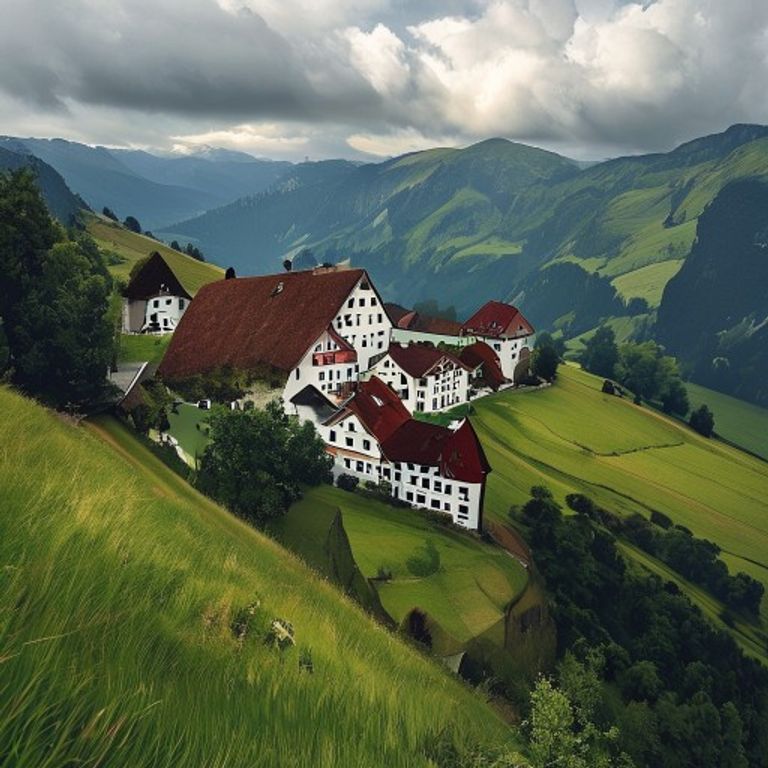
Nestled between Switzerland and Austria, this alpine principality is one of the richest and most industrialized countries per capita (false teeth and tools). Ruled by a prince with royal powers, it has no army, and the landscape is dominated by Vaduz Castle. It is a discreet tax haven and a winter destination, where the monarch invites all citizens to an annual garden party.
⚠️ Research conducted with the aid of Deep Research is subject to referential ambiguity.
🖥️Clean HTML code using a proprietary tool.
👥 Research by Guilherme Felipe, Curation by Sílvio Lôbo
The Litany of the Mountain: A Dive into Liechtenstein's Literature
Liechtenstein, the tiny principality nestled in the heart of the Alps, boasts a literary output that, while modest on a global scale, pulses with a unique cultural identity and a deep connection to its landscape and history. As a literary critic and researcher, it is fascinating to unravel the threads that weave the literary tapestry of such a particular nation. Liechtenstein's literature, often shaped by its proximity to neighbors of greater cultural and linguistic stature, such as Germany, Austria, and Switzerland, has developed its own voice, marked by introspection, appreciation for nature, and reflection on identity in the context of a small nation.
Key Authors and Their Contributions
Although Liechtenstein's literary pantheon may not feature names of massive international renown, the region has produced and hosted authors whose works reflect the local spirit with depth. Among the most significant names is Josef Rheinberger (1839-1901), a renowned composer, but whose lyrical writings and diaries offer a glimpse into the intellectual and artistic life in Liechtenstein in the 19th century. His work, while not the primary focus of his fame, reveals a keen sensitivity to natural beauty and a deep sense of belonging.
In the 20th and 21st centuries, authors like Manfred Stanger (born 1940) have emerged as important voices. Stanger, a prolific writer of short stories, poems, and essays, frequently explores themes of memory, identity, and the individual's relationship with the alpine environment. His writing is characterized by precise language and keen observation of detail, capturing the essence of life in a small, cohesive community.
Another name worth mentioning is Ernst N. Brugger (1921-2000), whose novels and stories often address the history and traditions of Liechtenstein, offering readers a portal to the past and to the narratives that have shaped national identity. His work is a testament to the importance of preserving collective memory in an ever-changing world.
Literary Movements and Historical Publications
Due to its size and geographical location, Liechtenstein has not presented formal, widely defined literary movements, as found in larger nations. However, it is possible to identify trends and currents of thought that have shaped literary production. Romanticism, with its emphasis on nature, sentiment, and the exploration of folklore, exerted considerable influence, especially in early writings that sought to capture the imposing beauty of the alpine landscapes and local traditions.
More recently, a trend towards introspective realism and memorialistic literature has gained momentum. Contemporary authors tend to focus on personal experiences, interpersonal relationships, and reflections on life in a society that, despite its wealth and stability, faces its own challenges and nuances.
Important publications in Liechtenstein naturally include the output of its own authors. The literary magazine "Land", published by the Liechtenstein Literary Association, has been a crucial vehicle for new talent and for the dissemination of established works. Furthermore, the publishing house Historischer Verein für das Fürstentum Liechtenstein (Historical Association for the Principality of Liechtenstein) frequently publishes works of historical and cultural significance that, indirectly, enrich the local literary landscape, offering context and inspiration for writers.
Liechtenstein's Cultural Identity Reflected in Books
Liechtenstein's cultural identity, intrinsically linked to its geographical and historical characteristics, is a recurring and central theme in the region's literature. Several elements emerge clearly:
- The Mountain as Metaphor: The imposing Alps are not mere backdrops but characters in themselves. They represent solidity, permanence, but also isolation and challenges. The Liechtensteiners' relationship with the mountain is one of respect, admiration, and, at times, a struggle against its elements.
- The Search for Identity in a Small Context: Being an independent principality amidst European powers fosters constant reflection on what it means to be "Liechtensteiner." Literature explores this search for identity, the appreciation of autonomy, and the preservation of traditions in an increasingly globalized world.
- The Importance of Community: Life in a small, cohesive community is frequently portrayed. Interpersonal relationships, family ties, and a sense of belonging are explored, highlighting the strength and complexities of living in an environment where everyone knows each other.
- Preservation of Heritage: There is a strong desire to preserve local history, traditions, and customs. Literature acts as a guardian of these memories, documenting and celebrating the principality's cultural legacy.
- The Influence of Neighbors and Uniqueness: Liechtenstein's literature deals with the duality of absorbing cultural influences from neighboring countries while simultaneously asserting its own uniqueness. This interaction is a driving force for artistic expression that seeks a balance between the universal and the particular.
In summary, literature in Liechtenstein, while perhaps not boasting a volume comparable to other nations, offers a valuable perspective on the human experience in a unique context. It is a litany of the mountain, a celebration of resilience, and a profound meditation on identity that resonates with the austere beauty and rich history of an unforgettable principality.





