



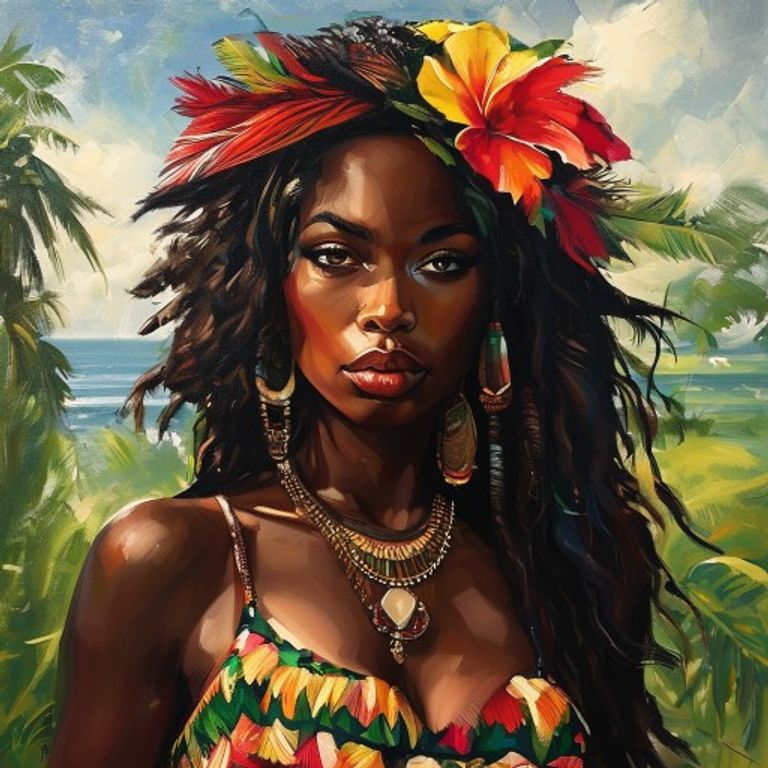
The Caribbean's 'Nature Island,' Dominica, distinguishes itself by not having mass tourism or typical white-sand beaches, but rather rainforests, rivers (365 of them), and volcanic hot springs. It is the only place in the Eastern Caribbean with a significant remaining population of indigenous Kalinago people. It is a destination for hikers and lovers of wild and pure ecotourism.
⚠️ Research conducted with the aid of Deep Research is subject to referential ambiguity.
🖥️Clean HTML code using a proprietary tool.
👥Research by Guilherme Felipe, Curation by Sílvio Lôbo
The Island's Voice: An Essay on Dominican Literature
Dominica, affectionately known as the "Nature Island," boasts a rich literary tapestry that reflects its lush landscape, complex history, and the resilient soul of its people. Dominican literature, though sometimes less visible on the global literary scene, pulses with authenticity and offers deep insights into the island's cultural identity, shaped by African heritage, European influences, and the very force of nature that surrounds it.
Key Authors and Their Contributions
The Dominican literary scene has been enriched by authors who, through their words, have given voice to the island's experiences, aspirations, and challenges. A prominent name is Jean Rhys, although her connection to Dominica is complex and often associated with her formative period. Born in 1900, Rhys captured the sensual atmosphere and the complexities of interracial relationships in her works, especially in her semi-autobiographical novel "Voyage in the Dark" and her renowned "Wide Sargasso Sea," which serves as a prelude to Charlotte Brontë's classic "Jane Eyre."
More contemporaneously, authors like Edgar "Wadix" Wallace have emerged, offering vibrant perspectives on island life, folklore, and music, often utilizing Creole patois in their narratives.
Other writers, such as Lennox Honychurch, while better known for his historical works, have also contributed to the cultural understanding of Dominica through his writings, which frequently address the island's history and heritage.
Historical Literary Movements and Important Publications
Dominica does not stand out for formally defined literary movements as in other regions, but the evolution of its written production follows social and political changes. During the colonial period, literary output was scarce and often shaped by external voices. With growing national consciousness and the independence movement in the 20th century, a desire emerged for literature that reflected Dominican identity.
Important publications include:
- Local magazines and newspapers that, over the decades, have served as platforms for emerging poets and short story writers.
- Anthologies of poetry and short stories that seek to gather the diversity of voices from the island.
- Works by authors who have become cult figures, whose books circulate widely among Dominicans and the diaspora.
While large-scale academic and literary publications may be limited, "word of mouth" and the informal circulation of manuscripts and printed works have been vital for the dissemination of Dominican literature.
Local Cultural Identity Reflected in Books
Dominican cultural identity is a common thread in much of its literary production. The strong connection to the land and nature is omnipresent. The volcanic mountains, dense rainforests, rushing rivers, and deep blue sea are not mere backdrops but characters in themselves, influencing the mood, themes, and metaphors used by writers.
African heritage, passed down through slavery and the diaspora, is another central element. Rituals, beliefs, community strength, and the struggle for freedom are frequently explored. Creole patois, a language that mixes African and French influences, also finds its space, adding an authentic and vivid layer to the literary language, challenging the hegemony of English.
Cultural duality, with French (from the colonial era) and British (post-independence) influences coexisting with local traditions, also manifests. This complexity, far from being a contradiction, enriches the literature, allowing authors to explore themes of hybrid identity and the search for a place in the world.
In summary, Dominican literature is a testament to the resilience, beauty, and complexity of an island that, despite its geographical smallness, possesses a powerful and captivating literary voice. Its writers, with their authentic narratives, continue to paint a vivid picture of the Dominican soul, a legacy that echoes through its pages and beyond.





