




Every day I am asked about monitors, resolutions, and the like. Here is a reference for the most common resolution proportions.
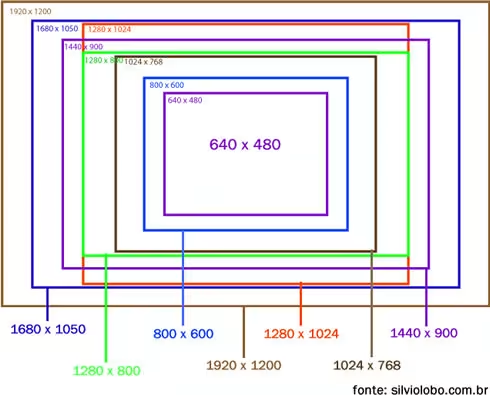
The 10 most used monitor resolutions according to the W3C website.
1. 1024×768 - 38.52%
2. 1280×800 - 17.46%
3. 1280×1024 - 14.50%
4. 1440×900 - 6.90%
5. 800×600 - 5.12%
6. 1680×1050 - 4.83%
7. 1152×864 - 3.14%
8. 1920×1200 - 1.53%
9. 1280×768 - 1.46%
10. 1280×960 - 1.08%
Monitor Types:
CRT (from the English, Cathodic Ray Tube, in Portuguese: Cathode Ray Tube, it was the monitor known in early computers and televisions, hence it was called "traditional", but it is falling into disuse.
LCD (from the English Liquid Crystal Display, in Portuguese liquid crystal screen), besides the more pleasant physical characteristics, the technical aspects are also quite superior to its predecessor. Less image distortion, due to the fact that the screens are flat, not curved like CRT; less emission of harmful radiation, causing less eye strain; and, finally, lower energy consumption.
And plasma screens?
These are commonly used in high-resolution TVs. These televisions operate with thousands of microcells that react independently to electrical stimuli. Each of them operates as its own light source and does not require central illumination. For this reason, plasma televisions are capable of producing great contrasts, sharp brightness, and richer colors. On the other hand, plasma televisions suffer from response time and burn-in, which are traces that appear in very fast images.
Monitor Types:
CRT (from the English, Cathodic Ray Tube, in Portuguese: Cathode Ray Tube, it was the monitor known in early computers and televisions, hence it was called "traditional", but it is falling into disuse.
LCD (from the English Liquid Crystal Display, in Portuguese liquid crystal screen), besides the more pleasant physical characteristics, the technical aspects are also quite superior to its predecessor. Less image distortion, due to the fact that the screens are flat, not curved like CRT; less emission of harmful radiation, causing less eye strain; and, finally, lower energy consumption.
And plasma screens?
These are commonly used in high-resolution TVs. These televisions operate with thousands of microcells that react independently to electrical stimuli. Each of them operates as its own light source and does not require central illumination. For this reason, plasma televisions are capable of producing great contrasts, sharp brightness, and richer colors. On the other hand, plasma televisions suffer from response time and burn-in, which are traces that appear in very fast images.





