



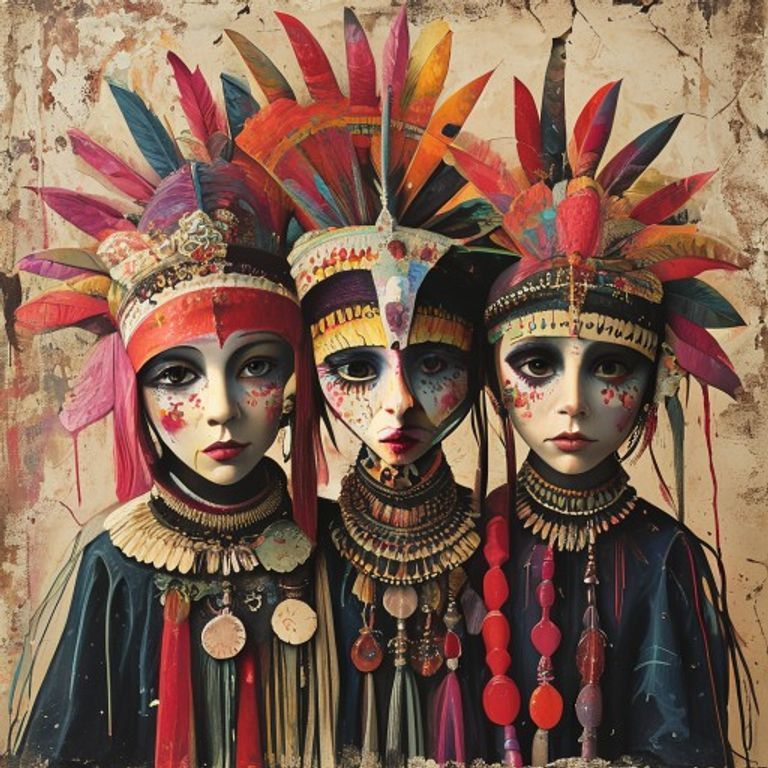
This municipality in the State of Amazonas inspires literature focused on folklore and caboclo mythology, serving as the basis for rich narratives about the legends of Boi-Bumbá and Amazonian cosmology.
⚠️ Research conducted with the aid of Deep Research is subject to referential ambiguity.
🖥️Clean HTML code using a proprietary tool.
👥 Research by Guilherme Felipe, Curation by Sílvio Lôbo
The Voice of the Island: A Dive into Parintins' Literature
Parintins, a riverine island in the heart of the Amazon, is globally recognized for the grand spectacle of the Boi-Bumbá Folkloric Festival. However, behind the vibrant celebration of colors, rhythms, and myths, beats a rich and often underestimated literary production that serves as a mirror and guardian of local cultural identity. This literature, in its essence, is a continuous dialogue between the exuberance of Amazonian nature, the syncretism of beliefs, and the resilience of its people, manifesting in poems, prose, and chronicles that transcend mere regionalism to touch the universal.
Founding Voices and Pioneers of the Written Word
The literature of Parintins, like that of many Amazonian cities, has its roots in orality, in the legends of indigenous peoples, and in caboclo narratives passed down through generations. However, the formalization of writing brought to light names that became pillars. Among the most prominent are:
- Simão Assayag: Considered one of the greatest exponents of the literature of Parintins and Amazonas. A poet, chronicler, and journalist, Assayag is a master in the art of describing the caboclo soul, the beauty of the Amazonian landscape, and the complexity of human relationships with the river and the forest. His work is an invitation to reflect on identity and existence, permeated by a deep lyricism and a melancholy characteristic of riverine solitude. His poetry, in particular, captures the essence of the island and its inhabitants.
- Leopoldo Neves: Although his work was broader in the Amazonian scene, Leopoldo Neves is a relevant figure for understanding the foundations of regional writing, with a perspective that often dialogued with the peculiarities of his origin and the Amazonian region as a whole, influencing generations.
- Nonato de Nazaré: A contemporary poet and short story writer, he represents an important voice of the more recent generation. His work often explores the nuances of daily life in Parintins, the magic of Boi-Bumbá, and social transformations, keeping alive the flame of regional poetry with a touch of modernity.
- Jurandir Novaes: Another notable name in local chronicles and historical research, contributing to the preservation of Parintins' memory and traditions through the written word.
These authors, each in their own way, contributed to building a literary body that, although not formally grouped into "schools," shares a deep connection with the reality of Parintins.
Literary Movements and Themes: From Regionalism to Contemporaneity
The literature of Parintins can be understood through thematic and stylistic cycles, rather than rigid literary movements:
- Amazonian Regionalism and Naturalism: In its early stages, Parintins' literature was strongly tied to Amazonian regionalism, characterized by detailed descriptions of nature, the struggle of man against a hostile environment, and the exaltation of caboclo and indigenous culture. Flora, fauna, rivers, and legends were the protagonists, shaping characters and destinies. There is a strong naturalist streak in the portrayal of riverine life, with its difficulties and raw beauty.
- Modernism and the Search for Identity: Inspired by the echoes of Brazilian modernism, Parintins' literature began to incorporate new forms and deepen the search for local identity, beyond mere description. Poetry gained more formal freedom, and prose explored the psychology of characters and the complexity of social relationships on the island. The Boi-Bumbá festival, previously folklore, began to be portrayed as a metaphor for Parintins' own life and culture.
- Contemporaneity and Boi-Bumbá as the Epicenter: More recent production, especially from the second half of the 20th century and into the 21st, has deepened the exploration of Parintins' identity. The Boi-Bumbá Festival emerges as a narrative epicenter, not just as a theme, but as a structuring element of the local worldview. Contemporary literature addresses the fusion of the sacred and the profane, the Caprichoso/Garantido duality as a mirror of the city's soul, and the environmental and social issues that afflict the Amazon.
Orality continues to be an invisible but present pillar, influencing the rhythm of prose and the musicality of poetry, connecting writing to the ancestral roots of stories told around the fire or by the riverbank.
Publications and Platforms for Expression
The dissemination of Parintins' literature has always faced logistical challenges of distance and infrastructure. Historically, the main outlets were:
- Local Newspapers and Magazines: Periodicals like the now-defunct A Voz de Parintins or cultural supplements of newspapers from the capital, Manaus, served as platforms for poets and chroniclers to publish their work. This was the space where the printed word found its most immediate audience.
- Regional Anthologies and Collections: Many authors from Parintins had their works included in anthologies that sought to map Amazonian literary production, ensuring visibility beyond the island's borders.
- Independent Editions and Cultural Funding: Over time, publishing solo books became more feasible, often with the support of cultural incentive laws or independent efforts. The Casa da Cultura de Parintins and other local institutions play a crucial role in promoting and fostering this work.
- Digital Platforms: More recently, the internet and social media have opened new avenues for dissemination, allowing Parintins' literature to reach a wider audience, overcoming geographical barriers.
Parintins' Identity Reflected in Literature
The literature of Parintins is, in its essence, a multifaceted mirror of local identity. It reflects:
- The Amazon as Setting and Character: The river, the forest, the creek, the torrential rain, the scorching sun – everything is more than landscape; it is an active character that shapes lives, destinies, and worldviews. Nature is both a source of sustenance and challenges, and its mystical force permeates the narratives.
- Boi-Bumbá as a Universal Metaphor: The festival is not just an event, but a cultural fabric that permeates existence. It represents duality (Garantido/Caprichoso), the struggle between good and evil, resurrection, the celebration of life, and ancestral memory. Many literary texts use the structure and characters of the ox (the master, the young lady, the shaman, the cunhã-poranga) to explore universal themes of love, loss, celebration, and community.
- Cultural Syncretism and Faith: The fusion of indigenous, caboclo, and Catholic beliefs is a recurring theme. The "enchanted ones," the curupiras, the iaras, and popular beliefs coexist with Christian faith, creating a unique magical-religious universe that manifests in poetry and prose.
- Riverine Life and the Caboclo Condition: Parintins' literature portrays the uniqueness of life on the riverbank, the canoes, the stilt houses, fishing, farm work. It gives voice to the condition of the caboclo, the Amazonian man, a product of miscegenation, with his dilemmas, joys, and ancestral knowledge.
- The Struggle for Preservation: Faced with the environmental and cultural threats that loom over the Amazon, Parintins' literature also assumes a role of resistance and awareness, calling for the preservation of the forest, the rivers, and traditions.
Conclusion
The literature of Parintins is a cultural treasure that deserves to be more widely known and studied. It is not merely an artistic manifestation but a vital record of the soul of a community that has transformed the exuberance of its environment and the richness of its traditions into raw material for the written word. By giving voice to poets and prose writers like Simão Assayag and Nonato de Nazaré, the island of Parintins transcends mere folkloric scenery to establish itself as a hub of intellectual production, where ink and paper perpetuate the magic, history, and identity of a people who dance, sing, and write their own Amazonian epic.





