



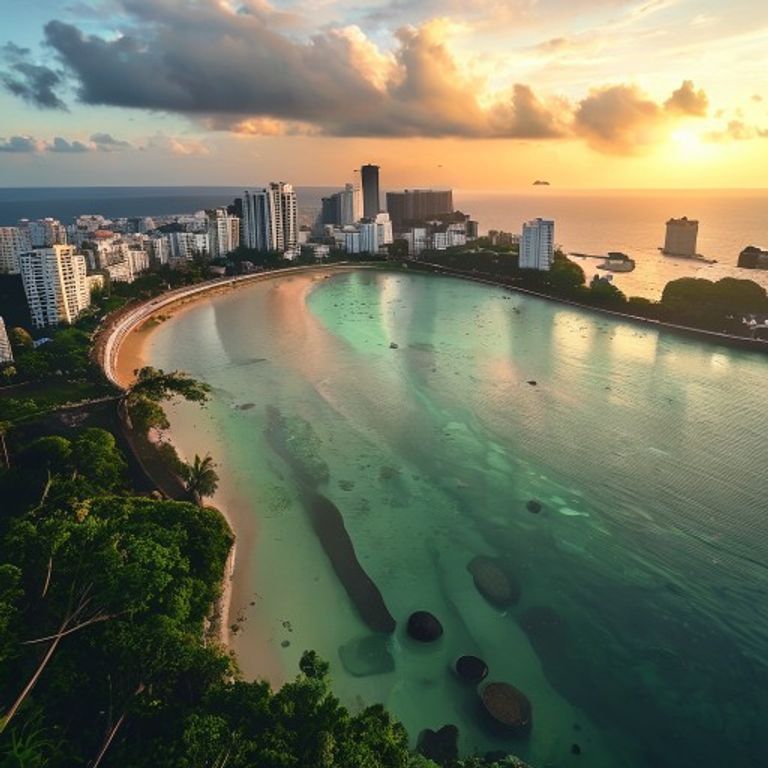
This municipality in the state of Paraná, the oldest city in the state, is a center of historical literature and port legends, inspiring works that recall the colonial period and the coastal Caiçara culture.
⚠️ Research elaborated with the aid of Deep Research is subject to referential ambiguity.
🖥️Clean HTML code using a proprietary tool.
👥 Research by Guilherme Felipe, Curation by Sílvio Lôbo
The Tide of Memory and Word: An In-depth Look at Paranaguá's Literature
A port of stories and Paraná's gateway to the Atlantic, Paranaguá is not just a geographical and economic landmark, but also a cradle of sensibilities and narratives that have shaped and been shaped by the identity of Paraná. The literature born and nurtured in this historic city, the oldest in the state, is a valuable repository of the coastal soul, reflecting the waves that crash on its shores, the secrets guarded by its islands, and the pulsating rhythm of a people who live between land and sea. This essay aims to explore Paranaguá's literary currents, highlighting its main authors, the movements that influenced it, the publications that gave it a voice, and the indelible mark of local culture on its pages.
Historical Roots and First Voices
Paranaguá's history, dating back to the mid-17th century, naturally predates the formalization of "literature" in its modern sense. However, the first chronicles and records by travelers, missionaries, and settlers already sketched a narrative about the region, its customs, its people, and its exuberant nature. These texts, although not literary by intention, laid the groundwork for the imagination that would later flourish. The 19th century, with the advancement of the printing press and education, began to outline the first contours of a more autonomous cultural production, albeit modest and intrinsically linked to civic and journalistic life.
Emblematic Authors: The Bay's Brilliance in Letters
Paranaguá's literary richness, while perhaps not as prolific as that of large urban centers, is notable for its density and fidelity to its identity. Among the most prominent figures are:
- Leôncio Correia (1863-1950): Perhaps the most illustrious name associated with Paranaguá on the national scene. Although he built much of his career in Rio de Janeiro, where he became a member of the Brazilian Academy of Letters, Correia carried the mark of his homeland in his formation and sensibility. A journalist, chronicler, and poet, his work, while not always explicitly about Paranaguá, exhibits a melancholy and lyricism that many associate with his origin, a kind of longing for the bay and its landscapes. His prose and poetry are marked by Parnassian elegance and, at times, Symbolism, reflecting the dilemmas and beauties of his era.
- Alfredo Romário Martins (1888-1971): A historian, folklorist, and memorialist, Alfredo Romário Martins is a central figure for understanding the culture of Paraná and, in particular, of Paranaguá. His work does not fit into the literary canon of fiction or poetry in the strict sense, but his contribution to the preservation of memory, tales, legends, and local history is invaluable. Through his writings, Martins immortalized aspects of port life, Caiçara customs, and the indigenous and European traditions that make up the region's cultural mosaic, becoming an essential chronicler of the Paranaguá soul.
- Oscarino Faria (1910-1996): A poet, chronicler, and tireless defender of local culture, Oscarino Faria dedicated much of his life to celebrating Paranaguá. His accessible poetry, filled with affection, painted vivid pictures of the city, the port, the islands, and the daily lives of its inhabitants. Faria is a clear example of how local literature can be a faithful mirror of regional identity, with verses that resonate with the simplicity and depth of coastal life.
- Walter Martins: Another name that contributed significantly to the historiography and memory of Paranaguá, Walter Martins, like Alfredo Romário, dedicated himself to recording and analyzing the events and personalities that shaped the city, contributing vast research that serves as a basis for any cultural study of the region.
Literary Movements and Local Appropriation
Paranaguá's literature, in its formation, was not oblivious to the major Brazilian literary movements, but it absorbed and reinterpreted them in light of its own reality.
- Parnassianism and Symbolism: Present in Leôncio Correia's work, these movements lent formal rigor and a search for higher themes or for a more subjective and musical language. In Paranaguá, this influence manifested in poetry that, while universal in its concerns, sometimes found metaphors and settings in the local landscape.
- Regionalism: This is undoubtedly the most striking and natural movement for Paranaguá's literature. The strong cultural identity, the geographical and sociological specificities of the port and coastal city made regionalism an inevitable lens for many authors. The valorization of folklore, dialects, Caiçara customs, legends, and local history permeates the work of figures like Alfredo Romário Martins and Oscarino Faria, giving it authenticity and depth. Regionalism here is not merely descriptive but seeks to capture the essence of a way of life threatened by urban and economic transformations.
- Modernism and Beyond: Later generations, although perhaps not formally associated with specific modernist schools in the Paranaguá context, incorporated the formal and thematic freedom of Modernism, allowing for a more direct and less idealized exploration of the complexities of life in a constantly changing port city, with its social tensions, natural beauty, and challenges.
Important Publications: The Stage for the Word
The circulation of ideas and literary works in Paranaguá has always been tied to the vitality of its communication channels. Local periodicals played a crucial role in disseminating literary and intellectual production:
- Local Newspapers and Magazines: Throughout the 20th century, newspapers like Diário do Comércio, A Notícia, and other smaller-circulation periodicals were the main stages for the publication of poems, chronicles, articles, and short stories by local authors. They served as spaces for cultural debate and the formation of a reading public. Many of the works by Oscarino Faria and local historians were initially published on these platforms.
- Independent Books and Regional Publishers: Over time, the publication of independent books, often by regional publishers or on the initiative of the authors themselves, allowed for the consolidation of longer works and the formation of poetry and prose collections that depicted Paranaguá's life.
- Academies of Letters and Cultural Institutions: The establishment of institutions like the Academia Parnanguara de Letras, although more recent, demonstrates the continuous effort to organize, preserve, and foster local literary production, serving as a meeting point and dissemination hub for new talents and for the memory of those who preceded them.
Cultural Identity Reflected in Books
Paranaguá's literature is, in essence, a mirror of its multifaceted cultural identity. The city, with its rich history and strategic location, offers a wealth of themes and inspirations:
- The Relationship with the Sea and the Port: The sea is a constant presence. Not just as a landscape, but as a way of life, a source of sustenance, a route for trade and migration. The waves, the ships, the fishermen, the sea legends, the longing of those who leave, and the hope of those who arrive are recurring motifs in poetry and prose. The port, with its frenetic rhythm and its mix of cultures, is a microcosm of human encounters and misunderstandings.
- History and Memory: The awareness of being Paraná's oldest city permeates the literary production. There is a deep respect for memory, for the preservation of the past, for the stories of settlers, indigenous people, and enslaved individuals who built the region. Many texts recall historical figures, significant events, and the colonial architecture that still endures.
- Folklore and Caiçara Legends: Oral traditions, island legends (like those of Ilha da Cotinga or Gruta das Encantadas), rituals, and the popular wisdom of the Caiçaras (traditional coastal population) are rich elements that fuel the literary imagination, giving it a unique flavor and a link to the deepest roots of the land.
- Exuberant Nature: The beauty of Paranaguá Bay, its islands, mangroves, and the surrounding Atlantic Forest are inexhaustible sources of inspiration. The description of the landscape is not merely decorative but often takes on a symbolic role, reflecting states of mind, life cycles, or the indomitable force of nature.
- Social Issues: A port city is also a stage for social tensions. Paranaguá's literature, in its most critical moments, can address inequalities, labor struggles, development challenges, and the coexistence between different social strata, without losing sensitivity to the small human stories that make up the social fabric.
Conclusion: A Legacy in Continuous Navigation
Paranaguá's literature, with its authors, movements, and publications, constitutes an invaluable cultural heritage. It offers us a window into the soul of a city that has managed to preserve its roots while opening itself to the world. More than mere words, the books born and inspired in Paranaguá are the voice of a community, the record of its joys and sorrows, the echo of its legends, and the reflection of its landscape. By navigating its pages, the reader is invited to feel the Atlantic breeze, hear the cry of the seagulls, and unravel the mysteries of a land where history and poetry meet at every tide. Paranaguá's literary legacy is a beacon that continues to guide new generations of writers, ensuring that the stories of the "Queen of the Coast" continue to be told, retold, and celebrated.





